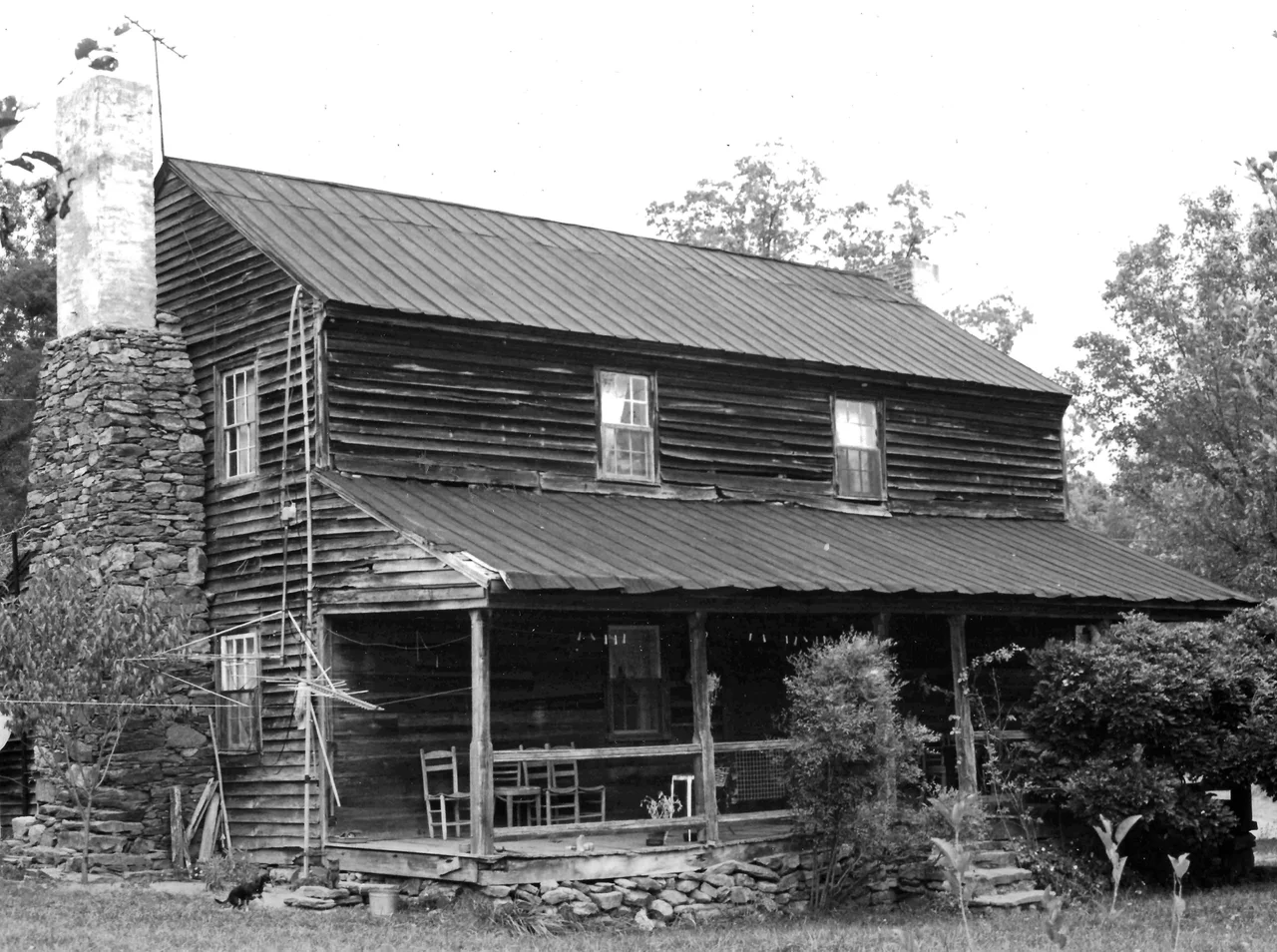

Perciphull Campbell House
The name catches in the throat before you ever say it correctly. Perciphull. Not Percival. Not Perciful. Perciphull, a spelling the Campbell family carried for four generations along the red-clay rises of Iredell County, in a corner of the North Carolina Piedmont where Hunting Creek slips quietly through second-growth woods. The house that bears that name is a two-story frame I-house with a stone foundation, gable roof, and exterior chimneys whose brick stacks were sheathed in stucco. It was built around 1820. And every plank in it was raised on labor that was not free.
A Planter, by Degrees
Perciphull Campbell, Sr., did not arrive in Iredell County as a man of property. He built it slowly, one tract at a time, along Hunting Creek through the 1810s and 1820s. By 1815 he had risen far enough in local standing that the North Carolina legislature appointed him one of four commissioners to lay out the new town of Williamsburg, the second town to be incorporated in the county. He performed marriages through the northern part of the county in the 1820s, most likely as a justice of the peace. Architectural evidence and his land purchases together point to the I-house being built during that same decade, as the visible declaration of a man whose holdings had finally grown enough to require it.
The Names the Ledgers Kept
What the ledgers preserve, the architecture does not. By 1850, after Campbell had moved south to a second residence on Big Rocky Creek, he was recorded as the owner of twenty-one enslaved people. His son Perciphull Campbell, Jr., who took over the Hunting Creek home place after his father moved, was listed in the same census as the owner of ten. His grandson L.V. Campbell, still living under his father's roof, already held three in his own name by the age of majority. The principal crops these households produced were wheat, rye, oats, and above all corn. The records that survive name the masters in full and reduce the people they enslaved to numerals in a column. Their names, their families, and the work they did to build this house and feed its inhabitants are absent from the documents the National Register would later consult, and that absence is itself part of what stands at this site.
Four Generations on Hunting Creek
Perciphull Sr. died at his Rocky Creek property on June 6, 1853, leaving an estate that took years to unwind. His son Perciphull Jr., named co-executor, continued at Hunting Creek with his wife Tabitha Morgan and their five children until his own death on October 22, 1862, in the middle of the Civil War. Tabitha lived on at the home place until 1879, after which the house passed to L.V. Campbell. When L.V. died intestate in May 1888, the property entered another round of legal limbo. His estranged widow M.E. Campbell remained in the house for the rest of her life, and the deed eventually settled on their daughter Alice, who lived there for nearly half a century more. A detailed 1917 county map shows her as "Miss Campbell," still in residence.
Alice's Long Tenancy
Alice Campbell's quiet half-century in the house is the longest single chapter in its history. On December 4, 1935, she finally signed it over to L.C. Henderson, conveying the home place and 139 acres with the careful provision that she could occupy and enjoy the profits of the property for the rest of her natural life. The remainder of her natural life turned out to be seven weeks. She died on January 21, 1936, in the eighty-first year of her age, and the Perciphull Campbell home place passed forever out of the family that had built it. The house was added to the National Register of Historic Places in 1980. The contributing smokehouse stands nearby, the kind of small outbuilding where most of the unrecorded labor of a working farm actually happened.
What the I-House Shape Tells You
From the road, the house reads as a textbook of an old vernacular form. The I-house is two stories tall, one room deep, with chimneys at each gable end. It was the prosperous farmer's house across the upland South in the early nineteenth century, a deliberately upright silhouette meant to be read from a distance. Stuccoed brick stacks on the chimneys, stone footings, a smokehouse off to the side: every element is conventional, every element is well-made. What is remarkable is how clearly such a building lets you see the world that built it. Stand at the rise above Hunting Creek and the Piedmont rolls out unchanged in any direction that matters. The fields are quieter now, the labor is invisible, but the ledger numbers remain, and so does the house.
From the Air
Located near Union Grove in northern Iredell County, North Carolina, at 36.04 degrees north, 80.84 degrees west. The site sits in the upper Piedmont along Hunting Creek, west of Interstate 77 between Statesville and the Yadkin River. Best viewed below 4,000 feet AGL in clear conditions; the surrounding agricultural patchwork helps separate the wooded creek bottoms from open ridges. Nearest tower-served airports are Statesville Regional (KSVH) about 20 miles south and Smith Reynolds (KINT) at Winston-Salem about 35 miles east-northeast. KGSO (Piedmont Triad International) lies further east. Class E airspace; check for crop-dusting activity in summer.
Nearby Stories
- Chang and Eng Bunker 8.9 km away
- Hickory, North Carolina 17 km away
- Piedmont Triad International Airport 20 km away
- Thomas Gillespie 24 km away
- North Carolina Aviation Museum 33 km away
- Mebane's Bridge 38 km away
- Appalachian Ski Mountain 41 km away
- Emory and Henry University 70 km away