
Thomas Gillespie
The 1790 federal census records, for Rowan County, North Carolina, a household headed by Thomas Gillespie, Sr. and seven enslaved people. The census did not record their names. Gillespie's will, six years later, mentions six of them. We do not know what they looked like, what they hoped for, or where they were born, only that their labor sustained a 1,000-acre plantation on Sills Creek and a much larger family fortune that would one day produce an American president. Any history of Thomas Gillespie that starts with his accomplishments and stops there has missed the people who made those accomplishments possible.
From Virginia to the Yadkin
Gillespie's paper trail begins on December 1, 1740, when 'Thomas Glassbey' purchased 400 acres in northern Augusta County, Virginia, in a draft of the Shenandoah called Long Glade. The forty-shilling deed is the first document that places him anywhere. Sometime before 1750, Thomas, his wife Naomi, and their young son James moved south to Anson County, North Carolina. By tradition they were the first European family to settle west of the Yadkin River in that part of the colony. The land they reached was Catawba and Cheraw territory, and their settlement was part of a Scots-Irish migration that would, within a generation, transform the Carolina backcountry. By the time Rowan County was carved out of Anson in 1753, the Gillespies were established on Sills Creek with a Granville Land Grant in hand.
Built by Enslaved Labor
By his death in 1796, Gillespie owned around 2,570 acres in Rowan County alone. His plantation house had more than five rooms. He owned a cotton gin, raised flax and wheat, kept horses and cattle. None of that infrastructure would have existed without the work of the people he enslaved. Census records identify seven; his will identifies six by name. In a county where 1,742 enslaved people lived among 2,432 households in 1790, Gillespie's holdings placed him squarely within the planter class that built the regional economy on coerced labor. The crops they cultivated, the structures they maintained, and the children they raised in slavery are the foundation of every later achievement attributed to the family. Their names, mostly absent from the surviving record, deserve the search.
Thyatira and the Salisbury Brigade
Gillespie was an early elder at Thyatira Presbyterian Church, founded by 1750 on Cathy's Creek and the oldest Presbyterian church in this part of western North Carolina. Religious life and political life ran together in the Scots-Irish settlements. When the Revolution came, Gillespie served as a commissary in the Rowan County Regiment, one of five commissaries under Quartermaster General Joseph Marbury, responsible for provisioning a brigade of roughly 1,400 to 2,000 men. The work was unglamorous: requisitioning grain, securing salt, finding wagons. For his service he received land grants totaling roughly 6,000 acres on Flat Creek and the Duck River in what became Tennessee in 1796, plus parcels in Washington and Greene counties along the Nolichucky and Clinch rivers. His sons would eventually claim that land.
The Polk Connection
Gillespie's daughter Lydia married Captain James Knox. Their daughter Jane Gracey Knox married Samuel Polk. Their son was James Knox Polk, eleventh President of the United States, who annexed Texas, fought a war with Mexico, and added the territory that became California, Arizona, New Mexico, Utah, Nevada, and parts of Colorado and Wyoming to the United States. Thomas Gillespie did not live to see his great-grandson born; Polk arrived in 1795, the year before Gillespie's death. But the family fortune that gave Polk his start was built on land granted to Thomas, and that land was made productive by the enslaved laborers whose names history mostly failed to record. The presidential line is real. So is the cost.
A Shared Grave at Thyatira
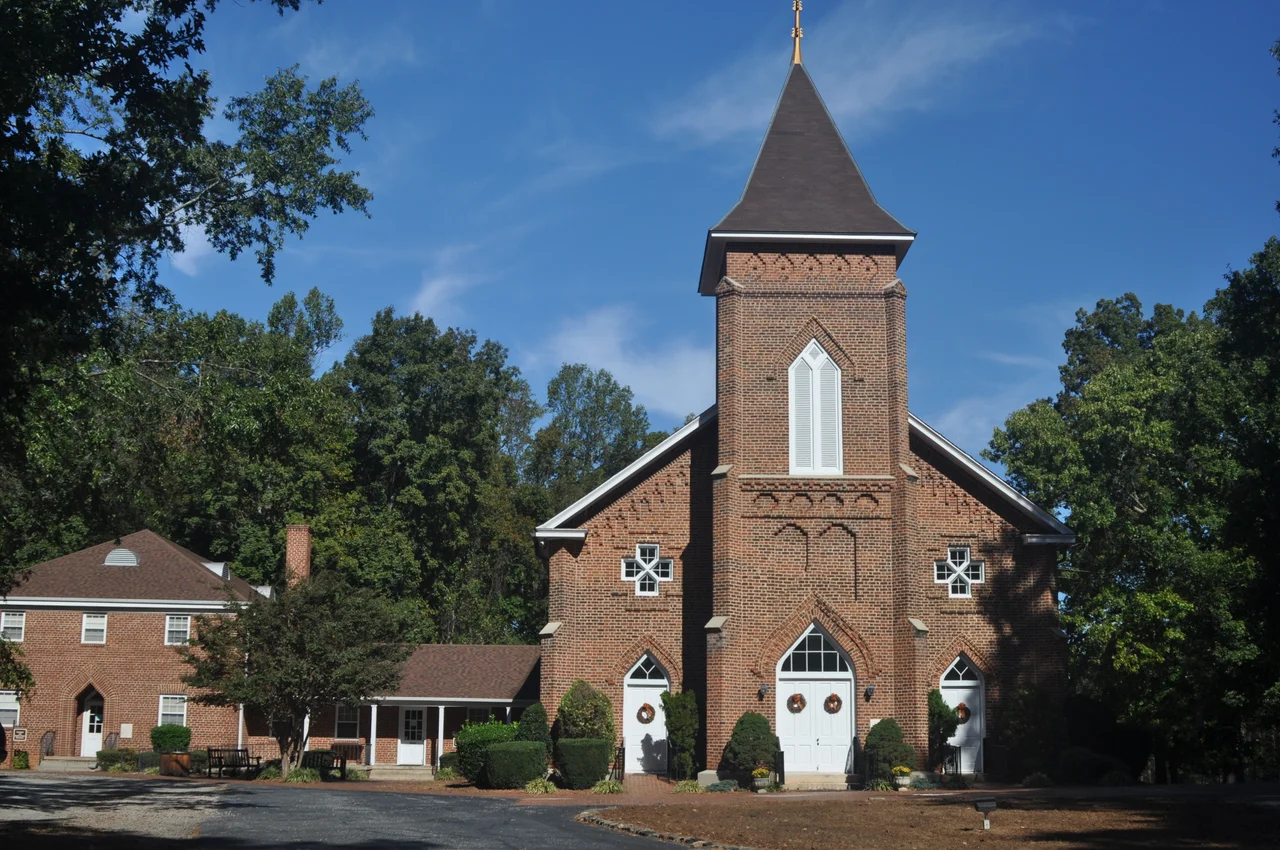
Thomas and Naomi Gillespie died on the same day: December 13, 1796. Thomas was 78, Naomi 69. According to their memorial at Thyatira Presbyterian Church, they had been married 51 years. Six of their sons carried them to their place of interment, where they were laid in the same coffin. The shared grave is one of the more striking artifacts in a cemetery full of Revolutionary-era markers. The Thyatira churchyard also holds Thomas's father-in-law John Knox and the older generation of Cowans, Brandons, and Locks who built the country's first inland Presbyterian society. The Gillespies are not the only family there whose wealth depended on slavery. They are simply the family whose lineage runs through the White House.
From the Air
Thomas Gillespie's Sills Creek plantation was in southwestern Rowan County, North Carolina, near present-day Mill Bridge at roughly 35.65 degrees N, 80.64 degrees W. The grave is at Thyatira Presbyterian Church on White Road off NC 150. Best viewed from 3,000 to 5,000 feet AGL. Mid-Carolina Regional (KRUQ, Salisbury) is the nearest field, about 10 miles east. Rolling piedmont farmland, with the church complex visible as a clearing in the hardwoods.
Nearby Stories
- University of North Carolina at Charlotte 5.3 km away
- Hickory Motor Speedway 12 km away
- Kings Mountain Mine 18 km away
- High Point, North Carolina 19 km away
- Battle of Colson's Mill 21 km away
- North Carolina Aviation Museum 25 km away
- Perciphull Campbell House 25 km away
- Blowing Rock 52 km away