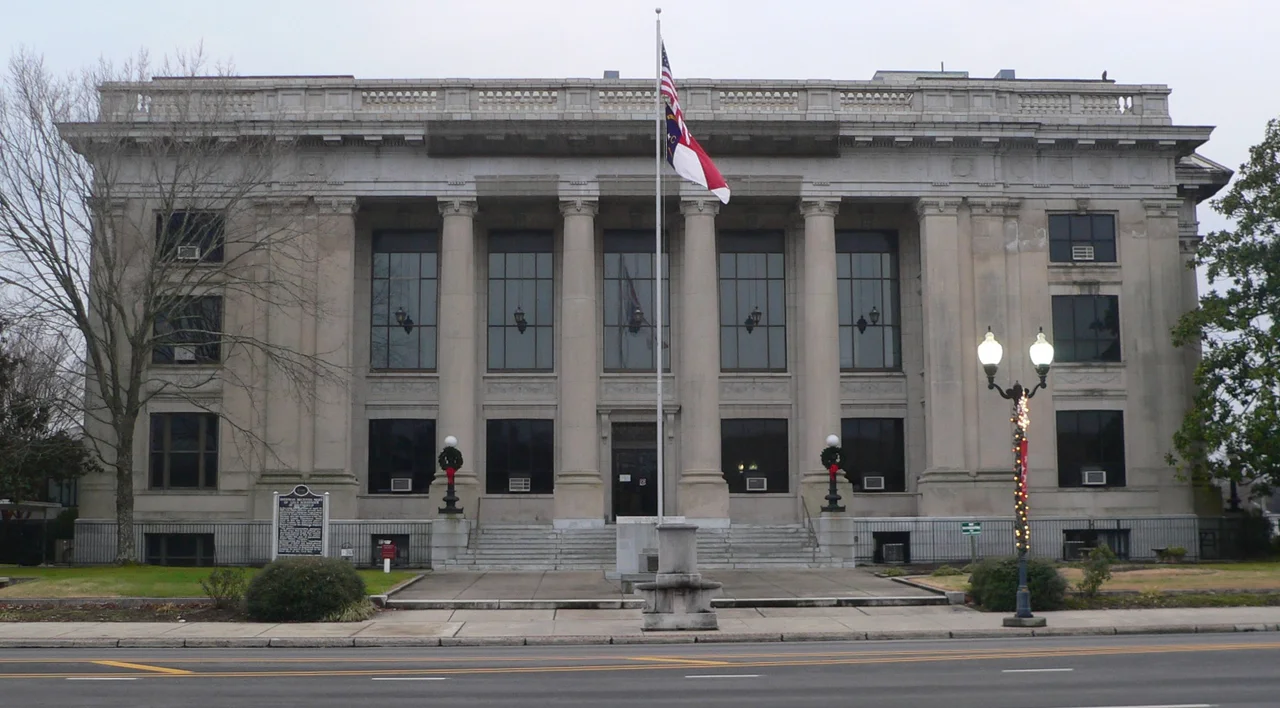

Johnston County, North Carolina
On March 19, 1865, eight weeks before the war ended, Confederate General Joseph Johnston launched the South's last serious offensive of the Civil War in a field near a Johnston County crossroads called Bentonville. He had perhaps 20,000 men. Sherman had 60,000. The fight lasted three days, and the largest Civil War battlefield in North Carolina now occupies that ground. Today Johnston County holds 215,999 people across 795 square miles of coastal-plain farmland and fast-growing suburbs east of Raleigh. The Bentonville battlefield is still there, and so is the tobacco-warehouse town of Smithfield where the actress Ava Gardner spent her childhood, and so is the Ham and Yam Festival every year, named for the two crops — pork and sweet potatoes — that Johnston County still grows better than almost anywhere else.
Bordered by Counties That Took Pieces
Johnston County was established in 1746, named for Gabriel Johnston, governor of the province from 1734 to 1752. Over the next century, the General Assembly carved away at it — Orange County in 1752, Dobbs in 1758, Wake in 1770, Wilson in 1855. Each act of legislative subtraction left Johnston smaller and the surrounding counties larger, until the modern boundaries settled into something close to their present shape. Smithfield, the county seat, was the westernmost freight port on the Neuse River, and in 1770 the provincial government built a tobacco warehouse there to hold crops before they floated downriver toward markets and ships. The Neuse still runs through. The river is older than the borders, and the borders, as borders do, have outlasted most of the reasons they were drawn.
The Battle of Bentonville
Sherman's army was marching north from Georgia, having burned what he chose to burn, headed for a junction with Grant's forces in Virginia. Joseph Johnston gathered the scattered remnants of three Confederate commands — perhaps 20,000 men against Sherman's 60,000 — and attacked them near Bentonville on March 19, 1865. The fighting lasted three days. The Confederates inflicted real casualties but could not break the Union advance. Sherman's army moved on to occupy Goldsboro within the week. The battlefield is now a State Historic Site, the largest of its kind in North Carolina, where the contour of the land still matches the contemporary maps drawn by officers who were there.
Ava Gardner's Grabtown
She was born in 1922 in a community called Grabtown, the youngest of seven children on a tobacco farm. The family lost the farm during the Depression and moved into a teacherage in Brogden. Her father died when she was fifteen. She graduated high school and left for New York a few years later, arriving in Hollywood in 1941. By 1941 she was in Hollywood, eventually a star whose name still arrives in the same breath as Sinatra and Hemingway. She is buried in Smithfield, beside her mother and father, and the Ava Gardner Museum in town keeps her costumes, scripts, and personal letters in rooms that smell faintly of old paper. Smithfield holds an Ava Gardner Festival every year. Grabtown is still on the map. The teacherage is still standing. Johnston County, which is so often described by what passes through it on the way somewhere else, never quite lets go of the people who were once theirs.
Cotton, Tobacco, Sweet Potatoes
Eli Whitney's cotton gin arrived in the county around 1804, and cotton became the dominant cash crop for half a century until the Panic of 1893 collapsed cotton prices and forced farmers into bright-leaf tobacco. Smithfield opened a tobacco market in 1898. The county's first bank opened the same year. Cotton mills followed in Smithfield, Clayton, and Selma. Tobacco built the towns; the railroad — North Carolina Railroad in 1856, the Wilmington and Weldon Short-Cut in 1886 — gave the towns of Princeton, Pine Level, Selma, Clayton, Kenly, Micro, Four Oaks, and Benson their reasons to exist. Today Johnston County is one of the country's top producers of pork and sweet potatoes, and the Ham and Yam Festival in Smithfield celebrates both with a frankness that smaller cities elsewhere might find hard to muster.
Triangle Tides
Johnston County is part of the Raleigh-Cary Metropolitan Statistical Area, and that affiliation has remade it. Clayton has become the county's largest community, drawing commuters who work in Raleigh and want yards. The 2020 census recorded 215,999 residents, up sharply from previous decades. Politically the county has shifted as well — a classic Solid South Democratic stronghold from 1880 through the 1960s, then steadily Republican from 1968 onward. In 2024, Republican Mark Robinson narrowly carried Johnston County by roughly 0.3 percent in the gubernatorial race — even as Democrat Josh Stein won the governorship statewide by nearly 15 points. The county is still rural in much of its acreage, but the borders of urban North Carolina keep moving east, and Johnston County is increasingly inside them.
From the Air
Centered at 35.52N, 78.37W, southeast of Raleigh in the Neuse River basin. Johnston County covers 795 square miles between Wake County (northwest) and Wayne County (southeast). Nearest airports are Johnston Regional Airport (KJNX) in Smithfield, Raleigh-Durham International (KRDU) about 30 miles northwest, and Seymour Johnson AFB (KGSB) about 20 miles southeast. The Neuse River is the primary navigation reference, flowing diagonally through the county; I-95 runs through Smithfield.
Nearby Stories
- Raleigh–Durham International Airport 4 km away
- Global TransPark 7.6 km away
- Battle of Bentonville 9.6 km away
- Tarboro, North Carolina 14 km away
- Cary, North Carolina 21 km away
- Methodist University 25 km away
- Skylight Inn BBQ 29 km away
- Purefoy-Dunn Plantation 31 km away