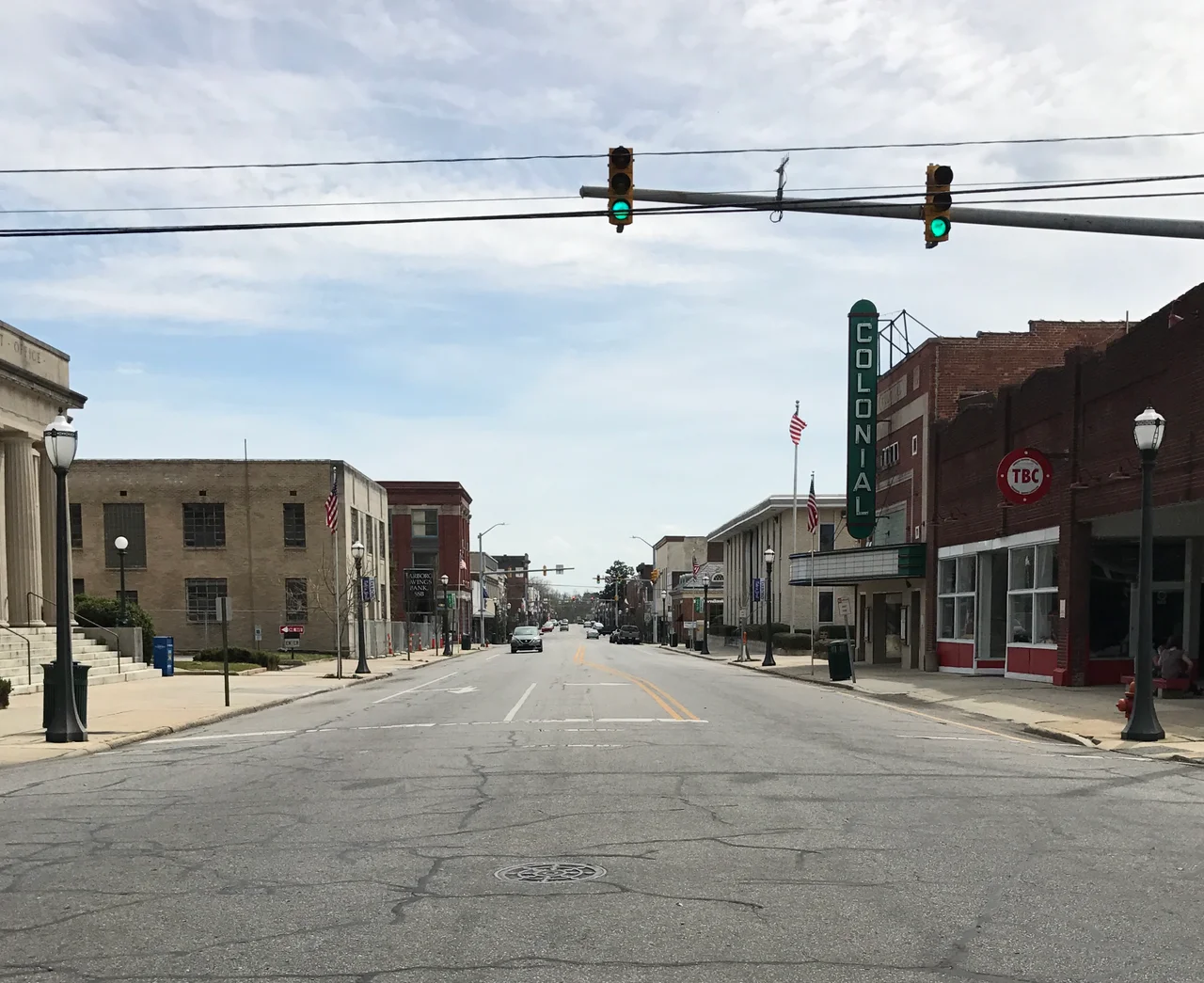

Tarboro, North Carolina
When Congressman George Henry White left Tarboro in 1900, he said he was leaving because it was impossible for a Black man to be a man in North Carolina. The 1899 disfranchising constitution had stripped Black citizens of the vote that had elected four African-American congressmen from the 2nd district in the last quarter of the nineteenth century. White had been one of them. He moved to Washington and then to Philadelphia, where he became a successful banker. He never came back. Tarboro itself - the ninth-oldest incorporated town in North Carolina, settled in a bend of the Tar River where the Piedmont meets the coastal plain - kept its 45-block historic district and its colonial town common, and waited a long time before it could acknowledge what White had been talking about.
Founded in 1760
The Tuscarora people called the river Taw - river of health - and by 1750 the area was widely known as Tawboro. Tarboro was officially chartered on November 30, 1760, by the colonial General Assembly, when Joseph and Ester Howell deeded 150 acres to a group of commissioners for five shillings and one peppercorn. The town was laid out with 12 initial lots and a 50-acre common set aside for public use. Streets ran 80 feet wide, crossing at right angles to form 2-acre squares. Each lot was supposed to sell for two pounds, but the commissioners didn't get full payment on all 109 lots ultimately offered, and some went for less. Tarboro became the county seat of Edgecombe in 1764. The North Carolina State Legislature met in town in 1787 (and again, two centuries later, in 1987). President George Washington slept here in 1791 during his Southern tour and noted the artillery salute he received was as good as could be given with one piece.
George Henry White and the Disfranchising Constitution
By the 1870s, Edgecombe County had a majority-Black population, the result of antebellum cotton plantation labor and postwar settlement patterns. African Americans organized politically and won office. Between 1875 and 1901, four Black men represented North Carolina's 2nd congressional district in Washington - including George Henry White, a Tarboro lawyer and the last Black congressman from the state for nearly a century. White also lived in town. After the 1898 Wilmington insurrection and the 1899 disfranchising amendments that made it nearly impossible for Black North Carolinians to vote, White declined to seek reelection in 1900. He delivered a closing speech on the House floor in which he predicted Black Americans would return to Congress. He was right by 95 years. The federal Voting Rights Act of 1965 finally restored what the 1899 constitution had taken away. By then White had been dead for fifty years.
The Town Common and the Historic District
The Tarboro Town Common, set aside in the 1760 charter, is the only surviving original colonial town common on the East Coast outside Boston. A 15-acre park canopied by tall oaks, it originally surrounded the town and served for common grazing, community gatherings, and military drills. War memorials stand here now. The 45-block Tarboro Historic District, recognized by the National Park Service in 1977, has more than 300 contributing structures, including five 18th-century homes (the oldest being the c. 1785 Archibald White house) and more than two dozen antebellum houses built between 1800 and 1860. The Blount-Bridgers House, an 1808 Federal-style mansion, operates as a museum and holds works by Hobson Pittman, a nationally recognized painter and Tarboro native. Calvary Episcopal Church and Churchyard, Coats House, Coolmore Plantation, the Cotton Press, Eastern Star Baptist Church, and many others are individually listed on the National Register.
Hurricane Floyd and Princeville
In September 1999, Hurricane Floyd stalled over eastern North Carolina and dumped catastrophic rainfall on watersheds already saturated by Hurricane Dennis. The Tar River, which wraps around about half of Tarboro, crested 24 feet above flood stage - exceeding the 500-year flood level along its lower reaches. Much of downtown Tarboro went under several feet of water. But the worst suffering was directly across the river. Princeville, founded in 1885 by formerly enslaved people and one of the oldest Black-incorporated municipalities in the United States, lost its levee and disappeared under more than twenty feet of water for ten days. Every house was damaged. National Guard troops loaded government records into trucks; FEMA photographers captured the bridge on James Street washed out. Tarboro's recovery was difficult. Princeville's recovery is still ongoing, and the question of whether to rebuild on the floodplain at all is one the town keeps having to answer. Notable Tarboro natives include Hubert Simmons of the Negro League Baltimore Elite Giants, Tuskegee Airman Willie H. Fuller, NFL running back Todd Gurley (who attended Tarboro High School), and General Hugh Shelton, former Chairman of the Joint Chiefs of Staff.
From the Air
Located at 35.90°N, 77.55°W in Edgecombe County, on the south bank of the Tar River, 16 miles east of Rocky Mount and 72 miles east of Raleigh. From cruise altitude Tarboro reads as a compact grid in a bend of the Tar, with Princeville visible across the river to the south. Tarboro-Edgecombe Airport (KETC) sits 3 miles north of downtown. Rocky Mount-Wilson Regional (KRWI) is 25 miles west, Pitt-Greenville (KPGV) 25 miles south, Halifax-Northampton (KIXA) 35 miles north, and Raleigh-Durham (KRDU) 87 miles west.
Nearby Stories
- Cherry Hill Plantation 7.8 km away
- Southern National Motorsports Park 8.2 km away
- Bertie County, North Carolina 13 km away
- Halifax County, North Carolina 14 km away
- East Carolina University 16 km away
- Hertford County, North Carolina 17 km away
- Beaufort County, North Carolina 27 km away
- Purefoy-Dunn Plantation 44 km away