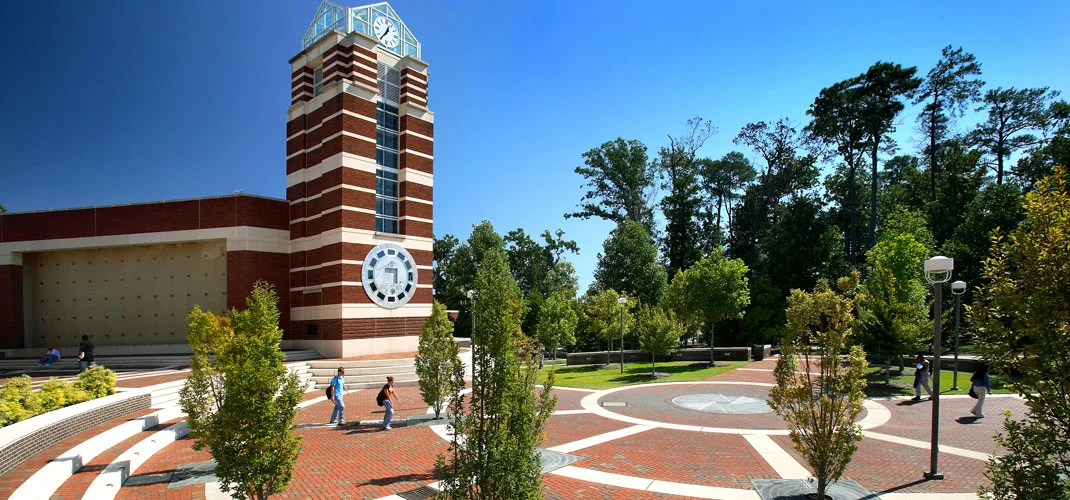

East Carolina University
On March 8, 1907, the North Carolina General Assembly passed an act titled, in the verbose style of the day, An Act to Stimulate High School Instruction in the Public Schools of the State and Teacher Training. What it actually established was a normal school in a small tobacco town that most of the state's political class had barely visited. Eastern North Carolina, then as now, was the rural half of the state - flat farmland, tobacco warehouses, a long drive from Raleigh. Thomas Jordan Jarvis, a former governor who became chairman of the first board of trustees, understood that a region without a college trained its teachers somewhere else and lost them. He spent the rest of his life making sure Greenville got the school.
From Teachers' School to Research University
East Carolina Teachers Training School opened its doors on October 5, 1909, with 43 acres and a mission to train, in the language of the founding charter, young white men and women - though for the first quarter-century almost all graduates were women. There were no male graduates at all until 1932. In 1920 the school became a four-year institution and renamed itself East Carolina Teachers College; the first bachelor's degrees were awarded the next year. By 1951 the curriculum had outgrown the name again, and East Carolina College took its place. The leap to university status came in 1967, and ECU joined the UNC System in 1972. Today the institution sprawls across about 1,600 acres on six properties, including an overseas campus in the Italian hill town of Certaldo Alto.
The Brody School and the Pirate Tradition
ECU is the only university in North Carolina with schools of medicine, dentistry, and engineering. The Brody School of Medicine was founded with an explicit mission - to train primary care physicians who would practice in underserved eastern counties - and U.S. News & World Report has consistently ranked it near the top nationally for primary care and rural medicine. A Brody faculty member, Walter Pories, developed the standard procedure for gastric bypass surgery, and researchers there documented the surprising finding that 80 percent of obese type-2 diabetic patients who underwent the surgery saw their diabetes reverse. Cardiothoracic surgeon Randolph Chitwood performed the first minimally invasive robotic-assisted mitral-valve repair in the United States. The School of Dental Medicine, approved in 2006, fills a similar gap for dental care in the region.
Pirates in Purple and Gold
The athletic teams are called the Pirates, and the football program plays in 51,000-seat Dowdy-Ficklen Stadium, one of the larger venues in the American Athletic Conference. Saturdays in Greenville draw fans from across eastern North Carolina who otherwise have no Division I FBS program nearby. The marching band is called the Marching Pirates. The alma mater, Hail to Thy Name So Fair, was written in the early 1940s by Harold McDougle, a Class of 1944 graduate who later taught in the music department. After every home football game, the team walks to the student section and sings the alma mater and the E.C. Victory song together with the crowd - a tradition that survives in college football's commercialized present because the people in the stands still want it.
Pirates Out in the World
Pirate alumni show up in unexpected places. Sandra Bullock attended ECU before leaving for New York and an acting career. Composer Caroline Shaw, who won a Pulitzer Prize for music in 2013 at age thirty, grew up in Greenville. Kevin Williamson wrote Scream and created Dawson's Creek. Rick Atkinson won a Pulitzer for An Army at Dawn. James Maynard founded Golden Corral. The Joyner Library on main campus holds 1.9 million bound volumes, including a 1733 Edward Moseley map - the first comprehensive map of colonial North Carolina, and the only original copy in the United States. Underwater archaeologists from ECU raised the anchors of Blackbeard's flagship, Queen Anne's Revenge, from Beaufort Inlet in 2011, three centuries after the pirate himself ran the ship aground.
From the Air
Located at 35.61°N, 77.37°W in the city of Greenville, on the Tar River about 75 miles east of Raleigh. The campus reads as a distinct grid of brick buildings just south of the river, with Dowdy-Ficklen Stadium and the athletic complex visible to the southeast. Pitt-Greenville Airport (KPGV) lies about 3 miles southwest of campus with daily flights to Charlotte. Rocky Mount-Wilson Regional (KRWI) sits 35 miles west, Kinston Regional Jetport (KISO) about 35 miles south, Elizabeth City Regional (KECG) to the northeast, and Raleigh-Durham (KRDU) 75 miles west.
Nearby Stories
- Southern National Motorsports Park 2.1 km away
- Princeville, North Carolina 3.3 km away
- Global TransPark 8.4 km away
- Beaufort County, North Carolina 19 km away
- Battle of Plymouth (1864) 22 km away
- Battle of Bentonville 25 km away
- Arapahoe, North Carolina 37 km away
- Purefoy-Dunn Plantation 46 km away