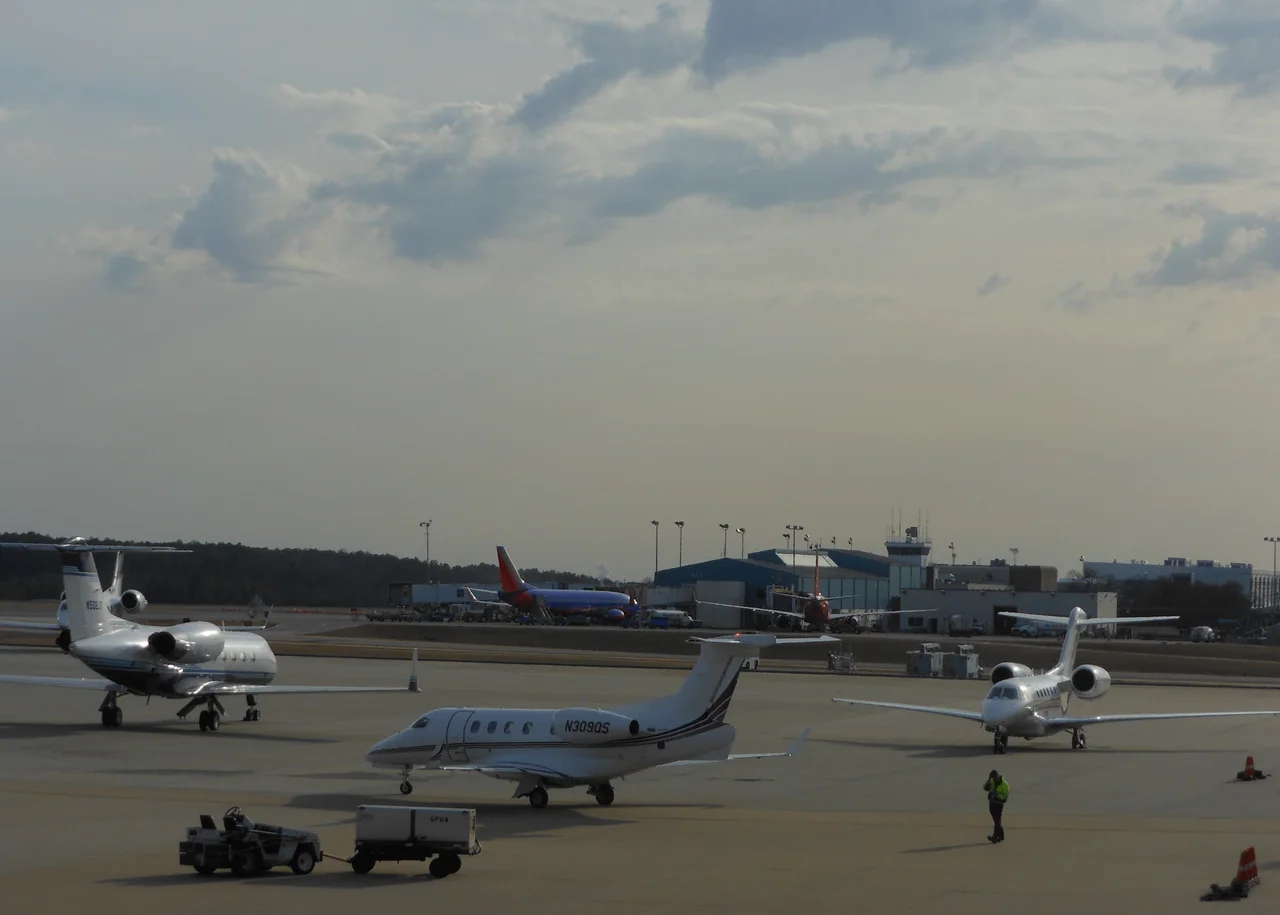

Raleigh–Durham International Airport
The runways you fly into RDU on today are not the original runways. The original three are still there, off to the southeast - 4,500-foot strips that were laid down in 1943 for the U.S. Army Air Forces and are now mostly used as taxiways and remembered ground. From the air on approach to runway 5L/23R you can see them clearly, three short scars in the grass running at odd angles, the bones of a wartime airfield grown over by a fifteen-million-passenger international airport. RDU - Raleigh-Durham International - was born in the war, nearly didn't survive deregulation, and then grew up into a regional aviation power partly because the Research Triangle wouldn't stop expanding around it.
From Army Barracks to Terminal A
After the war, civilian airlines moved in. Capital Airlines joined Eastern at RDU; Piedmont Airlines arrived in 1948. The original Terminal 1 building was constructed in 1955, repurposed from temporary structures that had served as Army barracks. In April 1957 the Official Airline Guide showed 36 departures a day - twenty Eastern, eight Capital, eight Piedmont. Nonstops didn't reach beyond Washington or Atlanta. Eastern started a Super Constellation nonstop to Newark in 1958. Delta arrived in 1970. In 1965 RDU saw its first scheduled jets: Eastern 727s. The airport was, like much of the segregated South, divided by race - separate waiting rooms for "White" and "Colored" passengers - until protests by students at the local universities forced desegregation in the 1960s. Air travel in the postwar South was politics, and RDU was no exception.
The American Hub That Wasn't
After airline deregulation in 1978, RDU caught a wave it didn't expect. American Airlines built a hub here through the 1980s, and at the peak in December 1992 was running 211 daily departures to 64 destinations - mostly eastern U.S., with AA hubs at Dallas/Fort Worth and Chicago-O'Hare as the western anchors. The first international flight from RDU left for Paris-Orly in 1988. Caribbean routes followed in 1989. But the hub was caught in a crossfire. Delta and Eastern dominated Atlanta. Northwest dominated Memphis. USAir dominated Charlotte. A short-lived Continental hub opened in Greensboro in 1993. By June 1995, American had shut the hub. The airport pivoted toward point-to-point service, picked up Air Canada to Toronto in 1996 as its first international carrier, and slowly rebuilt around discount carriers - Allegiant, Southwest, Frontier - while keeping Delta and American flying the legacy routes. Midway Airlines took over many of AA's gates briefly before going bankrupt after 9/11.
The Tech Boom Helps
What saved RDU - and eventually turned it into one of the fastest-growing mid-size airports in America - was the Research Triangle around it. By the 2010s, IBM, GlaxoSmithKline, Cisco, the NIEHS, and hundreds of biotech and software companies were within a fifteen-minute drive. They needed flights. The airport built terminals. Terminal 2 opened in 2008. Terminal 1 was renovated in 2014. Delta opened a Sky Club in 2009 and expanded it in 2016. The United Club followed in 2019, then Icelandair to Reykjavík in 2022. Avelo Airlines opened an operating base in February 2023 (though it announced closure for early 2026). Air France took over Paris service from Delta in 2023. Aer Lingus is scheduled to start nonstop service to Dublin on April 13, 2026 - RDU's fifth European route. In 2025 the airport handled 15.6 million passengers, breaking the prior year's record. It now ranks 35th in the U.S. by total passengers, serving 85 destinations across 31 states and nine countries.
The Long Memory of an Airfield
Three runways serve RDU today: 5L/23R north of the terminals, 5R/23L and 14/32 south. A new 10,639-foot 5L/23R is currently under construction north of the existing one, with paving scheduled for 2027 and completion in 2029. The Vision 2040 Master Plan calls for Terminal 1 expansion to 24 gates and Terminal 2 expansion to 53 gates by 2032. The North Carolina Army National Guard's 449th Combat Aviation Brigade and 1st Battalion of the 130th Aviation Regiment - flying AH-64 Apache helicopters - share the airfield. RDU has not been an easy airport. In November 1975, Eastern Air Lines Flight 576 crashed 282 feet short of runway 23 in heavy rain and undetected wind shear; 139 people were on board, and remarkably only eight were injured. In 1988 AVAir Flight 3378 crashed into a reservoir near Cary in low visibility, killing all twelve aboard. In 1994 American Eagle Flight 3379, a Jetstream 31, crashed near Morrisville after improper engine-failure procedure, killing 15 of 20 onboard. Each crash is part of the airport's institutional memory now, woven into pilot training and FAA documentation, alongside the three little wartime runways still visible from the climbout.
From the Air
ICAO KRDU at 35.878°N, 78.788°W in unincorporated Wake County, North Carolina, between Raleigh and Durham. Field elevation 435 ft MSL. Three active runways: 5L/23R and 5R/23L (parallel, generally favored), and 14/32 (crosswind). A new 10,639-ft 5L/23R is under construction north of the existing parallel. Two terminals (45 gates total) with no airside connection - shuttle bus or moving walkway between. International arrivals process through Terminal 2 gates C21-C25. Heavy mix of mainline (Delta, American, United) and low-cost (Southwest, Spirit, Avelo, Breeze, Frontier, Sun Country). NC Army National Guard AH-64 Apache helicopters share the field. Expect Class C airspace; check NOTAMs for ongoing runway construction.
Nearby Stories
- Orange County Speedway 3.7 km away
- Tobacco Road 8.7 km away
- Haw River 15 km away
- Johnston County, North Carolina 18 km away
- Soul City, North Carolina 25 km away
- Chinqua Penn Plantation 29 km away
- North Carolina Aviation Museum 40 km away
- Cherry Hill Plantation 45 km away