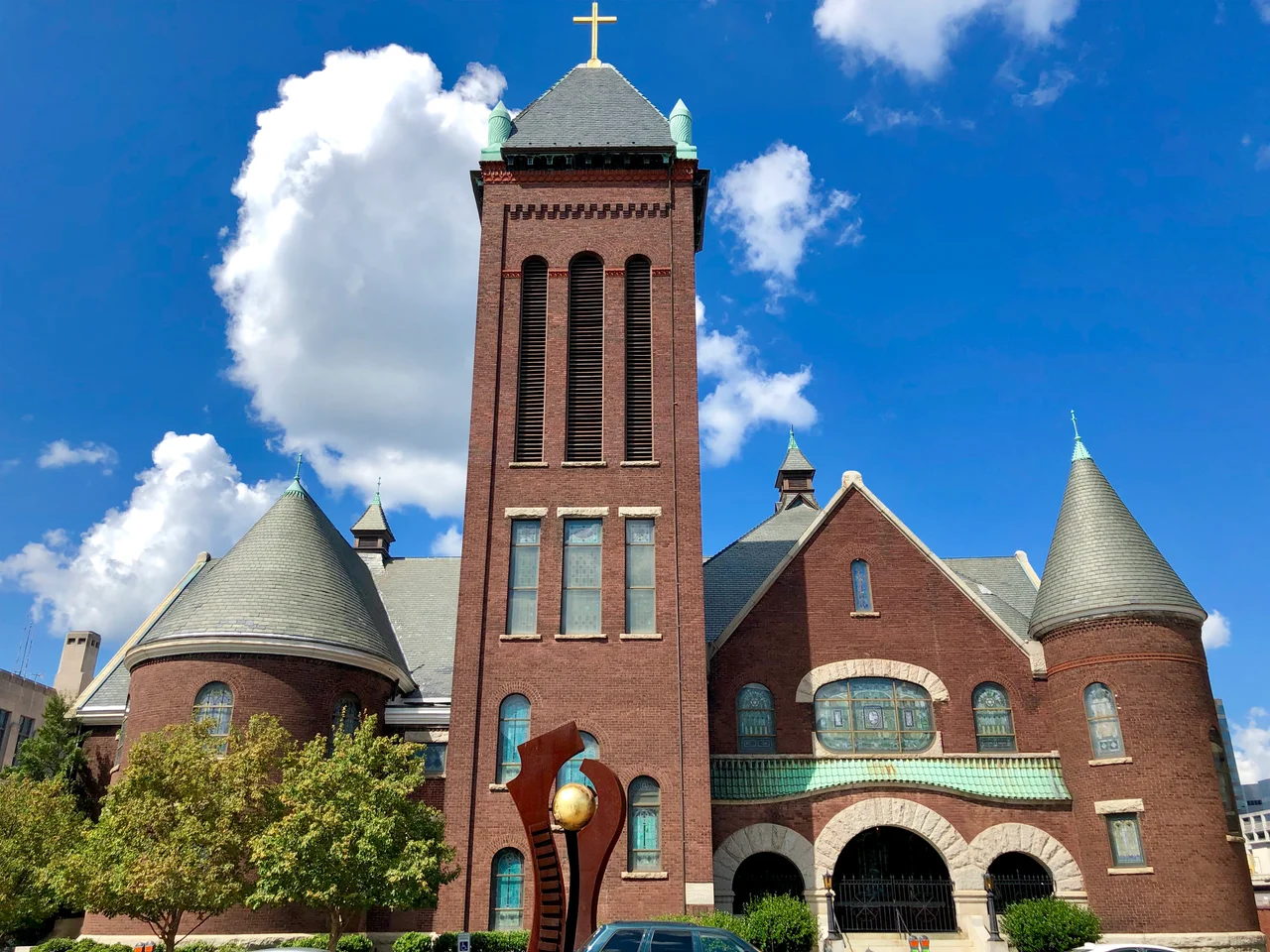

Greensboro, North Carolina
Just after four-thirty on the afternoon of February 1, 1960, four students from North Carolina Agricultural and Technical College walked into a Woolworth's at 132 South Elm Street, bought toothpaste and a few other items, then sat down at the lunch counter and asked for coffee. They were told the counter did not serve Black people. They did not leave. They sat until closing. They came back the next day with more students. Within a week the protest had spread across the South. Within months, lunch counters at Woolworth's and other chains were desegregating. The original counter still sits in the building, now the International Civil Rights Center and Museum. A section of it is on display at the Smithsonian in Washington.
A Town Planned Around a Courthouse
Greensboro was laid out in 1808 around a central courthouse square to succeed Guilford Court House as the seat of Guilford County. The location was chosen for being closer to the geographical center of the county, more easily reached on horseback or on foot. Before the colonists arrived, the area was home to the Saura, a Siouan-speaking people. Quaker migrants from Pennsylvania by way of Maryland reached the area around 1750. Three years later, 40 Quaker families were granted approval to establish the New Garden Monthly Meeting; settlement grew quickly, drawing members from as far away as Nantucket. Property for the future village was purchased from the Saura for $98. Three north-south streets - Greene, Elm, Davie - crossed three east-west streets: Gaston, Market, Sycamore. The plan is still visible in the bones of downtown.
The Confederacy's Last Capital
Greensboro played an outsized and unexpected role in the final days of the Civil War. As Union forces threatened Danville, Virginia, in April 1865, Confederate President Jefferson Davis and his cabinet escaped by train and reassembled in Greensboro on April 11. While there, they decided to split up and try to make their way west of the Mississippi to continue the war. The cabinet broke up and dispersed shortly afterward. Greensboro is the last place where the full Confederate government met as a body. Some historians consider it the Confederacy's final capital. At roughly the same time, North Carolina Governor Zebulon Vance fled Raleigh before William Tecumseh Sherman's forces and briefly maintained the state government in Greensboro. Vance proclaimed the North Carolina Surrender Declaration on April 28, 1865. The war ended in this courthouse town.
The Sit-Ins
On February 1, 1960, the four men known to history as the Greensboro Four - Ezell Blair Jr. (later Jibreel Khazan), Franklin McCain, Joseph McNeil, and David Richmond - asked for coffee at Woolworth's lunch counter and were refused. They sat anyway. They had receipts in their pockets from purchases at other parts of the store, and they brought them out and asked why their money was good everywhere else but not at the counter. By the second day there were 25 protesters. By the fourth day, more than 300. By the fifth, white students from Greensboro College and UNCG had joined. The sit-in spread to Durham, then to Nashville, then nationally. By July 25, the Greensboro Woolworth's was serving Black customers. Three more years of protests followed in Greensboro - including the May-June 1963 marches that became the largest civil rights protest in North Carolina history, jailing roughly 1,400 Black protesters and bringing young Jesse Jackson, then a student at A&T, to prominence as a national figure.
The Greensboro Massacre
On November 3, 1979, members of the Communist Workers' Party held an anti-Klan rally at the corner of Carver Drive and Everitt Street in the predominantly Black Morningside Homes neighborhood. Two cars carrying Ku Klux Klansmen and American Nazis arrived. After a brief confrontation, the Klansmen and Nazis opened fire. Five CWP members were killed: Sandra Smith, James Waller, Bill Sampson, Cesar Cauce, and Michael Nathan. Eleven other people were injured. Television footage from four local news stations was shown worldwide. In November 1980, an all-white state jury acquitted six Klan defendants. A 1985 civil suit found five Greensboro police officers and two other individuals liable for $350,000 in damages, paid to the Greensboro Justice Fund. The killings remain one of the most documented and least punished political assassinations in modern American history. In 2004, Greensboro convened the country's first Truth and Reconciliation Commission to confront what happened. The commission issued its report in 2006.
The Triad's Third City
Greensboro is now the third-largest city in North Carolina, with about 307,000 people in 2024. It anchors the Piedmont Triad, which holds about 1.7 million. Three interstates - I-40, I-85, and I-73 - converge here, making the city a national logistics hub. FedEx opened its mid-Atlantic air cargo hub at Piedmont Triad International in 2003. Toyota Motor North America announced a $1.3 billion battery plant in December 2021. HondaJet builds light business jets here. Boom Supersonic completed its Overture factory at the airport in June 2024. UNCG (20,000 students) and North Carolina A&T (the country's largest historically Black university, about 15,275 students) anchor a higher-education sector that includes Bennett, Greensboro, and Guilford Colleges. The ACC was founded here in 1953 and was headquartered in Greensboro for 70 years until relocating to Charlotte in 2023.
Quiet Excellence
The cultural list is long for a city this size. The Steven Tanger Center for the Performing Arts opened in November 2021 with 3,023 seats. The Greensboro Science Center includes a zoo, aquarium, and planetarium. Blandwood Mansion, completed in 1795 and renovated in 1846 with additions by New York architect Alexander Jackson Davis, is the earliest extant example of Italianate (Italian Villa Style) architecture in the United States and a National Historic Landmark. The Weatherspoon Art Museum at UNCG holds works by Henri Matisse, Willem de Kooning, Pablo Picasso, Andy Warhol, and Robert Rauschenberg. Guilford Courthouse National Military Park commemorates the March 15, 1781 battle that opened the campaign leading to British surrender at Yorktown. The Wyndham Championship, the last PGA Tour event before the FedEx Cup Playoffs, has been played at Sedgefield Country Club since 1938. The notable people list includes John Coltrane (raised in Greensboro and High Point), James Taylor (born here), and a long civil-rights roster - the Greensboro Four, Jesse Jackson, the activist tradition at A&T - that this courthouse town keeps adding to.
From the Air
Greensboro sits at 36.073N, 79.792W in central Guilford County, North Carolina. Field elevation about 897 ft MSL on the Piedmont uplands. Piedmont Triad International (KGSO) is the primary airport, about 8 nm northwest of downtown; Smith Reynolds (KINT) in Winston-Salem is about 22 nm west-northwest. From 3,000-5,000 ft AGL, downtown Greensboro is a cluster of mid-rise buildings around the old courthouse square, with UNCG and A&T campuses to the south and east respectively. The Greensboro Coliseum complex sits southwest of downtown. I-40 runs east-west on the south side, I-85 cuts diagonally to the southwest, and the Greensboro Urban Loop (I-73/I-840) encircles the city. The Triad's central position in the regional rail network makes Greensboro one of the busier Amtrak stops in North Carolina.
Nearby Stories
- Battle of Shallow Ford 4.9 km away
- Pyle's Massacre 8.1 km away
- Caswell County, North Carolina 9.2 km away
- Chang and Eng Bunker 13 km away
- Mebane's Bridge 23 km away
- North Carolina Aviation Museum 25 km away
- Thomas Gillespie 26 km away
- Deep River Camelback Truss Bridge 37 km away