
Campbell University
On January 5, 1887, a 26-year-old Baptist minister named James Archibald Campbell unlocked a small church in Buies Creek, North Carolina, and welcomed 16 students to the first day of classes at Buies Creek Academy. By the end of that first term, enrollment had grown to 92. Thirteen years later, on the evening of December 20, 1900, a suspicious fire destroyed everything except a large wooden tabernacle. Roused at 3:30 in the morning, Campbell watched his school burn down and told whoever asked: "Well, there's no chance to go on." A neighbor named Zachary Taylor Kivett came over the next day, found him still in bed, and said: "Why are you in bed? You're a Campbell. Get a hump on you." Over the next 478 days Kivett oversaw nearly every aspect of the academy's reconstruction - drawing plans, making the brick, sawing lumber, mixing sand and lime by hand. By January 8, 1901 - nineteen days after the fire - the tabernacle was open to classes again.
A Steam Engine in Britches
Kivett was a friend, not a wealthy donor. He brought money and labor in equal measure. The 1909 catalog called him "a steam engine in britches." Within the first days after the fire he had renovated the tabernacle for emergency classroom use, arranged for wagons to deliver lumber, and brought in carpenters. In November 1903 the new brick building - made of bricks fired on the school's own grounds - was completed at a cost of $30,000. The catalog called it "an everlasting monument to the love, loyalty, and sacrifices of our friends." Today it is called Kivett Hall, and it still anchors Academic Circle. The story of the fire and the rebuild became foundational - the kind of origin myth that an institution returns to when it needs to remember what it survived.
The Donor Who Heard a Voice
On the evening of September 26, 1923, D. Rich - treasurer of the R.J. Reynolds Tobacco Company - stayed overnight at the Campbell home in Buies Creek. According to the school's historian J. Winston Pearce, Campbell asked how Rich had slept. Rich replied that he had slept very little. "Jesus and I talked together most of the night," he said, "and Jesus told me 'Buies Creek must live.'" Rich died the following year and left one-eighth of his estate to the academy. He also provided $60,000 for the construction of the Carrie Rich Memorial Library, named in honor of his first wife, along with the first brick gymnasium and the D. Rich Memorial Building completed in 1926. The gifts came at exactly the moment when competition from new public high schools across North Carolina was threatening private academies. The infusion let Buies Creek Academy become a junior college, then a senior college in 1961, then finally a university in 1979.
The Founder Sells His School
At the Baptist State Convention in Wilmington in 1925, J.A. Campbell sold his interest in the academy - appraised at $56,000 - to the convention itself for $28,000. The school had grown to be worth more than $500,000 by then; Campbell was, in effect, donating half its value back to the institution he had founded. At the same meeting, the Reverend A.C. Hamby moved that the name be changed from Buies Creek Academy to Campbell College, in honor of the founder. The motion passed. Wake Forest College awarded Campbell an honorary Doctor of Divinity degree in 1926. J.A. Campbell died at 72 in 1934. His oldest son Leslie Hartwell Campbell, who had been eight years old the night the academy burned, succeeded him as president. The pattern would hold: Campbells have been associated with the institution that bears their name for more than 135 years, almost continuously.
Sandhills and Sandhill
The main campus sits in the Sandhills of southeastern North Carolina, in the small unincorporated village of Buies Creek near the Cape Fear River. The location is by design rural. The 1887 catalog noted with approval: "Being in the country, we avoid many of the temptations incident to towns and cities and save our patrons much extravagance in dress." Today Buies Creek lies about thirty-three miles south of Raleigh and thirty-three miles north of Fayetteville - close enough to draw students from both, far enough to maintain a campus culture distinct from either. Academic Circle, lined with magnolia trees, anchors the historic center. The newer Fellowship Commons stretches north toward the medical and pharmacy schools. The Lundy-Fetterman School of Business, opened in 1999, draws MBA candidates who frequently pursue joint degrees with the Pharm.D., J.D., or M.Div. programs - a deliberate cross-pollination strategy that gives Campbell a national reputation in professional education disproportionate to its undergraduate ranking.
From One Building to Eight Schools
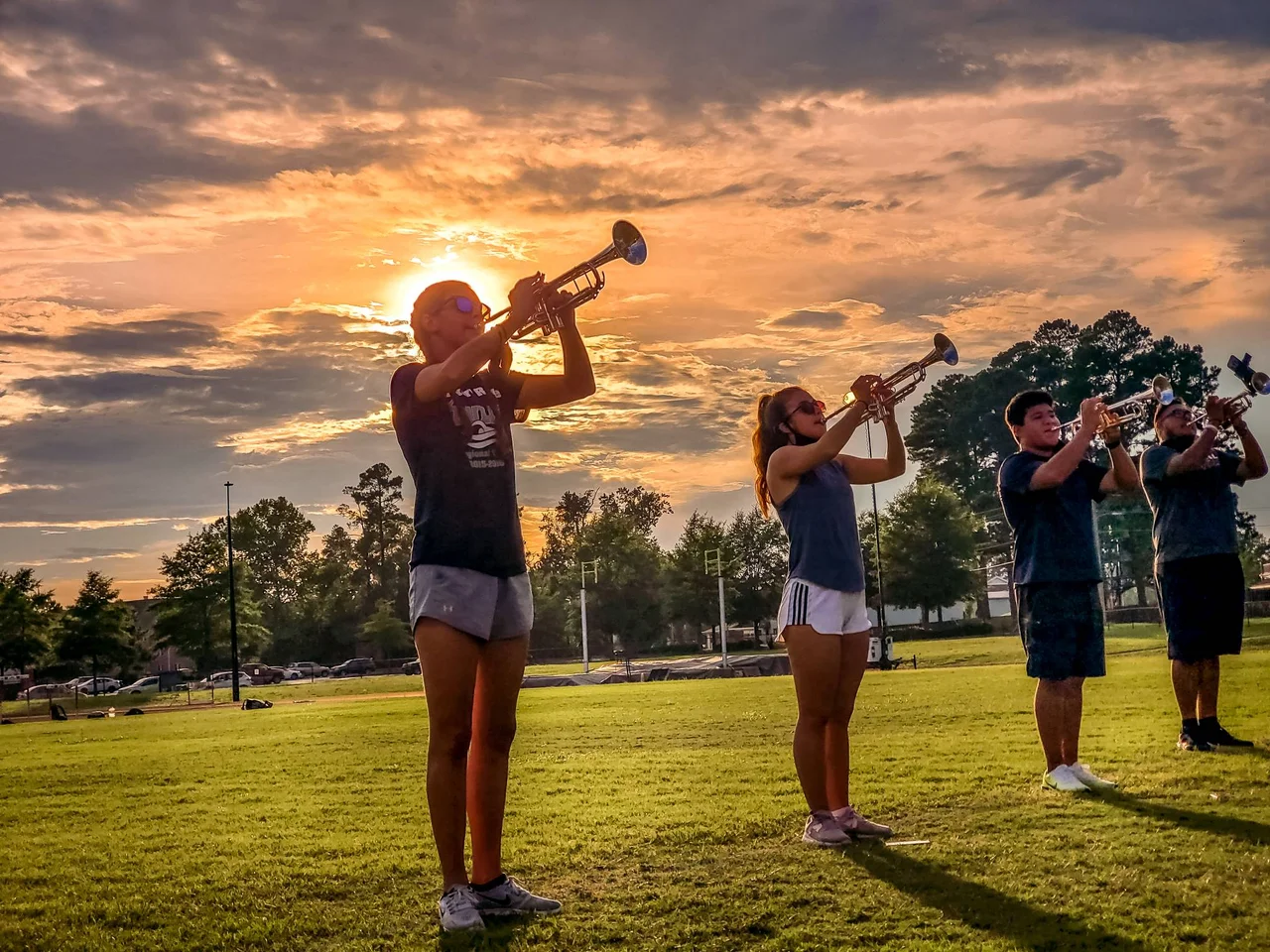
Today Campbell operates schools in arts and sciences, pharmacy and health sciences, divinity, education, business, engineering, law, osteopathic medicine, and nursing. The School of Engineering launched in fall 2015, ABET-accredited from the start. The Jerry M. Wallace School of Osteopathic Medicine accepted its first class in August 2013. The Norman Adrian Wiggins School of Law moved from Buies Creek to downtown Raleigh in 2009. Satellite campuses serve servicemembers at Fort Bragg and Camp Lejeune. In 2009, Campbell along with four other private North Carolina Christian colleges - Mars Hill, Gardner-Webb, Wingate, and Chowan - gained autonomy from the Baptist State Convention of North Carolina, preserving a "good faith and cooperative" relationship while taking control of their own boards. The Fighting Camels - twenty-one NCAA Division I varsity programs, members of the Coastal Athletic Association as of 2023-24 - play home games at Barker-Lane Stadium and the John W. Pope Jr. Convocation Center. The Sound of the Sandhills marching band still calls Buies Creek home, and the campus that Kivett rebuilt in 478 days now spans more than a square mile of the rural North Carolina the original catalog praised.
From the Air
Located at 35.4083°N, 78.7394°W in Buies Creek, Harnett County, NC - in the Sandhills region of southeastern North Carolina. The nearest airport is Harnett Regional Jetport (KHRJ) at Erwin, about 8 nm northwest. Raleigh-Durham International (KRDU) is roughly 35 nm north and Fayetteville Regional (KFAY) is 30 nm south. Best viewed at 3,500-5,500 feet AGL on transits between Raleigh and Fayetteville along the US 421 corridor. The campus is recognizable as a clustered village in otherwise rural sandhill country, with athletic fields and Barker-Lane Stadium visible south of US 421.
Nearby Stories
- 2009 ConAgra Foods Plant Explosion 3.7 km away
- Cherry Hospital 3.7 km away
- Sanford, North Carolina 9.1 km away
- Wilson, North Carolina 12 km away
- Delta Force 24 km away
- Cumberland County, North Carolina 26 km away
- Duplin County, North Carolina 26 km away
- Battle of Lindley's Mill 32 km away