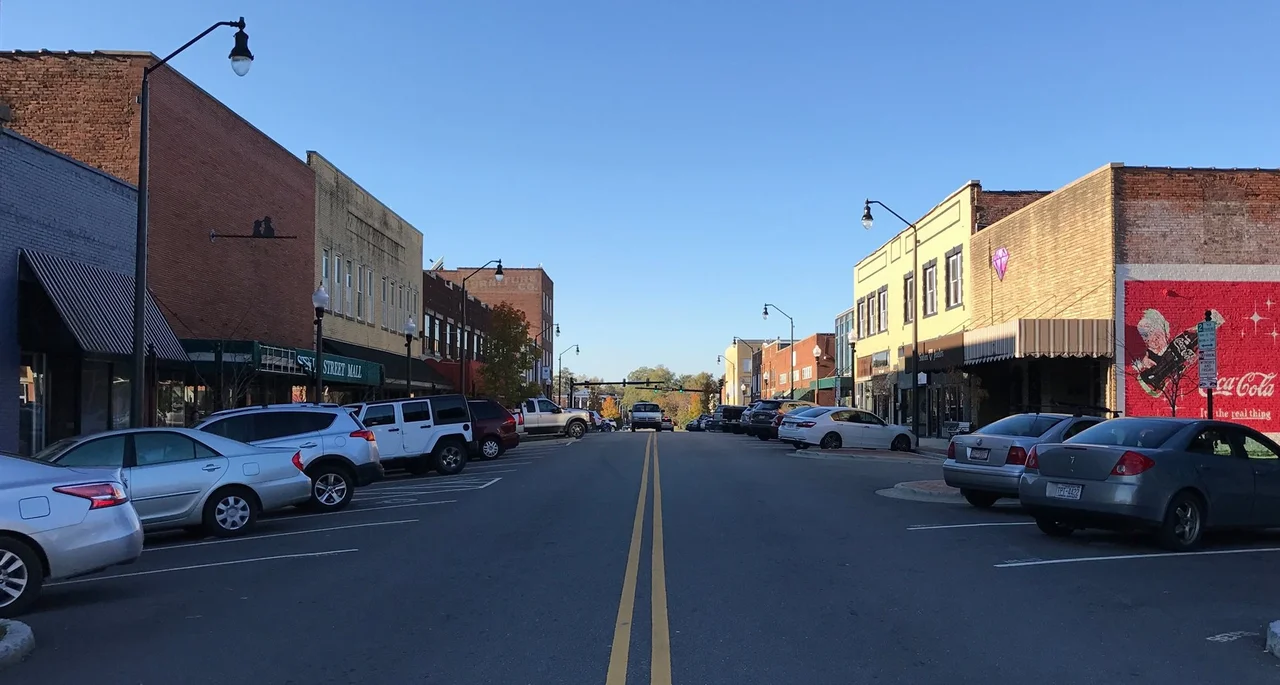

Sanford, North Carolina
The county seat got a Rural Free Delivery address because nobody could agree where to put the courthouse. When Lee County was carved out of three surrounding counties in 1907, Sanford and Jonesboro were both substantial towns, and both wanted to be the seat. Rather than choose, the new county put the courthouse in a field directly between them. For decades Lee County was the only county in the United States whose courthouse had an RFD address - a postal designation for rural delivery, not for any town at all. In 1947 the two towns finally merged. Jonesboro became Jonesboro Heights, a neighborhood of Sanford. The courthouse stayed where it had always been - in the middle, on the line between what used to be two towns and was now one.
Built on Brick
Sanford was named for C.O. Sanford, the railroad civil engineer who ran the lines that put the town on the map. He never lived here. The town was incorporated in 1874 around the rail junction he had built. What grew up around the tracks was an industrial center based on what the ground gave up: coal, brownstone, and clay. The brownstone went into row houses up and down the East Coast. The brick, once Sanford figured out how to make it cheap and durable, went almost everywhere. General Shale and Lee Brick and Tile still operate kilns here. The city earned the unofficial title Brick Capital, USA - a claim that has competition from places like Malvern, Arkansas and Sayre, Pennsylvania, but no one in central North Carolina takes those claims seriously. Drive through Jonesboro Heights and you see what the town was made of - red brick storefronts, brick streets where the asphalt is worn through, brick chimneys still rising over what used to be the kilns and yards.
The Sanford Spinners
Between 1941 and 1950, with a break for the war years 1943-45, Sanford fielded a Class D minor league baseball team called the Sanford Spinners. The cotton-mill name was honest - the textile mills paid most of the bills here. In 1941-42 the Spinners played in the Bi-State League. After the war they came back as part of the Tobacco State League and ran from 1946 to 1950. They played at Temple Park. Manager Zeb Harrington led them to three regular-season pennants. The Spinners are gone, the Tobacco State League is gone, Temple Park has been replaced. But Temple Theatre - which opened downtown in 1925 as a vaudeville house and movie palace - is still running as a regional performing arts venue. It is one of the things that survived. So is the Railroad House, an 1872 structure that now operates as a railroad heritage museum near the old depot.
Revolutionary Ground
Eight miles west of downtown, on the Deep River, sits the House in the Horseshoe - a 1772 plantation house owned by Continental Army Colonel Philip Alston that became, on July 29, 1781, the site of a small but vicious Revolutionary skirmish between Alston's Whigs and a Tory force led by David Fanning. The bullet holes are still in the walls. About four miles south on the Deep River sits the Endor Iron Furnace, a 35-foot stone stack built in 1862 that produced pig iron for the Confederacy until Union forces effectively shut it down. Both sites are managed as historic landmarks today. Sanford's National Register listings run long - the Downtown Sanford Historic District, the East Sanford Historic District, the Hawkins Avenue District, the Lee Avenue District, Buffalo Presbyterian Church, the Farish-Lambeth House, the Lee County Training School (one of the Rosenwald schools built to educate Black children in the segregated South), and more.
Notable Sons and Daughters
The list of people from Sanford runs in unexpected directions. The Hardy Boyz - Matt and Jeff, WWE professional wrestlers - have roots here; Matt was born in a Sanford hospital. Lita, the wrestler Amy Dumas, lived here as a kid. Floyd Council, the blues musician who lent half his name to Pink Floyd (the other half came from Pink Anderson), was born in Chapel Hill in 1911 and died in Sanford in 1976, where he is buried. NASCAR driver Herb Thomas, a two-time Grand National champion in 1951 and 1953, came from here. So did J.D. McDuffie, the journeyman NASCAR driver killed at Watkins Glen in 1991. Britton Buchanan finished as runner-up on the fourteenth season of The Voice. Robert T. Reives II, the current minority leader of the North Carolina House of Representatives, calls Sanford home. The Raleigh Executive Jetport (ICAO: KTTA), located eight miles northeast of town on the site of the old Sanford-Lee County Brick Field, opened in 2000 as a corporate-aviation gateway to the Triangle. Sanford sits 42 miles southwest of Raleigh, 36 miles northwest of Fayetteville. The geographic center of North Carolina is a few miles up the road in Chatham County.
From the Air
Sanford sits at 35.48 degrees N, 79.18 degrees W in Lee County, North Carolina, at about 400 feet elevation, 42 miles southwest of Raleigh. The closest airport is Raleigh Executive Jetport / Sanford-Lee County (KTTA), 8 nm northeast of town, opened 2000 at the old brick field site; two paved runways. Other nearby: Moore County (KSOP) 22 nm southwest; Fayetteville Regional (KFAY) 33 nm south; Raleigh-Durham International (KRDU) 35 nm northeast. Recommended viewing altitude 2,500-3,500 feet AGL. The brick kilns and clay pits of the surrounding countryside are visible as pale industrial scars; downtown's grid sits at the convergence of US 1, US 15, US 421, and US 501. The geographic center of North Carolina lies a few miles northwest in Chatham County.
Nearby Stories
- Campbell University 1.6 km away
- Yates Mill 6.8 km away
- Delta Force 8.8 km away
- Yadkin River 24 km away
- Battle of Lindley's Mill 24 km away
- Battle of Colson's Mill 26 km away
- Silver Hill Mine 36 km away
- Sampson County, North Carolina 39 km away