
Rocky Mount, North Carolina
Thelonious Monk was born in Rocky Mount in 1917 in a house on Red Row that no longer stands. His family left for New York when he was four, but the town keeps claiming him - a historical marker, a downtown event center, the occasional jazz festival - and Monk's strange and wonderful piano voice, with its pauses and dissonances and sudden bursts of melody, somehow feels right for a town built at the falls of the Tar River. The water drops here over a granite shelf where the Piedmont meets the coastal plain. It powered the cotton mill the Battle family built in 1818. It flooded downtown to the rooftops during Hurricane Floyd in 1999. It keeps moving.
Mills, Tobacco, and the Twin Counties
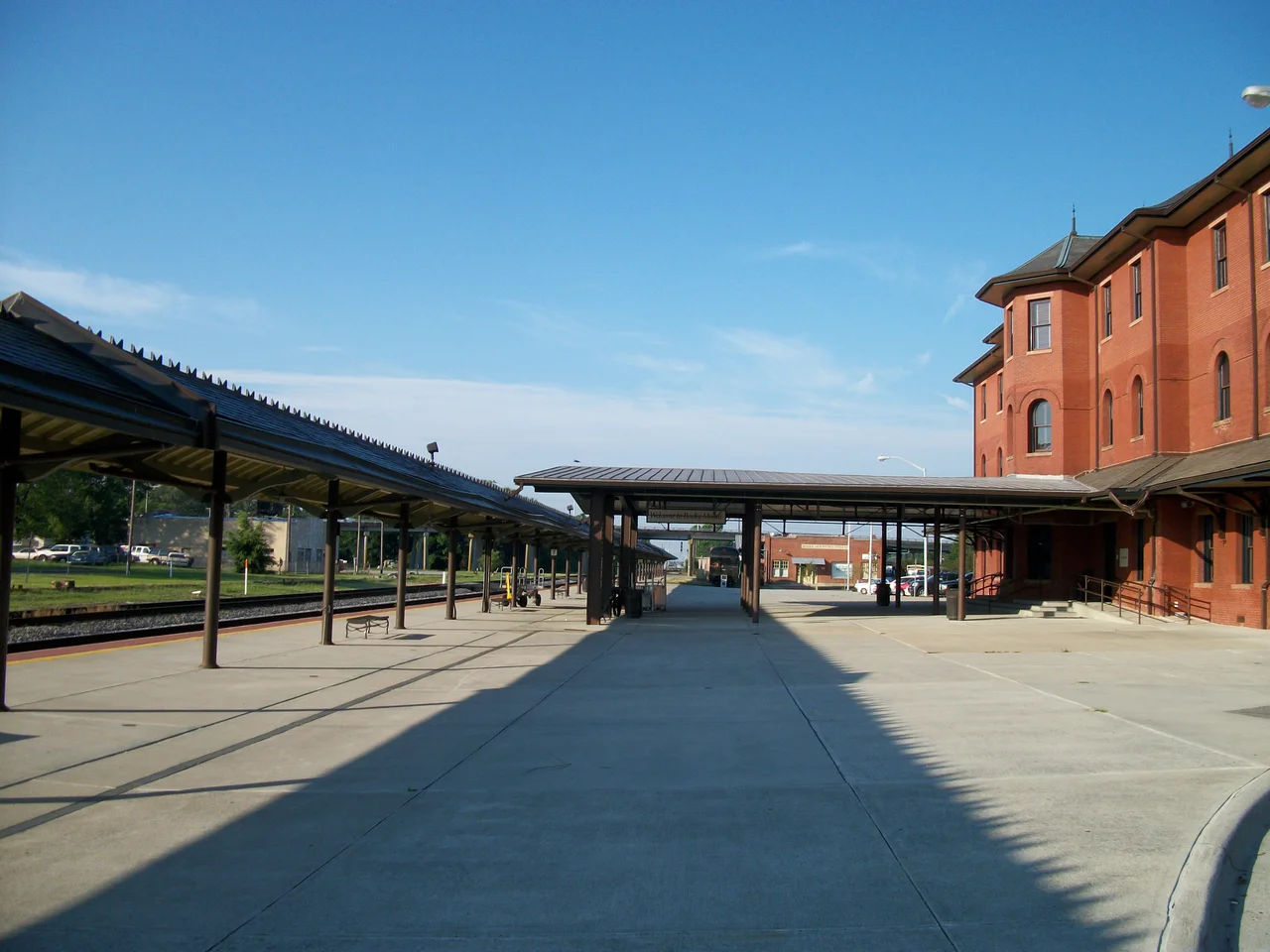
Rocky Mount straddles the Nash-Edgecombe county line at the head of navigation on the Tar River. The first mill - Rocky Mount Mills, North Carolina's second cotton mill - opened in 1818 and ran until 1996. Tobacco markets followed in the late nineteenth century, and the town grew as a regional center for both bright-leaf auctions and textile manufacturing. The Atlantic Coast Line Railroad established its repair shops and crew change point here in the 1890s; the original 1893 station still functions as the Rocky Mount Amtrak stop, with four northbound and four southbound trains a day to Washington, New York, Miami, and Philadelphia. The historic downtown district contains the Bellamy-Philips House, Bellemonte, Benvenue, Machaven, The Meadows, Stonewall, and the Rocky Mount Electric Power Plant. The Mills themselves have been redeveloped since 2014 as a craft brewery incubator and event campus.
Floyd, 1999
On September 16, 1999, Hurricane Floyd came ashore at Cape Fear as a strong Category 2, then stalled and dumped catastrophic rain across eastern North Carolina onto soil already saturated by Hurricane Dennis ten days earlier. The Tar River exceeded 500-year flood levels along its lower stretches and crested 24 feet above flood stage at Rocky Mount. Up to 30 percent of the city went underwater for days. Downtown businesses lost everything. Houses in low-lying neighborhoods filled to the second floor. Cars floated in parking lots that had never been near the river. Downstream at Princeville - a town established by formerly enslaved people in 1865, incorporated in 1885, and the oldest Black-incorporated town in America - the Tar poured over the levee and submerged the entire community under more than twenty feet of water for ten days. The recovery in Rocky Mount took years. The recovery in Princeville is still going.
The Native Sons
Rocky Mount has produced an unusual run of jazz, sports, politics, and letters. Buck Leonard, the Negro League first baseman now in the National Baseball Hall of Fame, played here before integration. Kay Kyser hosted Kollege of Musical Knowledge for NBC radio. Earle Hyman played Cliff Huxtable's father on The Cosby Show. Phil Ford led North Carolina to a national-championship game and won the Wooden Award. Roy Cooper served as governor. Two North Carolina governors - Cooper and Mike Easley - were born here. So was novelist Kaye Gibbons, who wrote Ellen Foster at twenty-six. Jack Kerouac lived off and on with relatives in town and called it Testament, Virginia in On the Road. Mary Elizabeth Winstead, the Emmy-winning actress, grew up here. So did Chuck Robbins, the CEO of Cisco. The town is roughly 60 percent Black, and its cultural output reflects that. The Reverend Dr. Martin Luther King Jr. delivered the original I Have a Dream speech at Booker T. Washington High School in Rocky Mount on November 27, 1962 - nine months before the more famous March on Washington version.
The Falls That Stay
Battle Park surrounds the falls of the Tar River - 57 biodiverse acres centered on the small drop where the water still tumbles over the rocks that gave Rocky Mount its name. The Tar River Trail, a seven-mile greenway, connects the park to the Rocky Mount Sports Complex and downtown. City Lake Park, built in 1937 by the Works Progress Administration, sits at the western edge of the trail. The Imperial Centre for the Arts and Sciences hosts a children's museum, a science center, an arts center, and a community theater. The Dunn Center at North Carolina Wesleyan University brings touring acts. Rocky Mount Mills brews beer in buildings where cotton thread spun for nearly two centuries. The city has changed economic engines several times - cotton, tobacco, textiles, pharmaceuticals, now distribution and logistics - and each time the river kept flowing through the middle of it, occasionally rising up to remind everyone who actually runs the place.
From the Air
Located at 35.95°N, 77.81°W on the Tar River straddling the Nash-Edgecombe county line, about 45 miles east of Raleigh. From cruise altitude the city reads as a grid along Interstate 95, with the falls of the Tar River visible as a slight bend and break in the water on the city's east side. Rocky Mount-Wilson Regional Airport (KRWI) is 9 miles southwest of downtown. Pitt-Greenville (KPGV) is 40 miles southeast, Kinston Regional Jetport (KISO) 50 miles south, Seymour Johnson AFB (KGSB) 35 miles south, and Raleigh-Durham (KRDU) 74 miles west.
Nearby Stories
- Purefoy-Dunn Plantation 13 km away
- Southern National Motorsports Park 19 km away
- Halifax County, North Carolina 20 km away
- Granville County, North Carolina 26 km away
- Tar River 28 km away
- Chowan University 33 km away
- Bertie County, North Carolina 37 km away
- Campbell University 44 km away