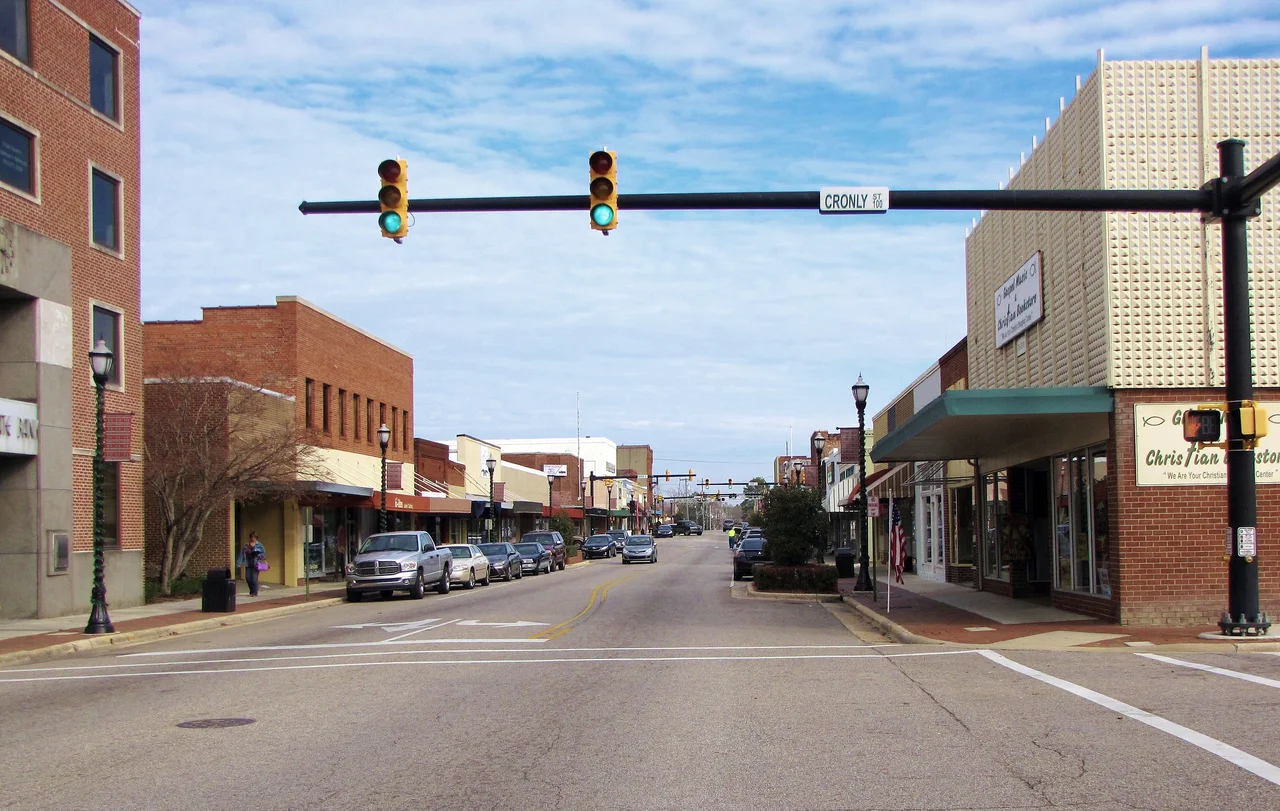

Laurinburg, North Carolina
In 1933, a fifteen-year-old from Cheraw, South Carolina, named John Birks Gillespie crossed the state line on a scholarship to a small boarding school in Laurinburg, North Carolina. The Laurinburg Institute had been founded in 1904 by Emmanuel and Tinny McDuffie, who had come from Snow Hill Normal and Industrial Institute in Alabama at Booker T. Washington's direction to build a school for Black students in the rural Carolinas. By the time Dizzy arrived, the Institute was already legendary. He stayed two years, played in the school band, and learned the trumpet seriously for the first time. Decades later, he returned often, and the Institute's musical reputation grew partly because of him.
Named for the McLaurins
Settlers arrived at the present town site around 1785. The settlement was named for a prominent local family — the McLaurins — and originally spelled Laurinburgh, pronounced 'Laurinboro,' the way Edinburgh is pronounced in Scotland. The town was within Richmond County's jurisdiction. In 1840, Laurinburg consisted of a saloon, a store, and a few shacks. The Wilmington, Charlotte and Rutherford Railroad came through in the 1850s, and the first train reached Laurinburg in 1861, just months before the Civil War turned the line into a military asset. The town became the seat of Scotland County when Scotland County was created in 1899 — a county named, like the town, for the Scottish settlers who had given the region its character.
The Laurinburg Institute
Among the historic sites listed on the National Register, the Laurinburg Institute stands out as more than architecture. Founded in 1904, it was — and remains — a historically Black boarding school that has served generations of Southern Black families when public education for their children was inadequate or denied. The Institute's alumni include Dizzy Gillespie, who attended on a music scholarship and discovered the trumpet there. Charlie Scott, the basketball player who became the first African American scholarship athlete at the University of North Carolina at Chapel Hill, was valedictorian of his Laurinburg Institute class before going on to Olympic gold in 1968 and an NBA career. Sam Jones, another Laurinburg Institute graduate, won ten NBA championships with the Boston Celtics. The Institute educated kids the South would not, and its alumni shaped American music and sport in ways no one accounting fully captures.
Historic Sites and Houses
Laurinburg's National Register listings document the layers of its 19th- and early 20th-century streetscape: the John Blue House, the Mag Blue House, the Central School, the Dr. Evan Alexander Erwin House, the E. Hervey Evans House, the Thomas J. Gill House, the Stewart-Hawley-Malloy House, Villa Nova, and the Laurinburg Commercial Historic District. Laurel Hill Presbyterian Church, just outside town, was one of the early Scottish Presbyterian congregations in the region. St. Andrews University — itself a National Register site — sits on the edge of town, the consolidation of two earlier Presbyterian colleges. The names McLaurin, McLean, McNair, and McKinnon thread through the cemeteries and street signs, the inheritance of a Scottish settlement that has not forgotten itself.
A Sister in Argyll
Laurinburg has one sister city, designated through Sister Cities International: Oban, in Argyll and Bute, Scotland. The pairing makes a kind of geographic poetry. The McLaurins for whom Laurinburg was named came from Argyll. So did many of the early settlers across this part of North Carolina, who landed in the Cape Fear region and pushed inland to settle along Drowning Creek and the Lumber River. They brought Gaelic place names, Presbyterian congregations, and the long Scottish memory of clan loyalty that the American South would, in time, partially absorb. Today, Scotland County events sometimes feature both Highland games and Carolina barbecue.
Who Came Out of Here
The list of people Laurinburg has sent into American life is improbable for a town of fewer than 15,000. Terry Sanford, the former governor of North Carolina and U.S. Senator who founded Duke's public policy school, was from here. So was U.S. Senator and Connecticut Governor Joseph Roswell Hawley, a Union Major General. NASA astronaut William S. McArthur flew four space missions. Oceanographer Samantha Joye led much of the scientific study of the Deepwater Horizon oil spill. Countertenor Bejun Mehta sings opera around the world. Ben Vereen tap-danced onto Broadway. NFL running back Zamir White plays for the Las Vegas Raiders. Country singer Bucky Covington made the American Idol top ten. Jazz trumpeter Woody Shaw shaped hard-bop. The Laurinburg Institute trained many of them. The town built the rest.
From the Air
Laurinburg sits at approximately 34.76°N, 79.47°W in southern Scotland County, North Carolina, about 19 miles northeast of Bennettsville, South Carolina. From cruising altitude, the town appears as a compact urban grid surrounded by mixed farmland and pine forest. The Laurinburg-Maxton Airport (KMEB) is about 6 miles northeast. Pope Field/Fort Liberty (KPOB) is approximately 45 miles north; Fayetteville Regional (KFAY) is also about 45 miles north. The terrain is flat coastal plain transitioning to sandhills, with Drowning Creek and the Lumber River system marking the southern boundary.
Nearby Stories
- Richmond County, North Carolina 11 km away
- The Robesonian Takeover 13 km away
- Fort Bragg 20 km away
- 1958 Mars Bluff B-47 Nuclear Weapon Loss Incident 28 km away
- Lynches River 38 km away
- Tabor City, North Carolina 40 km away
- Battle of Camden 43 km away
- Reed Gold Mine 44 km away