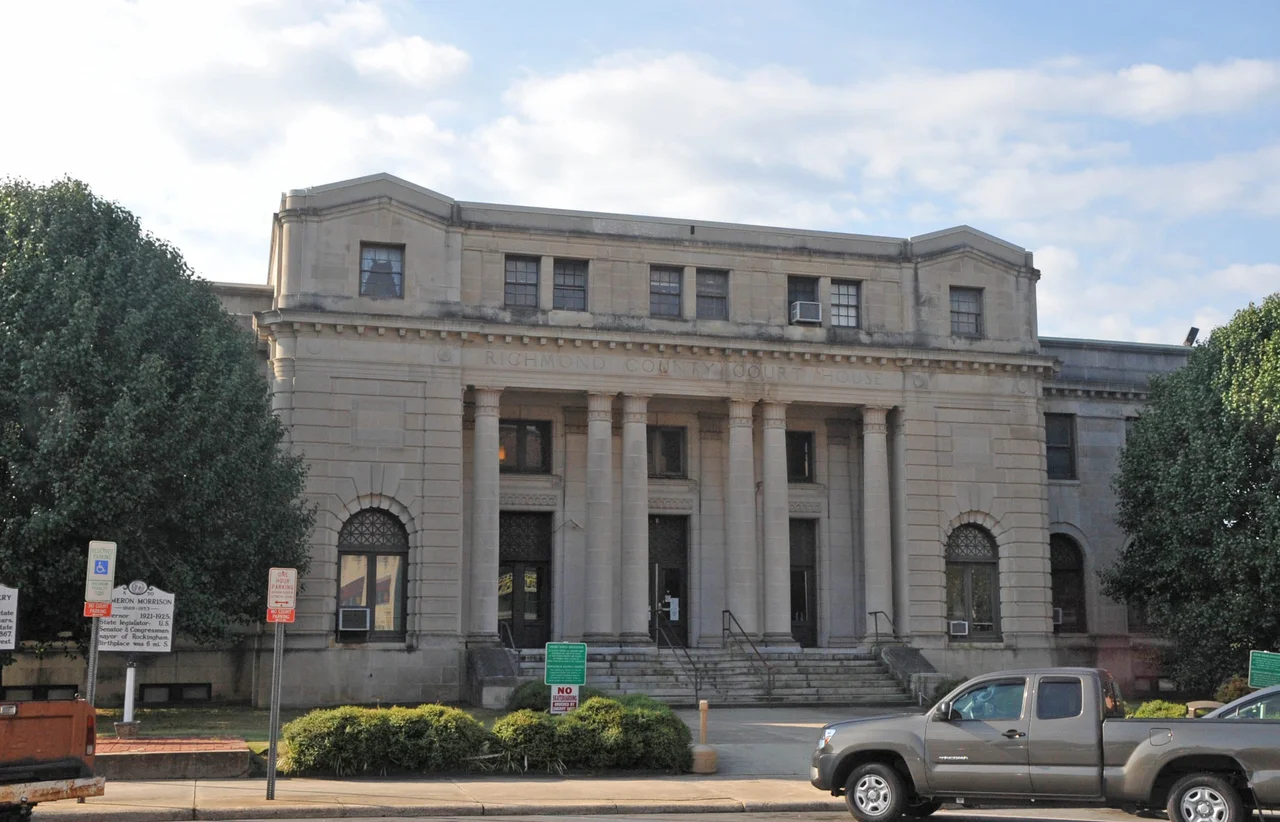

Richmond County, North Carolina
John Coltrane was born here. Hamlet, North Carolina, September 23, 1926 — in a small wooden house that still stands. He left as a young man and never really came back, but the saxophonist who would change jazz forever spent his first years inside the orbit of the Seaboard Air Line Railroad, where his grandfather preached, where every freight whistle marked the hours, and where five rail lines crossed each other inside a single small town. Richmond County's character was set long before Coltrane arrived: peach orchards in the Sandhills, cotton mills on the Pee Dee River, turpentine in the longleaf pines, and a railroad that made Hamlet briefly one of the busiest junctions in the American South.
Named for a Friend Across the Ocean
Richmond County was created in 1779, carved off Anson County and named for Charles Lennox, 3rd Duke of Richmond and Lennox — a British politician who, despite being a duke, had argued in Parliament against the war with the American colonies. The county seat, established a few years later, took the name of another sympathetic Briton: Charles Watson-Wentworth, 2nd Marquess of Rockingham. So in the years just after the Revolution, the new republic named one of its counties and one of its towns for the few Englishmen who had argued the Americans' case in London. By 1790 the county had 5,885 residents. By 1850, after cotton arrived and the western half of the county filled with plantations, enslaved people made up roughly half the population.
The Town Five Railroads Made
Hamlet should not have grown. In the 1880s it was an unremarkable Sandhills village in a poor county. Then the Seaboard Air Line Railroad chose it as the crossing point for five separate rail lines — north-south to Florida, east-west across the Piedmont, branches off in every direction. By 1900, Hamlet was a railroad town in the fullest sense: brick depot, division headquarters, repair shops, hotels for crews running long routes south. By 1954 Seaboard had built an $11 million classification yard one mile north of town, the first such yard in the Southeastern United States. The Hamlet station — a Queen Anne wooden depot with a wraparound porch and a clock tower — still stands, still serves Amtrak's Silver Star, and is one of the most photographed railroad stations in the South.
Sherman's Foragers, the Mills, and the Crash
Federal troops under General Sherman entered Richmond County in March 1865 on their way north from the Carolinas Campaign. They burned the Richmond Manufacturing Company mill — the county's first textile plant, built in 1837 — and pushed on. The mill was rebuilt as the Great Falls Mill in 1869. By the end of World War II, ten textile mills operated in the county, employing as many as 15,000 people. Then came globalization. Between 1993 and 2005, nine mills closed and 1,730 mill jobs disappeared. The Great Recession that began in December 2007 made it worse. Today the North Carolina Department of Commerce classifies Richmond as economically distressed. Cotton still grows in places. The peach orchards in the Sandhills still bloom in March. The mills are mostly silent.
The Rock, the Refuge, the Saxophonist
Three things in Richmond County draw outsiders. The first is Rockingham Speedway — The Rock — which opened in 1965 and hosted NASCAR Cup races until 2004, then sat empty for a decade before coming back in 2025. The second is the Pee Dee National Wildlife Refuge, a quiet expanse of bottomland swamp and longleaf pine on the county's western edge that hosts wood ducks, migratory waterfowl, and one of the last remaining clusters of red-cockaded woodpeckers in the eastern United States. The third is the Coltrane House in Hamlet, a small wooden structure where one of the most important musicians of the twentieth century spent his first six years. None of these three things would be possible without the railroad that made Hamlet a town and the textile money that built the county's brick downtowns.
A Citizen Petition That Worked
In November 1989, when Chem-Nuclear Systems announced a Richmond County site for a low-level nuclear waste disposal facility, a group of residents formed For Richmond County Environment — FORRCE — to fight it. They gathered 26,756 signatures opposing the site, more than sixty percent of the county's total population. Twelve hundred residents traveled to Raleigh to deliver the petition to the governor in person. In 1993, after years of pressure, the state panel voted to move the site to Wake County instead, with Richmond as its second choice. The project was eventually abandoned entirely. In a county that has lost mills, jobs, and people for thirty years running, FORRCE remains the answer to a question often asked: what does it take to win one against the long odds? Sometimes 26,756 signatures and a bus ride to Raleigh.
From the Air
Richmond County sits at roughly 35.00°N, 79.75°W in south-central North Carolina, covering 480 square miles along the Pee Dee River. Rockingham, the county seat, lies near the center. Hamlet sits ten miles east. Nearest airports: Richmond County (KRCZ) just north of Rockingham, Laurinburg-Maxton (KMEB) 25 miles southeast, and Moore County (KSOP) at Pinehurst 30 miles north. From altitude, look for the broad Sandhills band, the Pee Dee River meandering down the western boundary, the distinctive D-shape of Rockingham Speedway just off U.S. 1, and the great Hamlet rail classification yard with its long sidings extending north from town.
Nearby Stories
- Fort Bragg 12 km away
- Laurinburg, North Carolina 15 km away
- Carthage Nursing Home Shooting 19 km away
- The Robesonian Takeover 21 km away
- Haw River 30 km away
- Grace Evangelical and Reformed Church 32 km away
- Reed Gold Mine 37 km away
- Lancaster County, South Carolina 51 km away