.jpg)
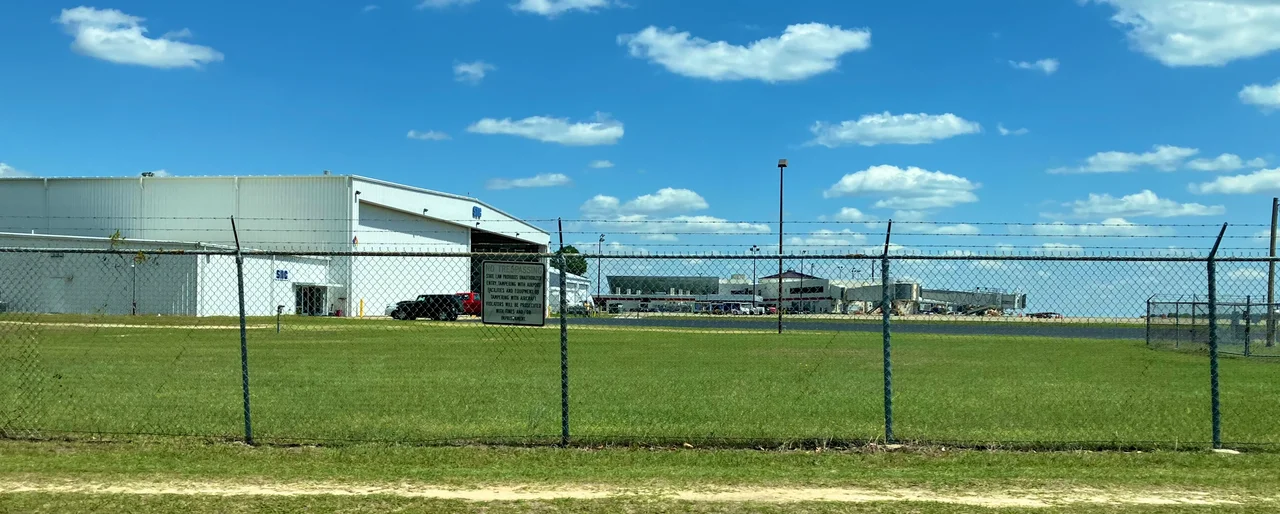
Fayetteville Regional Airport
Walk past security at Fayetteville Regional Airport and the first thing you see is the USO. Not a coffee shop, not a Hudson News - the USO. The lounge sits at the seam between Concourse A and Concourse B, doors open onto both, and it tells you everything about who actually uses this airport. KFAY moves a tiny number of passengers by national standards - roughly 250,000 enplanements a year - but most of them are wearing or about to be wearing uniforms. This is the airport of Fort Bragg.
Grannis Field
The airport's official name is Fayetteville Regional, but the historical name persists in pilots' notes and aviation paperwork: Grannis Field. It sits on 1,343 acres in southern Cumberland County, three nautical miles south of downtown Fayetteville, at 189 feet above sea level. Two asphalt runways serve it. Runway 4/22 is the long one - 7,709 feet by 150 feet, capable of handling everything from regional jets to medium business aircraft to occasional military lift. Runway 10/28 runs 4,801 feet by 150 feet, the shorter intersecting runway used for cross-wind operations and general aviation. The terminal is a modest two-concourse structure: two gates on Concourse A serving turboprop commuter and charter aircraft, four gates on Concourse B with jetbridges for regional jets and larger aircraft. Security and gates are on the second level; ticket counters and baggage claim sit below.
Who Comes and Goes
In a 12-month period ending December 2022, the airport handled 33,327 aircraft operations - an average of 91 per day. The breakdown reveals the airport's character: 44 percent general aviation, 37 percent scheduled commercial, 10 percent air taxi, 10 percent military. Seventy-four aircraft are based here: 56 single-engine props, 11 multi-engine, six jets, and one helicopter. The destination map skews heavily toward hub connections. Charlotte was the top destination with 95,290 passengers; Atlanta followed with 77,940. From those two cities, you can connect onward to anywhere. The airport has cycled through carriers over the years. Piedmont Airlines came first, eventually folding into US Airways. Atlantic Southeast became part of Delta Connection. American Eagle ran routes to Raleigh-Durham and Dallas/Fort Worth. Allegiant Air served Orlando-Sanford briefly. United Express tried Dulles for a while, with Air Wisconsin running CRJ-200s, but declared the route "no longer sustainable" in March 2019 and withdrew.
Soldiers Going Home
What the bare ridership statistics don't capture is the rhythm of the place. On certain days of the week, Concourse A fills up with new graduates of Fort Bragg's airborne school, fresh wings on their chests, duffels at their feet, heading home for two weeks of leave before reporting to their first units. Other days, the rotation cycles inward - soldiers returning from leave, their families dropping them off curbside. Around major deployments, charter aircraft stage at the general aviation ramp; sometimes whole battalions cycle through over a few days. The USO lounge, mentioned earlier and quietly central to the airport's identity, exists because of this. It is staffed by volunteers, equipped with phones, snacks, recliners, and Wi-Fi, and it stays open when terminals like this in cities of similar size would be quiet. For a young soldier flying alone for the first time, it is a place to sit that doesn't cost a dollar and doesn't expect anything.
Plans for a Different Terminal
Since 2014, the Fayetteville Airport Commission, airport management, and the Fayetteville City Council have been working on terminal expansion. The plan is straightforward: tear down the original Concourse A, which is the older ground-level concourse from the airport's first build, and replace it with an elevated jetbridge-equipped concourse matching Concourse B. The new terminal would have eight gates, all with jet bridges, two of those with adjustable-height bridges for larger aircraft. Security would expand to multiple TSA lanes. New restrooms and dining options would replace the modest current offerings. Behind the project sits a longstanding ambition: more carriers, more nonstop hub connections, more direct service to make travel from the Fayetteville metro area easier - for soldiers, for civilians, for the families that constantly cycle through this part of North Carolina. Whether the timing of any expansion holds in the current era of regional airline contraction remains to be seen. The USO will stay where it is regardless. That is one part of the airport's plan that nobody is going to change.
From the Air
KFAY is at 34.99°N, 78.88°W in Cumberland County, southern Fayetteville. Elevation 189 feet MSL. Runway 4/22 is 7,709 x 150 ft; Runway 10/28 is 4,801 x 150 ft, both asphalt. The airport sits about 12nm south-southeast of Fort Bragg's Pope Field (KPOB) and Simmons Army Airfield (KFBG). Tower-controlled with class D airspace. Charlotte (KCLT) and Atlanta (KATL) are the primary connection destinations. Check NOTAMs - military activity in the area can affect routing significantly.
Nearby Stories
- Laurinburg, North Carolina 4.7 km away
- Sampson County, North Carolina 9.1 km away
- Rockingham Speedway 18 km away
- Campbell University 19 km away
- The Robesonian Takeover 20 km away
- Johnston County, North Carolina 21 km away
- North Carolina Aviation Museum 53 km away
- Pender County, North Carolina 57 km away