
Robeson County, North Carolina
Few rural counties in America look like Robeson County. The 2020 census found 37 percent of residents Lumbee Indian, 23 percent Black, 25 percent white, and ten percent Hispanic — proportions that exist almost nowhere else outside of small zones in the borderlands of the Southwest. This is a county where three communities — Lumbee, Black, white — have lived alongside one another for two and a half centuries without any single one becoming dominant in the way that has happened in most of the rural South. It is also a county that has been ravaged by hurricanes, deindustrialization, the opioid crisis, and four hundred years of complicated history with race and land. To understand Robeson is to accept that no easy summary of the South works here.
Three Peoples, One Land
The Lumbee were here when the first Highland Scots and Buckskin whites arrived in the 1720s, drawn from earlier Native communities — Cheraw, Saponi, Tuscarora — that had been pushed together by colonial pressure. Wealthy white planters acquired the best land. Enslaved Africans were brought in to work cotton and tobacco. By 1850 the county had 7,290 whites, 4,365 enslaved people, and 1,171 free persons of color. In 1835 a new state constitution stripped Native Americans and free Black men of the vote and the right to bear arms. According to Lumbee oral tradition, what followed was the era of 'tied mule' incidents — a white farmer would tie a mule on an Indian's land, alert the authorities to a 'theft,' and force the Indian to settle by surrendering labor or land. By the 1860s, many Lumbees were landless on land their ancestors had farmed for generations.
Henry Berry Lowry and the Lowry War
The Civil War and its aftermath turned Robeson into a battlefield in a way that no other county in the South quite was. The Confederate Home Guard conscripted Lumbee men for forced labor at Fort Fisher, where many died. Lumbees hiding in the swamps began helping Union prisoners escape from the Florence Stockade. In December 1864, postmaster James Barnes was killed after threatening the Lowry family. In March 1865, the Home Guard executed Allen Lowry and his son William without trial for allegedly possessing stolen goods. What followed was the Lowry War — Henry Berry Lowry, Allen's surviving son, led a multiracial band of Lumbees, Black freedmen, and one poor white through the swamps for nearly a decade, raiding plantations, killing the former sheriff, robbing safes. In 1872 Henry Berry Lowry disappeared. The war ended in February 1874 when the last surviving member of the gang was killed. He is remembered in Lumbee community memory the way Crazy Horse is remembered by Lakota families — as a man who fought back, not as a bandit.
Hayes Pond, 1958
Twentieth-century Robeson County has its own moments. In January 1958, James 'Catfish' Cole, a Klan leader from South Carolina, advertised a rally near Maxton at Hayes Pond, explicitly to intimidate the Lumbee community after his Klan had burned crosses in St. Pauls and Lumberton. Roughly 500 armed Lumbee men arrived to break it up. There was gunfire. The Klan rally collapsed. Cole was later convicted of inciting a riot. Life magazine ran the photographs. The Battle of Hayes Pond, as it came to be called, ended Klan activity in this corner of North Carolina for decades and became part of the Lumbee story of self-defense — a story that runs through the Lowry War, through Hayes Pond, and into more recent events.
Drug Trade, Corruption, and the Newspaper Takeover
Robeson's midway location on Interstate 95 between Miami and New York pulled it into the cocaine trade of the 1980s. The county became one of North Carolina's most violent — its homicide rate four times the national average by mid-decade. Political tensions ran high. On February 1, 1988, two Tuscarora men, Eddie Hatcher and Timothy Jacobs, took the staff of The Robesonian newspaper hostage for ten hours, demanding that Governor James G. Martin investigate corruption in the county sheriff's office and the deaths of Lumbee men in Robeson — including the November 1986 shooting of unarmed Jimmy Earl Cummings by a sheriff's deputy. The governor agreed. The subsequent investigation found nothing — but the murder of Lumbee judicial candidate Julian Pierce in March 1988 and the 1993 murder of Michael Jordan's father James R. Jordan Sr. on the I-95 shoulder near Lumberton kept national attention on the county. In 2002 a state corruption investigation called Operation Tarnished Badge eventually convicted 22 sheriff's office personnel — the largest police corruption case in North Carolina history.
Hurricanes and Endurance
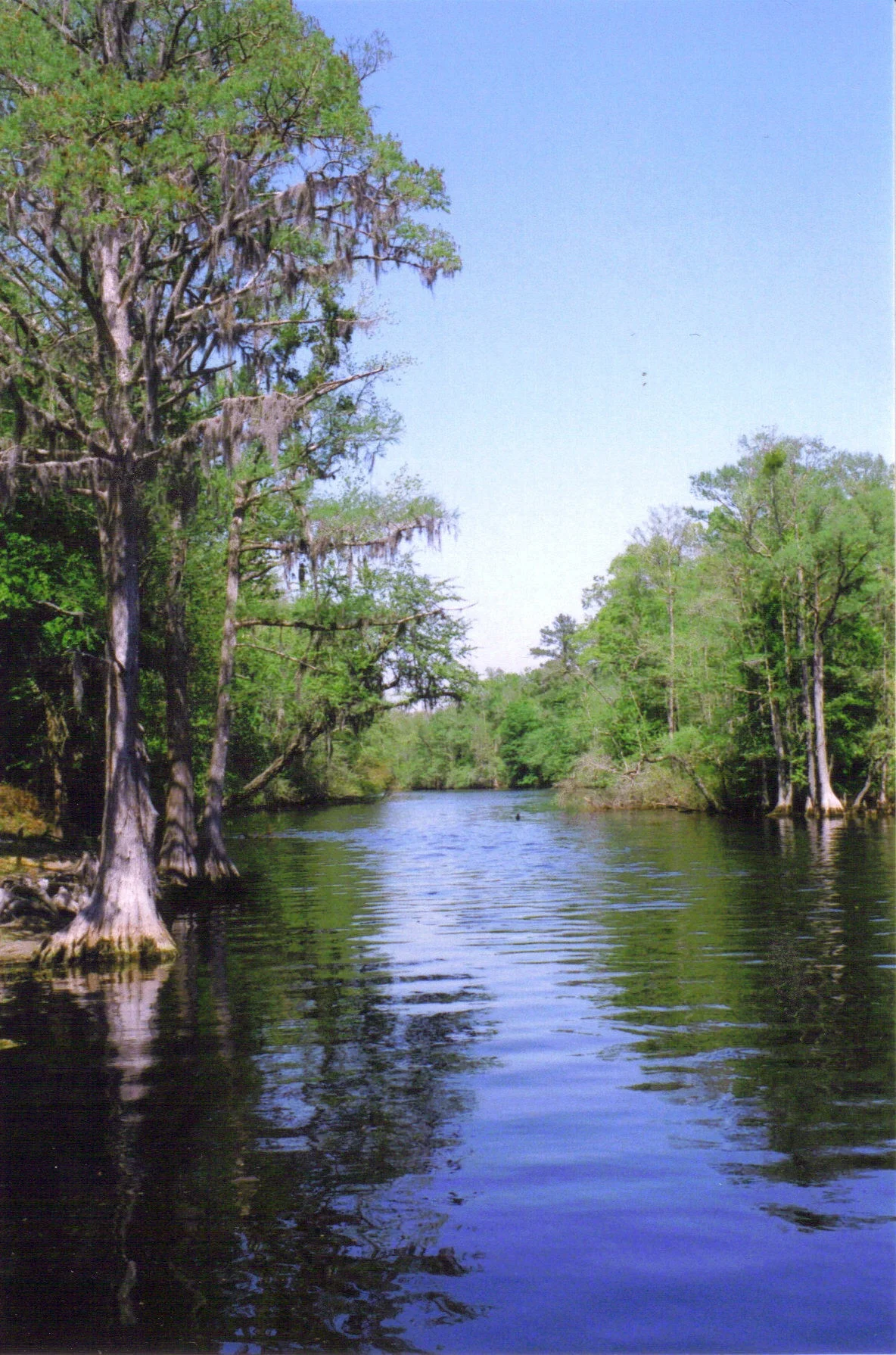
In 2016 Hurricane Matthew flooded Lumberton beyond record. In 2018 Hurricane Florence broke that record. Entire neighborhoods in west Lumberton were left abandoned. Robeson has the worst public health outcomes of any county in North Carolina, the highest opioid death rate in the state in 2021, and the lowest median household income in a region of low incomes. It also has the largest Native American population of any North Carolina county, the only historically Native university in the state at Pembroke, and a tradition of multiracial coexistence — sometimes uneasy, sometimes outright generous — that nowhere else in the rural South has quite matched. Trump won here in 2016, 2020, and 2024 with majority Lumbee support, after promising federal recognition. The Lumbee Homecoming still brings thousands home every summer. The Lumber River still runs black through the cypress. The county endures.
From the Air
Robeson County sits at roughly 34.65°N, 79.10°W in southeastern North Carolina along the South Carolina border, covering 949 square miles — the largest county in the state by area. Lumberton, the county seat, sits at the I-95/I-74 crossing. Nearest airports: Lumberton Municipal (KLBT) in Lumberton, Laurinburg-Maxton (KMEB) on the western boundary, Fayetteville Regional (KFAY) just north in Cumberland County. From altitude, look for the broad floodplain of the Lumber River meandering east through the county, the I-95 corridor cutting north-south, vast areas of Carolina bay-dotted lowland, and the distinctive crossroads pattern of Pembroke at the county's western edge.
Nearby Stories
- Cheraw, South Carolina 8.6 km away
- Delta Force 17 km away
- Darlington County, South Carolina 20 km away
- Columbus County, North Carolina 23 km away
- Battle of Colson's Mill 32 km away
- Battle of Averasborough 33 km away
- 1958 Mars Bluff B-47 Nuclear Weapon Loss Incident 45 km away
- Sampson County, North Carolina 46 km away