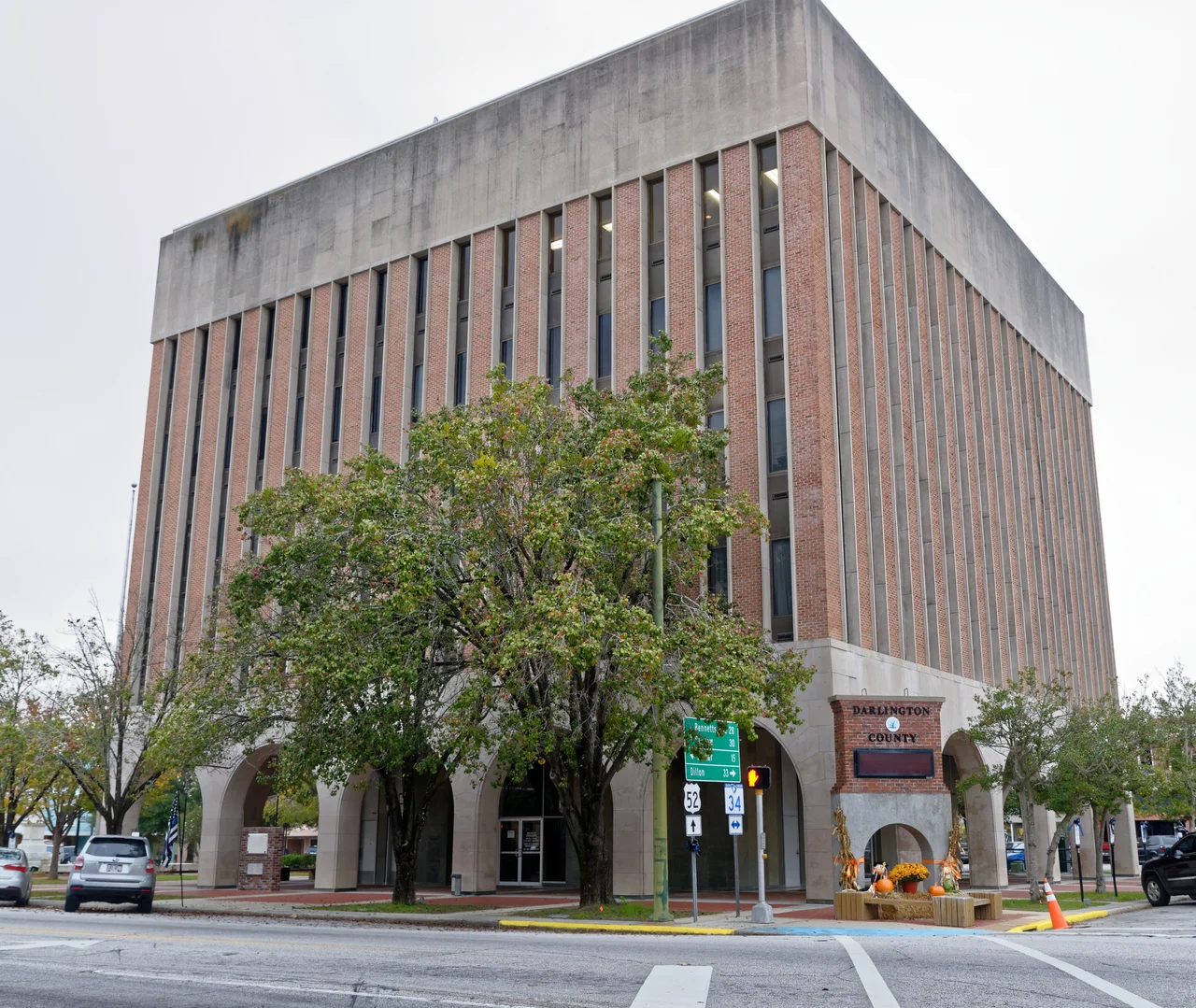

Darlington County, South Carolina
James E. Williams of Darlington County did not look like a war hero. He looked like a kid from rural South Carolina who had joined the Navy in 1947 at age seventeen to get out of the house. By the time he retired two decades later, he was the most highly decorated enlisted man in United States Navy history - Medal of Honor, Navy Cross, two Silver Stars, three Bronze Stars, three Purple Hearts. The decorations came from one afternoon on the Mekong River in October 1966, when his two-boat patrol stumbled into roughly sixty-five enemy boats and Williams decided to attack anyway.
Older than the County That Replaced It
Darlington was established as a district in 1785 - one of the early administrative units of the new state - and reorganized as a county in 1868. It predates Florence County, which was carved partly out of Darlington in 1888. The county covers a chunk of the Pee Dee coastal plain crossed by Lynches River and the Great Pee Dee, with two main population centers: the city of Darlington, the county seat, and Hartsville to the northwest. The 2020 census counted 62,905 people. Median age was 42.9 - older than the state average, a county that has been steadily losing its young to the cities while holding on to its retirees and its rural character. Fifty-seven percent of residents live in rural areas.
The Track Too Tough to Tame
Darlington Raceway is in the city of Darlington, and it gave the county its national identity. Built in 1950 by Harold Brasington on a plot of land where he had to swerve the layout around a neighbor's minnow pond, the 1.366-mile egg-shaped oval became NASCAR's first superspeedway. The asymmetric corners are the legacy of the minnow pond; the track is famously narrow and merciless, earning every winner a "Darlington stripe" of paint scraped off against the concrete wall. The Southern 500, run on Labor Day weekend since 1950, is one of NASCAR's crown-jewel races. Cale Yarborough, from nearby Timmonsville in Florence County but raced into legend at Darlington, called the track "a lady who can't be tamed."
Hartsville and the Cokers
Darlington County's largest city is not Darlington but Hartsville, sixteen miles to the northwest. Hartsville is the home of Coker University, founded by Major James Lide Coker after the Civil War; of Sonoco Products Company, which began as Coker's Southern Novelty Company and grew into a Fortune 500 packaging giant; of the South Carolina Governor's School for Science and Mathematics, a public boarding high school for the state's top science students; and of the H. B. Robinson Nuclear Generating Station, one of the first commercial pressurized-water reactors in the United States, operational since 1971. The Coker family essentially built modern Hartsville. The town still bears the imprint of one Confederate major's stubborn determination to make a living after the war.
Bobo Newsom and a Highway
Darlington County has produced an unusual number of professional athletes for a place this small. Albert Haynesworth, the NFL defensive lineman, was born in Hartsville. Orlando Hudson played second base in the majors; Jordan Lyles pitched in them; Bobo Newsom, born in 1907 in Hartsville, pitched twenty seasons for seven teams - Tigers, Senators, Cubs, Dodgers, Yankees, Giants, Red Sox - and finished with a 211-222 record that hides a 21-5 season in 1940 and a reputation as one of baseball's great characters. SC Highway 151 through Hartsville is named the Bobo Newsom Highway. The county tends to mark its sons in roads and buildings.
The Sailor from Fort Mill
James Elliott Williams was born in 1930 in Rock Hill but grew up in Darlington County. On October 31, 1966, his two-boat river patrol on the Mekong met a much larger enemy force of sampans and junks. Williams ordered an attack. The action stretched on through the afternoon over miles of river, and by the end his small force had destroyed a large number of enemy boats. Williams himself had been wounded but kept fighting. Lyndon Johnson awarded him the Medal of Honor the following year. Williams retired as Boatswain's Mate First Class, served as a U.S. Marshal in the 1970s and 1980s, and died in 1999 in Florence. He is buried at Florence National Cemetery. The Navy destroyer USS James E. Williams (DDG-95), commissioned in 2004, carries his name into the present century.
From the Air
County center near 34.33N, 79.96W. Cruise at 4,000-6,000 feet AGL for the full sweep of Pee Dee coastal plain. The Great Pee Dee River traces the eastern boundary; Lynches River cuts through the south. The Darlington Raceway is visible as a distinctive egg-shaped oval just southwest of the city of Darlington. Nearest airports: Hartsville Regional (KHVS) serves the northwest; Darlington County Jetport (KUDG) on the east side of Darlington; Florence Regional (KFLO) 15 miles southeast. The H.B. Robinson nuclear plant cooling tower near Hartsville is a recognizable landmark.
Nearby Stories
- Battle of Camden 9.7 km away
- Cheraw, South Carolina 11 km away
- Battle of Hayes Pond 13 km away
- High Hills of Santee 14 km away
- Lancaster County, South Carolina 19 km away
- Florence County, South Carolina 27 km away
- 1950 Myrtle Beach USAF C-46D Crash 39 km away
- Lumbee Tribe of North Carolina 41 km away