
Florence County, South Carolina
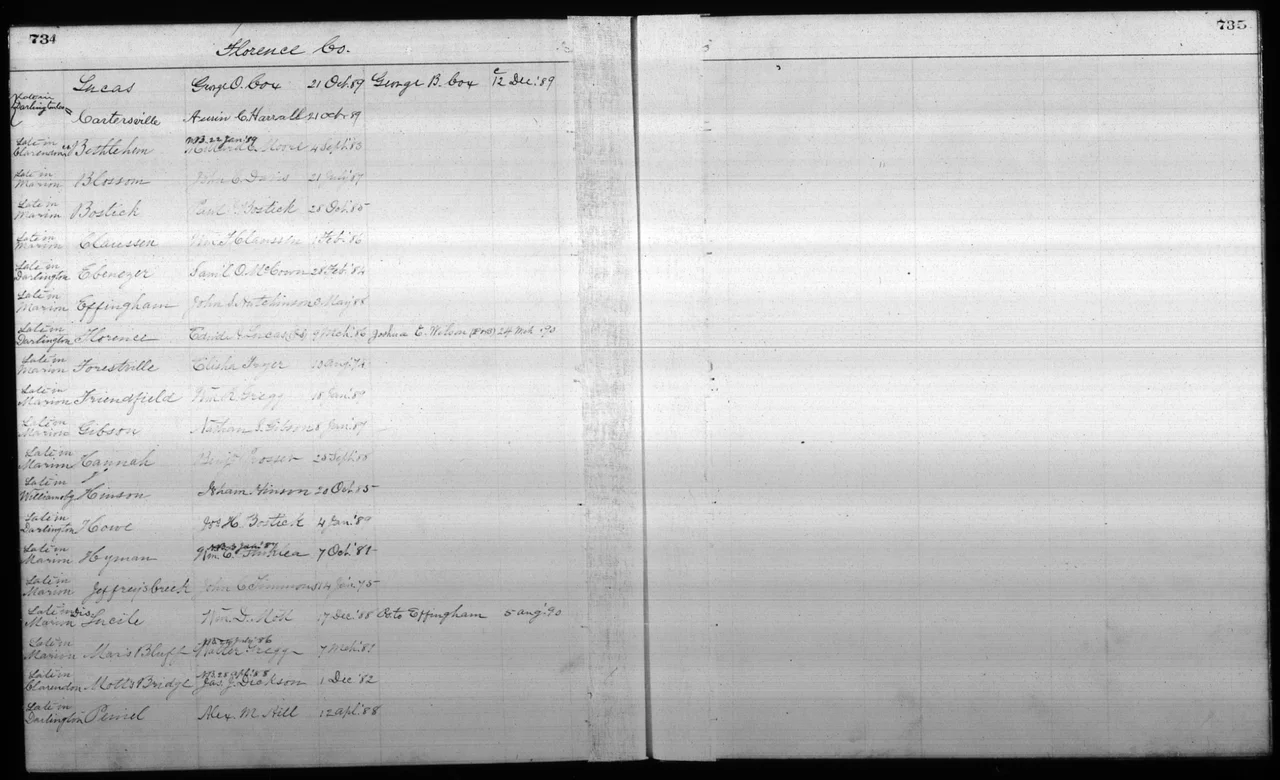
Florence the daughter never lived in the county that bears her name. She was the child of General William Harllee, the railroad president who in the 1850s built his home at the junction where the Wilmington and Manchester met the Northeastern Railroad. He called the community after her. Decades later, in 1888, the South Carolina legislature carved a new county out of pieces of Darlington and Marion - and slices of Williamsburg and Clarendon, with the last Williamsburg fragment not added until 1921 - and gave it the same name. Florence County was, from the beginning, a railroad child.
Eight Hundred Square Miles of Pee Dee
The county covers a little over eight hundred square miles of the Atlantic coastal plain, bounded on the east and northeast by the Great Pee Dee River and crossed on the west by the Lynches. The land is flat, the soil sandy in places and rich in others, and the rivers are the slow tea-colored streams typical of the coastal plain. Eight counties touch its borders. Florence the city sits near the geographic center and acts as the commercial spine of the Pee Dee region - the historic name for northeastern South Carolina, which takes its name from the Pee Dee people who lived along these rivers before European settlement.
The Railroads and the Stockade
Florence the city grew because three rail lines met there: the Wilmington and Manchester, the Northeastern, and the Cheraw and Darlington. In a region where rivers had once moved everything, the rail junction reorganized the economy in a generation. During the Civil War the strategic value worked against the Union men sent south as prisoners. The Confederacy operated the Florence Stockade just outside town, where thousands of Union soldiers were held in 1864-65; over 2,800 died of disease and exposure and lie buried at what is now the Florence National Cemetery. After the war, Reconstruction rebuilt civil government and, in 1871, chartered Florence the city. The county followed in 1888.
Marian Wright Edelman's Country
Florence County has produced complicated history and remarkable people. Marian Wright Edelman, founder of the Children's Defense Fund and one of the great civil rights leaders of the second half of the twentieth century, was born and raised in Bennettsville, the county seat of neighboring Marlboro County - and the wider Pee Dee context she came from is this country. The county also carries the harder weight of its past: on December 26, 1921, Bill McAllister, a Black man, was lynched in Florence County, one of the many racial murders that scarred South Carolina between Reconstruction and the civil rights era. Honest history holds both - the leaders the region raised and the violence it visited on its own.
Working Country
Today Florence County has about 137,000 people, more urban than rural in census terms but still farming country around the edges. The 2022 GDP of around 8.5 billion dollars makes it one of the more productive counties in the state outside the major metros. Employers include McLeod Health, Honda's manufacturing presence, GE HealthCare, Otis Worldwide, Duke Energy, QVC, Ruiz Foods, and Francis Marion University - named for the Swamp Fox, whose Revolutionary-era guerrilla war happened in these very swamps. The unincorporated community of Mars Bluff, east of Florence the city, gave the county and the world an unforgettable Cold War moment when an Air Force B-47 accidentally dropped a hydrogen bomb on the Gregg family home in 1958. The fissile core was elsewhere, but the conventional explosive was not.
Lynches River and Woods Bay
The county's protected places lean toward the watery and the strange. Lynches River County Park preserves blackwater cypress along one of South Carolina's wildest small rivers. Moore Farms Botanical Garden, on Darla Moore's family land in Lake City, brings in horticulture pilgrims by appointment. Woods Bay State Park sits partly within Florence County and protects one of the best-preserved Carolina bays - the oval depressions of mysterious origin that pock the coastal plain by the tens of thousands, often oriented northwest to southeast. From the air they are unmistakable. From the ground they are swamp forests of bald cypress and tupelo, dim and cool even in July. They are the county's quiet wonder.
From the Air
County center near 34.02N, 79.71W. Cruise at 5,000-8,000 feet AGL to take in the eight-hundred-square-mile expanse of coastal plain - flat, river-laced, with the geometric patterns of cotton, soybean, and tobacco fields broken by dark ribbons of bottomland hardwood. The Great Pee Dee River defines the eastern boundary; the Lynches River cuts the west. Primary airport: Florence Regional (KFLO) in the city of Florence. Nearby: Marion County Airport (KMAO) to the east, Conway-Horry County (KHYW) to the southeast. Look for the oriented oval depressions of Carolina bays from altitude - Woods Bay State Park preserves a classic example.
Nearby Stories
- Horry County, South Carolina 16 km away
- Sumter, South Carolina 20 km away
- Darlington Raceway 26 km away
- Brookgreen Gardens 26 km away
- Lumberton, North Carolina 40 km away
- Battle of Camden 43 km away
- Huntington Beach State Park 59 km away
- UFO Welcome Center 66 km away