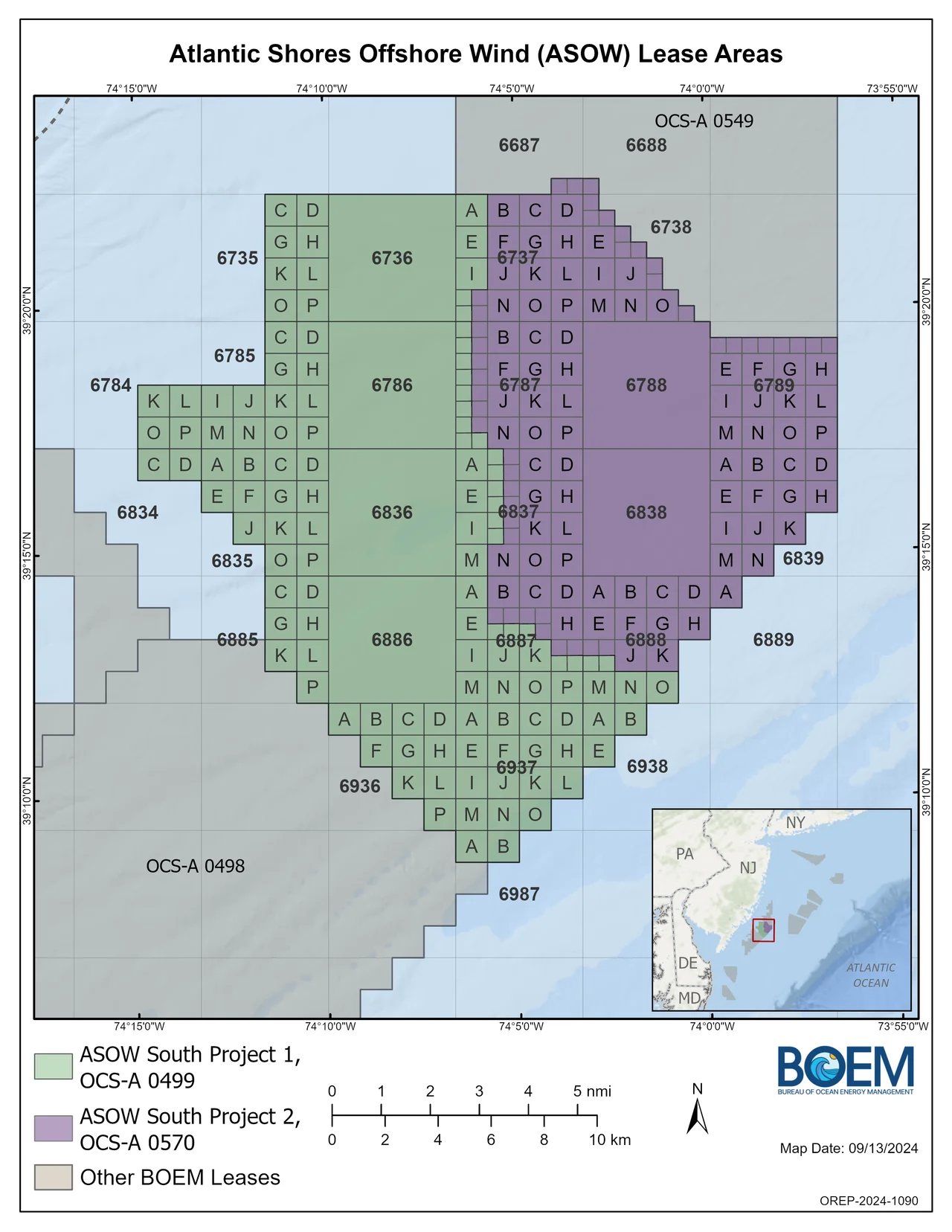

Atlantic Shores Offshore Wind South
Stand on the boardwalk at Brigantine on a clear day and look east, just over the horizon, and you cannot see them. That is the point. The Atlantic Shores Offshore Wind South project would place up to two hundred wind turbines roughly 7.56 nautical miles off the New Jersey coast - far enough that, depending on weather and atmospheric refraction, the blade tips would be barely visible from the beach. Each turbine would stand 919 feet tall to the tip - taller than the Washington Monument - on a 175-meter-tall hub turning a 379-foot blade through a 280-meter-diameter rotor. Together the turbines would generate up to 2,800 megawatts, enough to power approximately one million homes. None of them were ever built. The project was formally cancelled in June 2025, after federal politics, fishing-industry opposition, and a billion-dollar corporate retreat made it unviable.
Lease OCS-A 0499
The Bureau of Ocean Energy Management began leasing federal waters off the New Jersey coast for offshore wind development in 2011. The original tract, designated OCS-A 0499, sat about eight nautical miles offshore in waters between Atlantic City and Barnegat Light, in a stretch of ocean that combines steady prevailing winds with relatively shallow seabed and an existing transmission corridor running back to shore. The lease was acquired in 2015 and assigned in 2019 to Atlantic Shores Offshore Wind, LLC - a 50-50 joint venture between EDF Renewables, the renewable arm of the French utility EDF, and Shell New Energies US. In 2021 the lease was divided in two: Atlantic Shores Offshore Wind Project 1 (the southern portion, with 105-136 turbines and a target capacity of 1,510 megawatts) and Atlantic Shores Offshore Wind Project 2 (the northern portion, with 64-95 turbines and a target capacity of 1,327 megawatts). Each partner held a 50 percent interest in both. The Bureau of Ocean Energy Management approved the project's Construction and Operations Plan in October 2024, after thirteen years of environmental review, permit applications, and tribal consultations with the Narragansett, Shinnecock, and Lenape nations whose ancestral lands include the relevant Atlantic seabed.
The Save the Whales Banners
Opposition to the project from local communities on the New Jersey coast has been sustained and well-organized. The most visible group, Save Long Beach Island, gained national attention through 2023 and 2024 by linking the project to a series of unusual whale deaths along the mid-Atlantic coast. Researchers at the National Oceanic and Atmospheric Administration concluded the whale deaths were unrelated to offshore wind survey activity, but the public association stuck. In April 2023, an air banner reading Save the Whales was towed up and down the Atlantic City beach by the Committee for a Constructive Tomorrow - an organization the Energy and Policy Institute has documented as receiving funding from coal industry sources. Save LBI itself has connections to the Caesar Rodney Institute, a Delaware think tank funded in part by the American Fuel and Petrochemical Association. The legitimate concerns about marine mammals - the Final Environmental Impact Statement does project potentially major adverse effects on North Atlantic right whales, one of the most endangered whale populations on earth - became tangled with industry-funded opposition. The result was an information environment in which neither side could be entirely trusted, and a community deeply divided over what the actual risk to whales might be.
The Trump Order
On January 20, 2025, on his first day in his second term, President Donald Trump signed a presidential memorandum titled Temporary Withdrawal of All Areas on the Outer Continental Shelf from Offshore Wind Leasing and Review of the Federal Government's Leasing and Permitting Practices for Wind Projects. The order halted new permit approvals for offshore wind projects and called for a federal review of previously accepted proposals - including, by implication, Atlantic Shores South. Representative Jeff Van Drew of New Jersey's 2nd Congressional District, whose district includes Atlantic City and a long stretch of the Jersey Shore, had publicly called for such an order in early January. The Trump administration framed the move as a response to environmental and fishery concerns. Critics noted that it also tracked closely with the policy preferences of the fossil-fuel industry groups that had supported the president's campaign. For Atlantic Shores South, the order created legal uncertainty around permits that had already been approved through the multi-decade BOEM process.
Shell Walks
On January 30, 2025, Shell announced it was withdrawing from the Atlantic Shores joint venture, the same week the Trump order was signed. CFO Sinead Gorman cited the project's misalignment with Shell's capabilities and expected returns. Shell took a $996 million impairment charge. The company's strategic retreat from offshore wind had been underway for over a year by then - Shell had also stepped back from projects in the United Kingdom and Ireland - but the timing of the Atlantic Shores exit, on the eve of the Trump executive order, suggested commercial caution rather than coincidence. Shell's withdrawal left EDF Renewables with full ownership of the project and a write-down of approximately 934 million euros (about $980 million). Both Shell and EDF had each lost about a billion dollars on a project that had not yet placed a single turbine in the water. In February 2025, the New Jersey Board of Public Utilities declined to award contracts in its Fourth Solicitation - which had been Atlantic Shores's chance to re-bid power purchase agreements at higher prices - citing both Shell's withdrawal and a lack of credible final offers.
Cancelled
In June 2025, EDF Renewables submitted a petition to the New Jersey Board of Public Utilities asking to terminate Atlantic Shores South's offshore renewable energy credits and be released from all project obligations. The company cited the Trump administration's permitting freeze, Shell's departure, continued inflation, supply chain disruptions, and rising capital costs as reasons the project was no longer viable. EDF booked a $980 million impairment. The project was formally cancelled - the second major New Jersey offshore wind project to collapse after Orsted canceled the Ocean Wind 1 and Ocean Wind 2 projects in October 2023. Governor Phil Murphy's executive order target of 11,000 megawatts of offshore wind by 2040 became essentially unreachable. Atlantic Shores had planned to base its Operations and Maintenance Facility in Atlantic City, where the project would have created roughly 90 permanent jobs in a city that needs every job it can get. The boardwalk casinos still consume their nightly megawatts. The ocean still rolls in offshore. The two hundred turbines that might have spun there became, in the end, a set of blue lines on a permit drawing.
From the Air
The Atlantic Shores Offshore Wind South lease area sits approximately 7.56 nautical miles off the southern New Jersey coast at 39.1397°N, 74.0956°W (approximate center). The lease area covers a roughly 124,000-acre rectangle in federal waters between Atlantic City to the south-southwest and Barnegat Light to the northeast. No turbines have been constructed as of mid-2026. Recommended viewing altitude if overflying the planned project area: 5,000 feet AGL or higher; the area is currently active for shipping, fishing, and Navy operations. Atlantic City International Airport (ACY) is about 18 nautical miles west; KILG (Wilmington, DE) is about 75 nautical miles west; KSWF (Stewart, NY) about 100 nautical miles north. When and if construction proceeds, the turbines would dominate the visual horizon from the New Jersey coast on clear days, with blade tips reaching 919 feet above mean sea level - a height visible at distances exceeding 30 nautical miles in favorable atmospheric conditions.
Nearby Stories
- Sea Isle City 15 km away
- USS Jacob Jones (DD-130) 26 km away
- South Jersey 27 km away
- USS General G. W. Goethals 28 km away
- The Pine Barrens: Home of America's Oldest Monster 60 km away
- Wardenclyffe Tower 182 km away
- New Haven: The Yale Town Where Pizza Became Apizza 249 km away
- USS Atik 458 km away