
USS General G. W. Goethals
She was born German. Built in Bremen in 1911 as the Grunewald for the Hamburg America Line, she was one of four sister ships meant to extend the company's worldwide cargo trade - the prewar version of the global supply chain, German-flagged and German-built. By 1914 she was running between Hamburg and the Caribbean. When the First World War began, she ducked into the neutral port of Colon, Panama, and waited. She waited three years. When the United States entered the war in April 1917, the US Navy seized her in Panama and renamed her after the engineer who had built the Panama Canal itself - General George Washington Goethals. She spent the rest of her career under American flags, under American names, doing American work, before being scrapped in Scotland in 1937.
From Bremen to Colon
The Hamburg America Line, known as HAPAG, was Imperial Germany's largest shipping company - a global commercial force whose ships called at every major port from New York to Shanghai. In 1911, HAPAG ordered four new sister ships to expand the Wald class: Grunewald, Schwarzwald, Steigerwald, and Wasgenwald. Grunewald was built by Bremer Vulkan in Bremen-Vegesack with a quadruple-expansion steam engine producing 400 nominal horsepower and a top speed of 11 knots. She ran HAPAG's trade routes for three peaceful years. On August 1, 1914, HAPAG announced the suspension of all services. War was hours away. Germany ordered its merchant fleet into neutral or German ports immediately. Grunewald put into Colon, Panama. She stayed there for the next thirty-three months. Her Chief Engineer drowned in September 1916 when his launch overturned in the Chagres River below the Gatun Dam spillway.
Seized for the War
On April 6, 1917, Congress declared war on Germany. The American government immediately seized every German merchant vessel in American ports - and Panama, though nominally independent, counted as American for these purposes. President Woodrow Wilson signed an executive order on June 30 authorizing the US Shipping Board to take title to eighty-seven German ships, including Grunewald. The Panama Canal Railway was appointed as her operator. She was renamed for George Washington Goethals, the West Point graduate and Army Corps of Engineers officer who had supervised the completion of the Panama Canal between 1907 and 1914 - a project that had taken thirty thousand lives, redrawn the geography of world trade, and made Goethals one of the most famous engineers in American history. By 1917 he was running the Emergency Fleet Corporation, the wartime agency directing American shipbuilding. The ship that took his name was an appropriate symbol: a war-prize German liner pressed into Allied service.
The Rescue of S-5
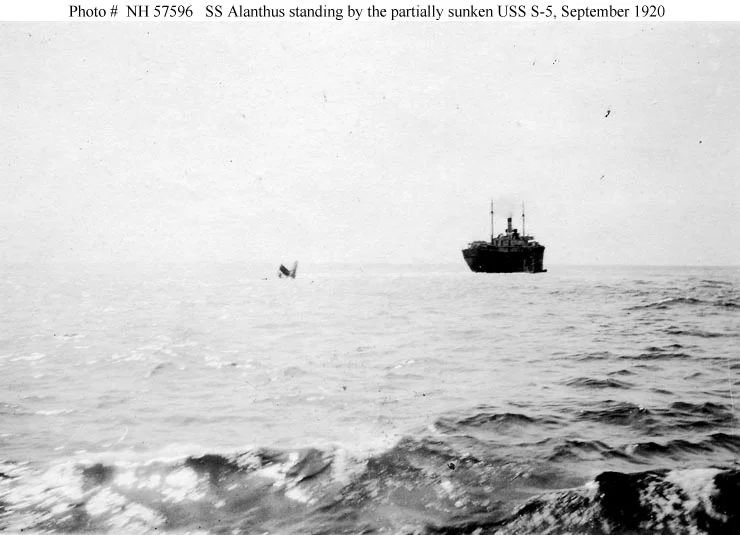
On September 1, 1920, the American submarine S-5 sank accidentally during a practice crash dive about 55 nautical miles east of Cape Henlopen, Delaware. The crew of forty surviving inside the flooded submarine performed one of the more remarkable feats of escape engineering in naval history: they partially refloated the boat by blowing tanks, lifting her stern at a 60-degree angle thirty feet above the surface. Then they drilled a hole in the hull, poked a brass pipe through it, and tied a man's undershirt to the pipe as a white distress flag. They lowered buckets and a funnel through the same hole to take fresh water and food from the surface. On September 2, the steamship Alanthus spotted the protruding stern and distress flag, and the General G. W. Goethals - by then commercially operated - arrived on the scene to assist, about 45 nautical miles east of the Delaware Capes. Captain E.O. Swensen of the Goethals changed course immediately. The Goethals's senior officers, including the Chief Engineer and both ship's doctors, transferred to Alanthus to manage the rescue of the trapped submariners.
Munorleans and the Stowaways
After the war, the ship passed through a peculiar sequence of owners. The Panama Canal Railway bought her from the US Shipping Board in 1920. In 1925 she was acquired by Marcus Garvey's Black Star Line - the Black-owned shipping company that Garvey founded as part of his pan-African business movement. The Black Star Line was already collapsing financially by then, and the ship was sold again at auction. The Munson Steamship Line picked her up cheaply in 1926 and renamed her Munorleans. She ran routes to Puerto Rico, Cuba, and the Bahamas. On November 27, 1926, US Customs officers inspecting her arrival in New York discovered fourteen Spanish and Portuguese stowaways hiding under a wooden structure in one of her coal bunkers. The stowaways were sent to Ellis Island. Three Munorleans crew members were arrested on suspicion of having helped them aboard. By 1929 she was running between New York and Brazil. In 1937 she was finally scrapped at Ardrossan, Scotland - twenty-six years after her launch and across at least four flags.
A Ship That Was Many Ships
The General G. W. Goethals was many ships in one - a German cargo liner, an American troop transport, a Black Star Line vessel, a Munson Line tramp, and finally Scottish scrap. Her career traced the arc of early twentieth-century maritime history: imperial German trade in 1911, world war and seizure in 1917, postwar disposal, the speculative ventures of the 1920s including Garvey's pan-African shipping experiment, the immigration restrictions of the same era that made her stowaway incident newsworthy, and the Depression-era scrap markets that ended her life. She is buried metaphorically off New Jersey by the coincidence of her geographic position when she helped rescue the S-5 crew. The wreck of the S-5 itself lies in those waters. The Goethals does not - she went to the breakers - but the rescue remains one of the more remarkable maritime stories of the New Jersey coast.
From the Air
The S-5 rescue site, where the General G. W. Goethals intercepted the distress call, lies at approximately 38.6 degrees north, 74.0 degrees west, about 45 nautical miles east of the Delaware Capes. From cruising altitude, the position is open Atlantic continental shelf water - no land features are visible from directly overhead. The Cape May County Airport (KWWD) lies about 50 nautical miles west; Atlantic City International (KACY) is about 60 nautical miles northwest. Cape Henlopen on the Delaware coast lies about 55 nautical miles west. The S-5 wreck remains in these waters today.
Nearby Stories
- USS Jacob Jones (DD-130) 3.6 km away
- Hereford Inlet Lighthouse 29 km away
- Atlantic Shores Offshore Wind South 33 km away
- SS Marine Electric 53 km away
- Assateague State Park 100 km away
- Wardenclyffe Tower 239 km away
- New Haven: The Yale Town Where Pizza Became Apizza 307 km away
- USS Atik 415 km away