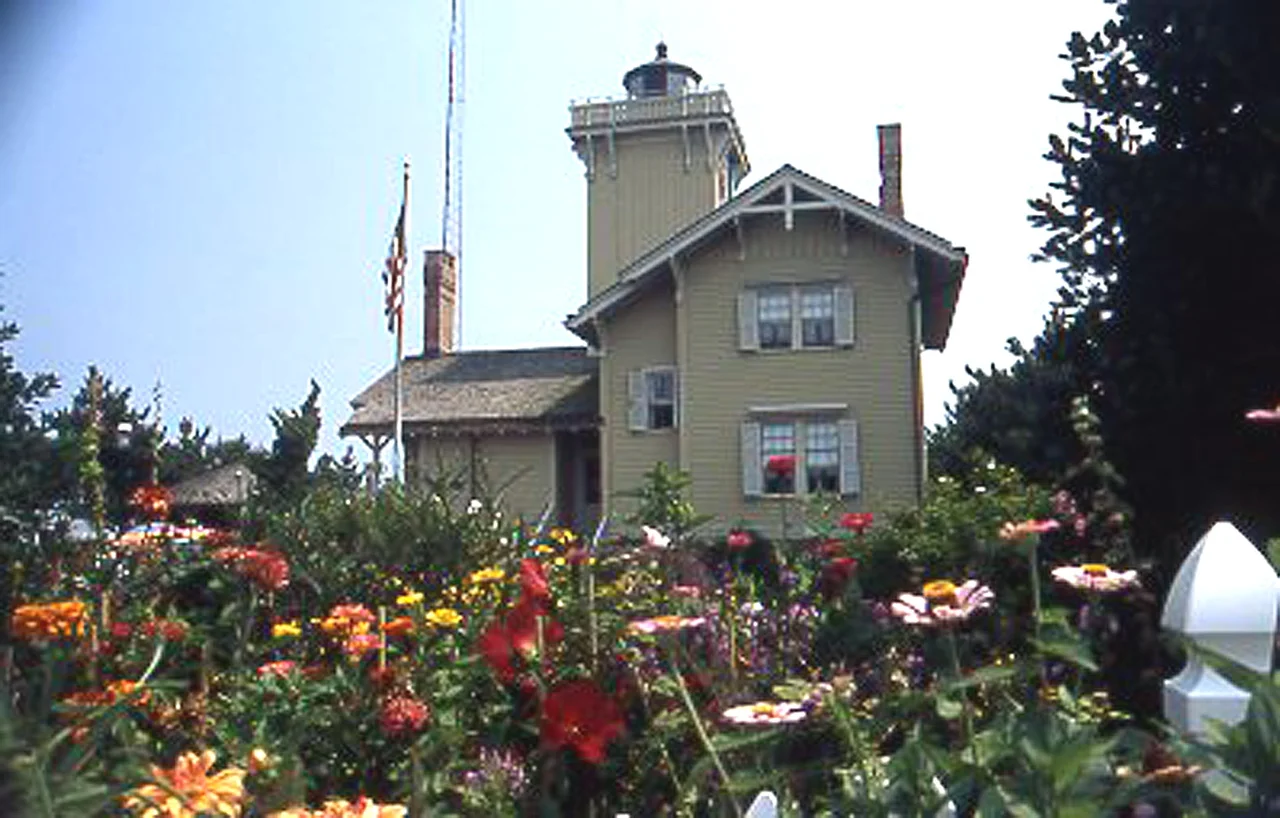

Hereford Inlet Lighthouse
The first keeper of the Hereford Inlet Lighthouse died less than three months into the job. John Marche took up his post when the tower lit for the first time in 1874, and not long after, he made the routine crossing to the mainland by rowboat. The boat overturned. He drowned. His successor, a Civil War veteran named Freeling Hewitt who went by "Captain," took over and stayed for the next forty-five years. That tension - between the lighthouse keeper's quiet domestic routine and the violent water just yards from the porch - has defined Hereford Inlet from the first whale-hunters who used these waters in the 1600s to the modern tourists who climb the tower today.
A Lighthouse That Looks Like a House
Most American lighthouses are sturdy brick or stone cylinders. Hereford is something rarer. Its fifty-foot tower rises out of a Stick-style Victorian frame house, all gables and decorative bracing and a wraparound porch - the same architectural language the painted Cape May cottages were speaking thirty miles south. Inside, the keeper's quarters look like a comfortable seaside home: parlor, kitchen, bedrooms upstairs, a stairway that turns and climbs into the lantern room. The whole structure was painted, for most of its working life, white with red trim and blue shutters - patriotic and tourist-friendly. In 2003 a restoration team scraped back to the original paint and returned the lighthouse to its historically accurate buff color. The beacon still works. It sweeps the Atlantic up to eighteen nautical miles out.
The Storm That Moved a Lighthouse
Hereford Inlet has always been an unstable place. Currents shift the sand; storms remake the shoreline. In August 1913 a hurricane drove water into the lighthouse foundation and threatened to take the whole structure with it. The Coast Guard's predecessor agency closed the light, brought in engineers, and physically moved the building 150 feet inland. It reopened in 1914 on dry ground. The original location is now underwater or beneath the modern beach. The relocation was not unique among American lighthouses - Cape Hatteras would later make the same journey - but in 1913 it was a notable feat of engineering. The lighthouse keeper at the time supervised the move, packed his family and his furniture, and started over.
Heinzman and the Garden Hose
In 1938 the keeper was Ferdinand Heinzman, and on the day in question he was painting the upper trim. A passing coastguardsman saw smoke coming out of an upstairs window and called the fire department. Heinzman tried to fight the flames from inside but was pushed back by the heat. He went outside, found a ladder, attached a garden hose, climbed to the second story, and fought the fire through the window. The lighthouse survived. The official investigation concluded that the painting had caused spontaneous combustion - a paint rag or solvent ignited by its own chemical heat. The lighthouse keepers across this stretch of coast were the kind of people who fought house fires with garden hoses. The job required it.
Decommissioned, Then Saved
In 1964 the Coast Guard decided automation was simpler than maintaining a keeper. They built a small skeletal tower nearby, transferred the light to it, and boarded up the lighthouse. For eighteen years the building sat dark. Salt and weather worked on the wood. The New Jersey State Police took the adjoining Life-Saving Station for its Marine Services Unit. In 1982 a group of North Wildwood residents petitioned to take over the lighthouse itself. They got it. In 1986 the Coast Guard moved the working light back inside the original tower, where it had belonged. North Wildwood's parks superintendent, Steve Murray, took charge of the grounds and planted a garden that has become one of the lighthouse's signature attractions. A new VRB-25 beacon was installed in 2018. The lighthouse is once again working - both as a museum and as an active aid to navigation maintained by the Coast Guard.
Anglesea and the Refuge
The lighthouse stands in what is now North Wildwood, but in the nineteenth century the local fishing village was called Anglesea. When storms struck, residents of Anglesea fled to the lighthouse for shelter - the only substantial building nearby with elevated rooms and stout walls. Captain Hewitt and his successors took them in for days at a time. The lighthouse functioned simultaneously as a navigation aid and as a community storm shelter, an arrangement no modern building code would endorse and that nonetheless worked. The Anglesea name survives mostly in the lighthouse's history and in a few local landmarks. The village became the present-day Wildwoods - one of the most heavily developed barrier-island strips on the Atlantic - and the lighthouse remains the oldest building of consequence along the entire stretch.
From the Air
The Hereford Inlet Lighthouse stands at 39.01 degrees north, 74.79 degrees west, at the northern end of Five Mile Beach in North Wildwood, New Jersey. From cruising altitude, look for the inlet itself - the gap between the developed barrier islands of the Wildwoods and Stone Harbor to the north. Cape May County Airport (KWWD) lies four nautical miles south. Atlantic City International (KACY) is about thirty nautical miles northeast. The lighthouse's fifty-foot tower and its gabled keeper's house are visible from low altitudes; from cruise, look for the distinctive shape of the inlet and the dense gridded streets of the Wildwoods just south of it.
Nearby Stories
- Woodbine, New Jersey 9.4 km away
- Absalom Jones 15 km away
- USS Jacob Jones (DD-130) 16 km away
- USS General G. W. Goethals 18 km away
- Bombay Hook National Wildlife Refuge 22 km away
- Atlantic Shores Offshore Wind South 24 km away
- Arthur W. Perdue Stadium 42 km away
- The Burning of the Morro Castle: Murder, Fire, and a Ship That Beached Itself at a Resort 115 km away