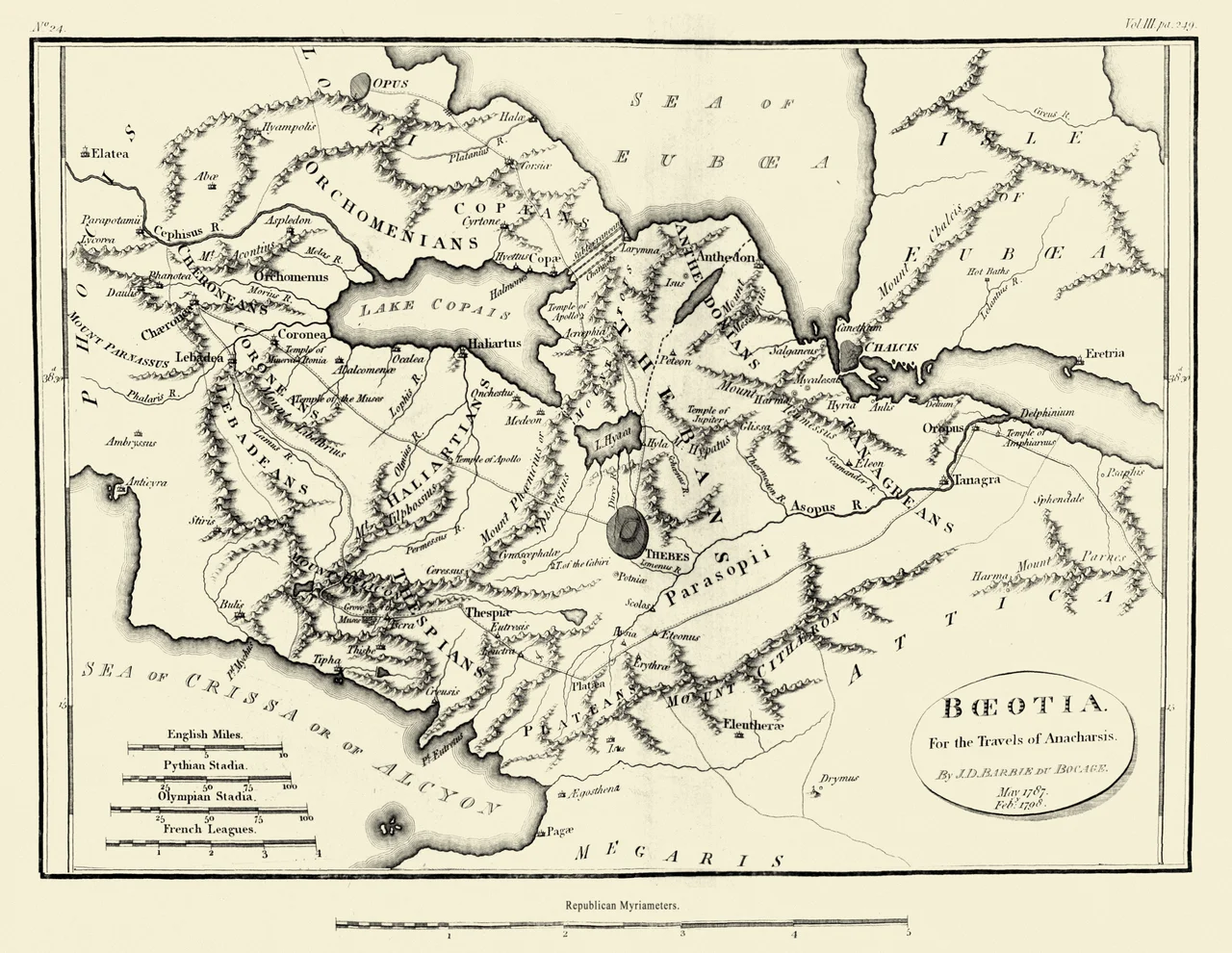

Aulis (ancient Greece)
It is a quiet stretch of shore now, all rock and scrub above the Euripus Strait, a few miles from Chalkida. But in the oldest stories the Greeks told about themselves, this was where a thousand ships dropped anchor and could not leave. According to Homer's Iliad, the fleet bound for Troy mustered at Aulis, sails ready, war ahead. Then the wind died. In the myth, the goddess Artemis had stilled the air to punish Agamemnon, the expedition's leader, who had killed a deer in her sacred grove and boasted that he hunted better than she. Day after day the sea lay flat and the ships sat useless, until the seers told Agamemnon the only price that would buy a wind: the life of his eldest daughter, Iphigenia.
Rocky Aulis
Homer calls the place "rocky Aulis," and the geographer Strabo, writing centuries later, dismissed it as a "stone village" whose harbor could hold no more than fifty ships. That practical detail says a great deal. If the legendary armada of a thousand vessels truly assembled here, it must have spilled into the larger anchorages nearby, with Aulis serving as the symbolic gathering point rather than a great port in its own right. The town never grew into an independent city. It belonged at various times to powerful Thebes and to neighboring Tanagra, a small harbor remembered less for what it built than for what was said to have begun here. Today the site lies at modern Mikro Vathy, near a chapel of Agios Nikolaos, the wind off the strait still doing as it pleases.
The Price of a Wind
The sacrifice of Iphigenia is myth, not history, and it should be held as the tragedy the Greeks themselves understood it to be. They returned to it again and again, never to celebrate it but to wrestle with its horror. In the version dramatized by Euripides, Iphigenia is lured to Aulis under the pretense of a marriage and discovers too late that she is the bride of a knife. Her father is trapped between his army's demand and his love for his child. Some tellings spare her at the last moment, when Artemis snatches her away and leaves a deer in her place; others let the blade fall. Either way, the story refuses comfort. It asks what a leader owes his people, what a parent owes a child, and whether any cause can be worth a daughter's life. The wind, when it finally rose, carried that question to Troy.
Where Legend Touches Ground
What makes Aulis haunting is its ordinariness. There is no soaring temple here to match the weight of the legend, only a modest archaeological site, a small bay, and the constant motion of the Euripus just offshore. That is fitting. The Trojan War may rest on a kernel of real conflict in the Late Bronze Age, but Aulis belongs above all to the Greek imagination, the place where the heroic age set sail and where its first casualty, in the telling, was a girl who had done nothing wrong. Standing on this rocky height, you are not looking at proof of anything. You are looking at the shore where a civilization chose to locate one of its hardest questions about war, sacrifice, and the cost of glory.
From the Air
Aulis lies at roughly 38.43 degrees north, 23.59 degrees east, on the Boeotian (mainland) side of the Euripus Strait, about 5 km south of Chalkida at modern Mikro Vathy. From the air, find the narrow strait and its bridges at Chalkida, then trace the mainland coast a short way south to the small rocky headland and bay. Nearest major airport is Athens International (LGAV) about 45 km to the south; Nea Anchialos (LGBL) lies to the northwest. The site is low and modest, best picked out in clear morning light against the blue of the strait.
Nearby Stories
- Hellenic Police 2.9 km away
- Tower of Aliartos 8.5 km away
- Great Sand Beach 13 km away
- John the Russian 22 km away
- Saint George Monastery, Aidipsos 23 km away
- Sousaki Volcano 25 km away
- Skyros 32 km away
- Carystus 46 km away