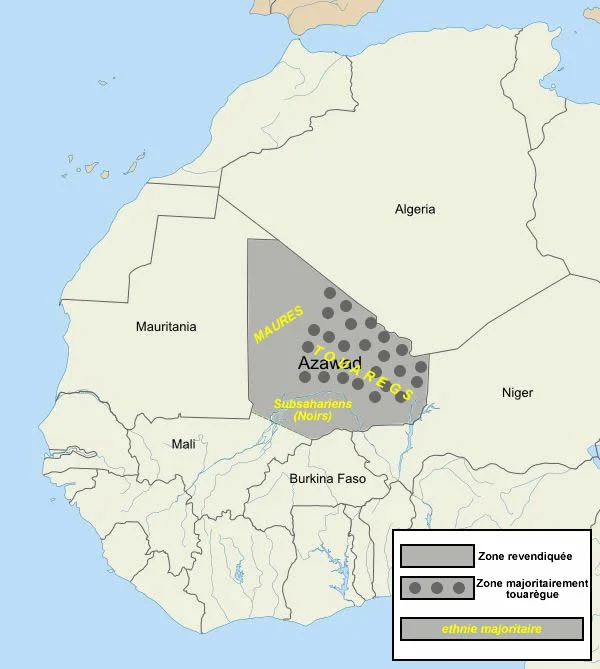

Azawad
In the Tuareg tongue the word is Azawaɣ, the land of transhumance, a name for the seasonal wandering between pastures that has defined desert life for centuries. For ten months in 2012 it meant something far larger and far more fragile: an independent country, declared across the northern half of Mali, that no other nation on Earth would recognize. Azawad existed on paper, in proclamations and a provisional council, and on the ground only briefly. By early 2013 it had been swept aside. Its story is the story of an old aspiration colliding with a region spinning out of control.
The Tuareg Aspiration
The Tuareg are a Berber people of the central Sahara, herders and traders whose homeland was sliced apart by colonial borders that paid no heed to where they actually lived. When French Sudan became independent Mali in 1960, many Tuareg found themselves a minority within a state run from distant Bamako, and they rose against that rule again and again - in 1962, in the 1990s, in the late 2000s. The grievance was persistent: a sense that the desert north, with its distinct people and culture, was governed as an afterthought. Azawad, as the rebels imagined it, would gather the regions of Timbuktu, Kidal and Gao together with part of Mopti - roughly sixty percent of Mali's land - into a homeland of their own.
A State Declared
The opportunity came from outside the desert. The 2011 collapse of Muammar Gaddafi's Libya sent weapons and battle-hardened Tuareg fighters streaming home into a destabilized Sahel. On 17 January 2012 the National Movement for the Liberation of Azawad, the MNLA, launched its rebellion. Within weeks the Malian army was reeling. Gao and Kidal fell in March, Timbuktu on 1 April, and on 6 April Bilal Ag Acherif signed a declaration of independence, naming Gao as the temporary capital and pledging a constitution and a democracy that honored the United Nations charter. But the world said no. The Economic Community of West African States called the declaration null and void. Not a single foreign government recognized the new state.
Hijacked and Erased
What undid Azawad was as much internal as external. The MNLA had not taken the north alone; it had advanced alongside Islamist groups, chief among them Ansar Dine, whose vision of a strict religious state was sharply at odds with the secular nation the Tuareg separatists said they wanted. The two briefly tried to merge, then fractured, and over the summer of 2012 the better-armed jihadists drove the MNLA from the cities it had helped capture. The secular dream curdled into something else entirely. By 14 February 2013 the MNLA had renounced its claim to independence and asked Bamako to negotiate. Azawad, the country, was gone - a place where a long-held aspiration briefly took the shape of a flag, then dissolved back into a contested desert whose troubles were only beginning.
From the Air
Azawad, as claimed in 2012, covered roughly the northern 60 percent of Mali; the symbolic center near Gao sits around 16.27 N, 0.05 W on the Niger Bend. The terrain is mostly Saharan and Sahelian flatland, with Gao and Timbuktu the principal cities. Nearest major airport is Gao (GAGO); Mopti (GAMB) lies to the southwest. This is an active conflict region with severe security restrictions and limited civil aviation.
Nearby Stories
- Askia Daoud 15 km away
- Agacher Strip War 124 km away
- Mount Hombori 132 km away
- Hombori 152 km away
- Liptako 197 km away
- Pendjari National Park 564 km away
- Oti-Keran National Park 675 km away
- Tin Hinan Tomb 850 km away