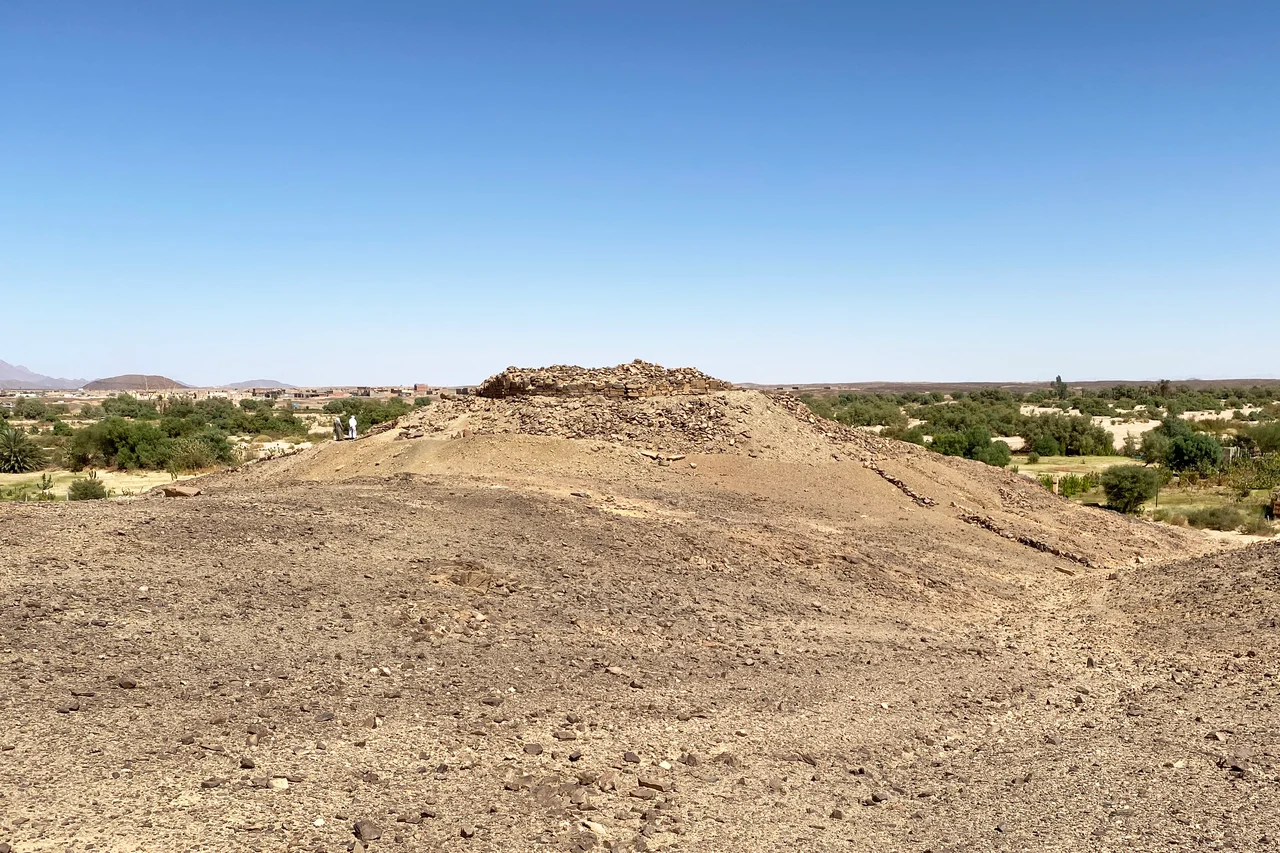

Tin Hinan Tomb
For generations the Tuareg told of an ancestral queen named Tin Hinan, the "Mother of us all," and for generations outsiders assumed she was only a legend. Then, in 1925, explorers cut into a monumental tomb on a hill in the deep Sahara and found her: the skeleton of a tall woman lying on a wooden litter, her head turned to the east, her arms heavy with gold and silver. Tin Hinan was real. Her tomb rises near the oasis of Abalessa, in the volcanic Hoggar Mountains of southern Algeria roughly a thousand miles south of Algiers, a stone monument standing alone in one of the emptiest landscapes on Earth, holding the memory of a woman the Tuareg still call the mother of their nation.
Woman of the Tents
Her name carries its meaning lightly. Tin Hinan means "woman of the tents," and the Tuareg also know her as Tamenokalt, which means "queen." To them she is the ancestral matriarch, the founding mother from whom the Tuareg of the Hoggar trace their descent. The tomb that holds her is itself a statement: a large, multi-chambered stone structure set on a rounded hill above the meeting of two desert watercourses, built in an architectural style that was widespread across the Berber Sahara in classical times. It was not a grave dug in haste. It was a monument raised for someone who mattered, in a place chosen to endure, and endure it has, through sixteen centuries of sun and sand.
What the Tomb Held
When Byron Khun de Prorok opened the tomb in 1925, with a more careful excavation following in 1933, the find was extraordinary. The woman wore seven silver bracelets on her right forearm and seven gold bracelets on her left, with another silver bracelet and a gold ring placed beside her. The remains of an intricate necklace of gold and pearls, some real and some artificial, lay with the body. Among the grave goods was a small gold foil bearing the imprint of a Roman coin of the emperor Constantine, struck in the early fourth century, the detail that let archaeologists date the burial. A fourth-century date matched the radiocarbon dating of the wooden bed and the style of the pottery. This was a woman buried with wealth and ceremony, honored in death as she had evidently been in life.
Reading the Bones
In the 1960s the anthropologist E. Leblanc studied the skeleton and described a tall, lithe woman with broad shoulders, slender legs, and a narrow build. The French explorer Henri Lhote noticed something curious about the tomb's construction, arguing that its style resembled the fortifications Roman legionaries built in desert regions, and suggested it may have been raised over an older Roman outpost. Whether or not he was right, the question hints at how layered this corner of the Sahara is: a place where Berber, Roman, and Saharan worlds brushed against one another along the ancient routes that crossed the desert. Tin Hinan belonged to that crossroads world, and her tomb is one of its most striking surviving traces.
A Queen Still Honored
Tin Hinan never stopped mattering to the people who claim her. The remains and treasures were carried north to Algiers, where the body now rests in the Bardo National Museum, and the discovery transformed a figure of oral tradition into a documented historical queen. For the Tuareg she remains a living symbol, an emblem of a heritage in which women have long held unusual standing and respect. To find her tomb out in the Hoggar, far from any road and ringed by black volcanic peaks, is to understand why she endured in memory long before a spade ever confirmed her. Some figures are too important to forget, and the desert kept her until the world was ready to listen.
From the Air
The Tin Hinan Tomb stands near Abalessa at roughly 22.88°N, 4.87°E, in the Hoggar (Ahaggar) Mountains of the deep southern Algerian Sahara, about 80 km west of the city of Tamanrasset. From the air the monument is a small stone structure on a rounded hill above the junction of two wadis, set within a dramatic landscape of dark volcanic peaks and pale desert flats. The nearest major airfield is Aguenar – Hadj Bey Akhamok Airport at Tamanrasset (ICAO: DAAT) to the east. The high desert offers exceptional visibility for most of the year, with crystalline skies broken mainly by seasonal dust and haze; the rugged Hoggar massif rising from the surrounding plain is one of the most distinctive natural landmarks in the entire Sahara.
Nearby Stories
- Hoggar Mountains 28 km away
- Air Algérie Flight 6289 30 km away
- Béryl Incident 100 km away
- Gerboise Blanche 547 km away
- Gerboise Bleue (nuclear test) 572 km away
- Askia Daoud 816 km away
- Tomb of Askia 870 km away
- 2015 Zaria Massacre 1316 km away