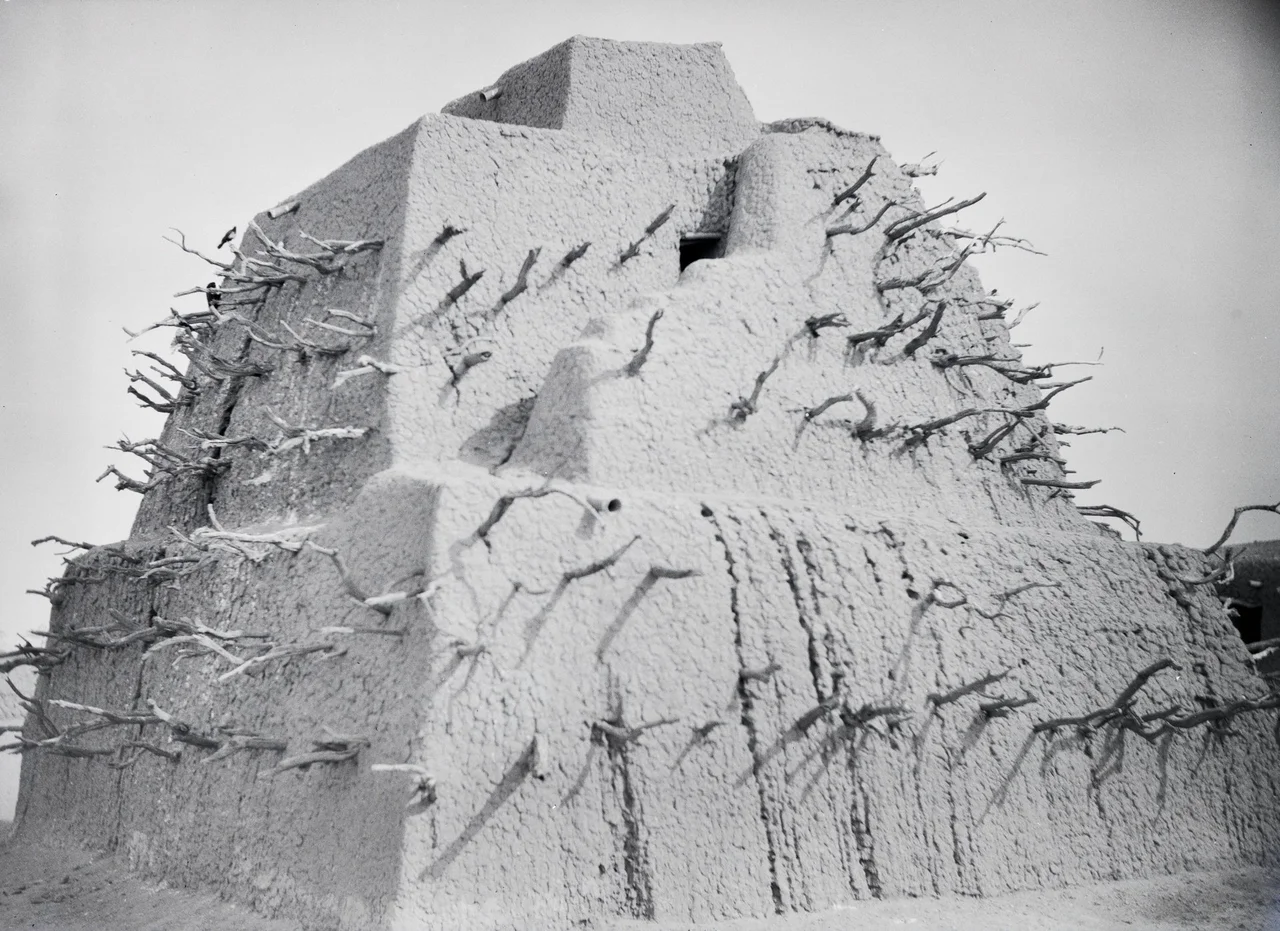

Tomb of Askia
From a distance it looks like nothing you have seen before: a steep brown pyramid, seventeen metres tall, its sloping flanks pierced all over with the protruding ends of wooden beams, like a porcupine of timber and earth. This is the Tomb of Askia, the resting place of one of medieval Africa's greatest rulers, and the largest pre-colonial monument still standing in Gao. It is not stone. Every surface is mud, shaped by hand and renewed by hand for more than five centuries.
An Emperor's Last Monument
Askia Muhammad I built it at the end of the fifteenth century, around 1495, when Gao was the capital of the Songhai Empire and he was its most powerful ruler. A devout Muslim, he had made the long pilgrimage to Mecca, returning around 1497 and afterward making Islam the official faith of his empire. The tomb was raised to mark that piety and that power. Tradition holds that the structure was built like a house, with rooms and passageways inside, and that it was sealed when the emperor died. Several of his successors lie buried in the surrounding courtyard, but Askia Muhammad alone rests within the pyramid itself.
Architecture of Earth
The tomb is the supreme example of the Sudano-Sahelian building tradition, a style of monumental mud architecture native to the West African Sahel and found nowhere else on Earth in quite this form. Those wooden beams jutting from the walls, called toron, are not decoration alone. They are permanent scaffolding. Mud buildings must be replastered again and again, season after season, or the rains and the dry heat will wear them away. The toron let masons climb the structure to renew its skin. A building like this is never truly finished. It survives only because each generation rebuilds it, which makes the tomb less a frozen artifact than a living act of devotion passed from hand to hand across the centuries.
Still in Use
What sets the Tomb of Askia apart from a ruin is that it was never abandoned. The complex includes the pyramidal tomb, two flat-roofed mosques, a cemetery, and an open-air assembly ground, and the people of Gao still gather here to pray. The mosque buildings were expanded in the 1960s and 1970s, a protective wall was added in 1999, and electricity arrived in the early 2000s, bringing ceiling fans, lights, and a loudspeaker mounted at the top. To stand in its courtyard is to stand inside a working place of worship that has held its purpose since the age of Columbus.
World Heritage at Risk
UNESCO inscribed the Tomb of Askia on its World Heritage List in 2004, calling it a fine example of the monumental mud-building traditions of the Sahel and a testament to the wealth Songhai drew from the trans-Saharan trade in salt and gold. But heritage status cannot make a region safe. When conflict swept northern Mali and Gao fell to armed groups in 2012, the country's ancient earthen monuments came under threat, and the tomb's place on the list of World Heritage in Danger reflects how fragile such treasures become when the people who maintain them are caught in war. The tomb still stands, still cared for, a brown pyramid against the desert sky, asking to be protected as carefully as it has been rebuilt.
From the Air
The Tomb of Askia stands in Gao, Mali, at roughly 16.29 N, 0.044 W, near the eastern bank of the Niger River. From the air its steep pyramidal form is a recognizable landmark against the low surrounding city; best viewed at lower altitudes in clear, dry conditions. Nearest airport is Gao International (GAGO), a short distance to the city. The Niger River and La Dune Rose, the pink dune on the opposite bank, help orient navigation.
Nearby Stories
- Askia Daoud 15 km away
- Agacher Strip War 124 km away
- Mount Hombori 132 km away
- Hombori 152 km away
- Liptako 197 km away
- Pendjari National Park 564 km away
- Oti-Keran National Park 675 km away
- Tin Hinan Tomb 850 km away