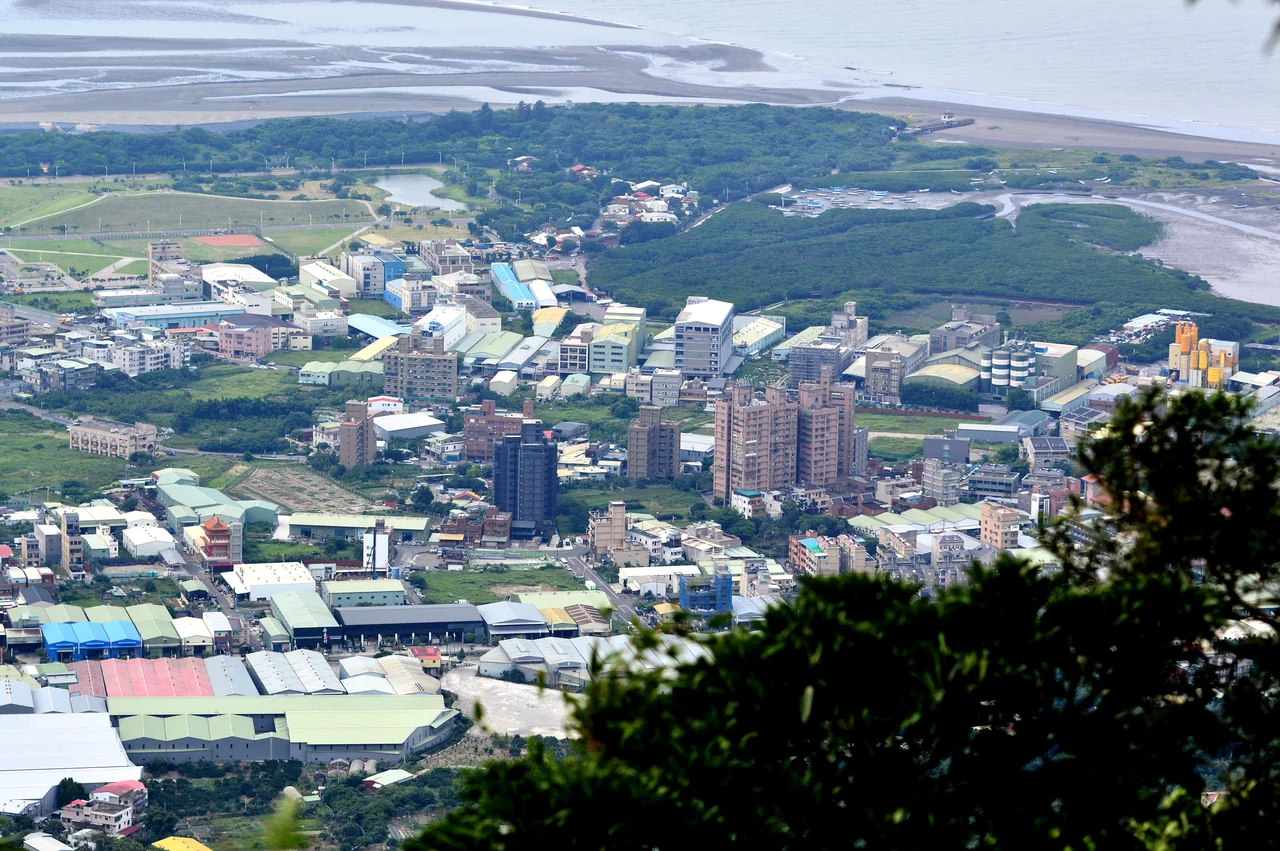

Bali District
In 1955, an ROC Air Force pilot noticed his compass behaving strangely over a stretch of the Tamsui River's west bank. He reported the anomaly. Investigators discovered why: the ground beneath what is now Bali District was dense with iron ore deposits—and, as it turned out, the iron slag and smelting furnaces of a people who had been working metal on this riverbank somewhere between 200 and 1500 CE. The Shihsanhang site, now protected under a prize-winning archaeology museum, is one of Taiwan's most significant prehistoric finds: pottery, glass beads traded from Southeast Asia, bronze bowls, gold ornaments, and the skeletal remains of nearly 200 individuals buried in a distinctive fetal position. A compass malfunction solved a two-thousand-year-old mystery. That combination of the accidental and the remarkable is very much in keeping with Bali—a district that rewards the visitor who crosses the river.
The Compass That Found the Past
The Shihsanhang Museum of Archaeology opened in 2003 and has offered free admission since 2010. Its collection traces the lives of a community now believed to be ancestral to the Ketagalan Pingpu Aboriginal people—ironworkers, traders, and farmers who occupied this river bend for over a millennium. The glass beads in the display cases came from Southeast Asia, evidence of a trading network that reached well beyond Taiwan long before European ships arrived. The building itself is worth the ferry trip: it won the 2002 Taiwan Architecture Prize and the 2003 Far Eastern Architect Award, its angular concrete forms set against the riverbank in a way that manages to feel both monumental and site-specific. The museum sits a short bicycle ride from the Bali Left Bank Park, and most visitors combine both in a single afternoon.
The Robin Hood of Bali
Liao Tian-ding was born in 1883 and died in 1909 in a cave in what is now Bali District. In the years between, he became the most wanted man under Japanese colonial rule—a thief who targeted colonial institutions and wealthy collaborators, and who evaded authorities with a skill that passed into legend. His story inspired a Cloud Gate Dance Theater production and a suite by the Prague Symphony Orchestra. The temple dedicated to him in Bali, completed in 1975, draws visitors who come to petition a folk hero whose appeal rests on what he represented rather than what he actually did. Whether the historical record supports the 'Robin Hood' framing is a question local historians debate; what is undeniable is that Liao became a symbol of resistance for a community under occupation, and that symbols have their own kind of staying power. The Liaotianding Temple sits among the district's quieter streets, its incense rising into the same subtropical air where its subject once hid.
The River View and What It Shows
The six-minute ferry from Tamsui to Bali's Left Bank makes one of the simplest great visual transitions in the Taipei area. Looking back east from the Bali pier, the Tamsui riverside promenade is visible—the old shops, the crowd, the red-and-white Fort Santo Domingo rising on its bluff above the town. Further north, the white cables of Lover's Bridge (a 196-meter cable-stayed footbridge) curve above the river mouth. Turn west and the view is entirely different: the Wazihwei mangrove wetland, the flat cycling path stretching south along the riverbank, and behind everything the 616-meter cone of Guanyin Mountain—an inactive volcano whose silhouette, Taiwanese tradition holds, resembles the goddess of mercy lying on her side. The Bali Left Bank Park path runs along the water for several kilometers, paved and suitable for the rental bikes available near the ferry pier. On weekdays, the path is quiet. On weekends, it fills with families, and the cafes and food stands near the pier open their shutters.
Crossing from Tamsui
Bali is most naturally approached as a half-day extension of a Tamsui visit. The ferry runs every ten to fifteen minutes from Tamsui's main pier, takes about six minutes, and costs very little. Cyclists can bring their bikes aboard. From the Bali pier, almost every attraction in the district is within a comfortable cycling distance—the archaeology museum, the Left Bank Park path, the Wazihwei nature conservation area with its boardwalk through the mangroves, and the smaller Bali Ferry Pier food stands where vendors sell oyster vermicelli and other Taiwanese snacks. Many of the stands close on weekdays when the visitor flow drops, so weekends are the livelier option. For those arriving directly from mainland China, a fast ferry service from Pingtan (approximately three hours) connects to Bali District directly—an unusual and direct link between the island and the mainland across the Taiwan Strait.
From the Air
Bali District sits at 25.15°N, 121.40°E on the west bank of the Tamsui River where it meets the Taiwan Strait, approximately 16 km northwest of central Taipei. From altitude, the river mouth is clearly visible: the narrow channel between Tamsui on the east bank and Bali on the west, the Lover's Bridge cable span just north of the ferry crossing, and Guanyin Mountain's volcanic cone rising to the west-southwest. Taipei Songshan Airport (TSA / RCSS) is approximately 15 km to the east-southeast. Taiwan Taoyuan International Airport (TPE / RCTP) is approximately 20 km to the southwest.
Nearby Stories
- Sanxia Car Attack 9.6 km away
- Dapu Incident 28 km away
- 2022 Chinese Military Exercises Around Taiwan 45 km away
- North Jiangsu Main Irrigation Canal 960 km away
- General Cliff Rock Paintings 1031 km away
- Sinking of MV Sewol 1042 km away
- Yellow Sea 1091 km away
- Twin Forts of Romblon 1377 km away