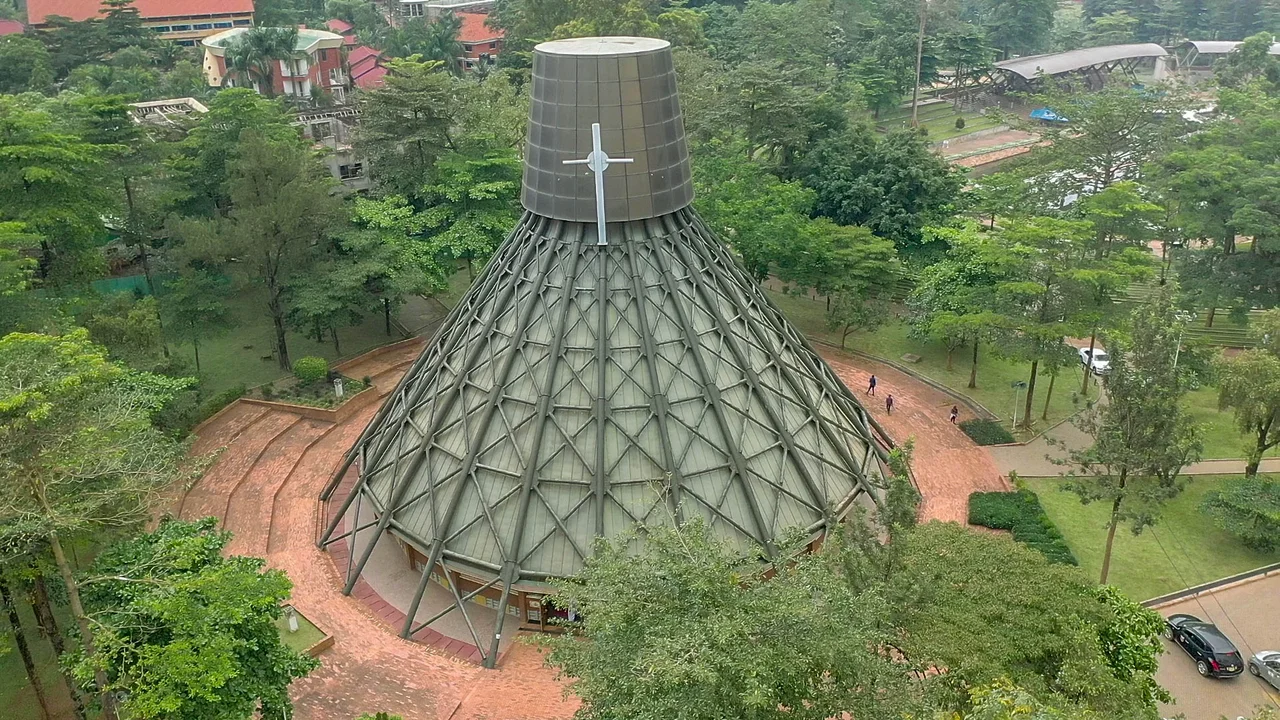

Basilica of the Uganda Martyrs, Namugongo
Among the young men killed here on June 3, 1886, was a boy of thirteen or fourteen named Kizito. He was the youngest of the converts that Kabaka Mwanga II ordered burned at Namugongo, and his age is part of why this place draws more than a million pilgrims each year. The Basilica of the Uganda Martyrs rises on the ground where they died, its roof built to echo the shape of a traditional Buganda hut, supported by columns meant to recall the spears and stakes of their executioners. It is a church about ordinary people, mostly young, who chose death over the abandonment of a new faith, and whose names Uganda has refused to forget.
The People Who Died Here
They were not abstractions. Most were pages and servants in the royal court of Buganda, young men and boys who had recently converted to Christianity, both Catholic and Anglican. When Kabaka Mwanga II turned against the new faith, he demanded they renounce it, and they would not. Between 1885 and 1887 some forty-five were killed across the kingdom; the largest single execution came on June 3, 1886, at Namugongo. Charles Lwanga, who had taken charge of the court pages, was among them, and so was young Kizito. Lwanga was burned slowly and apart from the others. The accounts that survive describe young people who comforted one another, who prayed as the fires were lit, and who faced their deaths with a composure that unsettled even those carrying out the king's orders.
Why It Happened
The killings grew out of a collision of power and loyalty. Mwanga II was a young king watching foreign influence, Christian missionaries, Muslim traders, and rival European empires, press into his kingdom from every side. The converts at his court answered to a God and a conscience he did not control, and he read that as defiance of the throne. The breaking point came when the pages refused his demands. What followed was not a single act of rage but a sustained persecution, ground that historians still study for what it reveals about faith, sovereignty, and the wrenching changes reshaping the African Great Lakes in the 1880s. The victims were caught in forces far larger than themselves, and they paid with their lives.
A Church in the Shape of a Hut
The basilica that honors them is deliberately Ugandan. Ground was broken in 1965, and construction finished in 1968, in the years just after independence, when a new nation was choosing what to enshrine. Rather than import a European silhouette, the architects gave the church a soaring conical roof modeled on a traditional Buganda dwelling, raised on slanting columns. It was elevated to a minor basilica by decree in 1993 and stands close to the very spot where Lwanga and Kizito died. The building does not hide its subject behind grandeur. Its form roots the martyrs in their own culture, a reminder that this was a Ugandan story before it was a global one, and that the people remembered here belonged to this land.
A Nation's Pilgrimage
Each June 3, Martyrs' Day, the grounds at Namugongo fill with one of the largest religious gatherings in Africa. Pilgrims walk for days from across Uganda and neighboring countries to reach the shrine, and the crowd often numbers well over a million. Pope Paul VI canonized the martyrs on October 18, 1964, and three popes have since come to honor them; Pope Francis celebrated Mass at Namugongo on November 28, 2015. The site has grown into a shared landscape of memory, with Catholic and Anglican shrines side by side, mirroring the two communities the persecution touched. What endures is not the cruelty of a king but the dignity of the people he could not bend, an annual act of remembrance for the young and the faithful who died on this ground.
From the Air
The Basilica of the Uganda Martyrs stands at Namugongo at 0.385 N, 32.651 E, in Kira Municipality, about 17 km northeast of central Kampala. Entebbe International Airport (HUEN) lies roughly 45 km southwest on Lake Victoria, the main gateway for visitors; Kajjansi airfield (HUKS) is closer to the lake. From the air the basilica's distinctive conical, hut-shaped roof and surrounding open assembly grounds stand out against the green, suburbanizing landscape northeast of the capital, with Kampala's hills to the southwest and Lake Victoria beyond. The equatorial setting gives steady year-round daylight; wet-season afternoons bring haze and convective cloud. Note the immense pilgrim crowds and restricted airspace around Martyrs' Day in early June.
Nearby Stories
- Bujagali Hydroelectric Power Station 12 km away
- Entebbe 16 km away
- Nyero Rock Paintings 82 km away
- Ntusi 87 km away
- Bunyoro 118 km away
- Battle of Kabamba 118 km away
- Migingo Island 154 km away
- Budongo Forest 157 km away