
Bath Abbey Cemetery
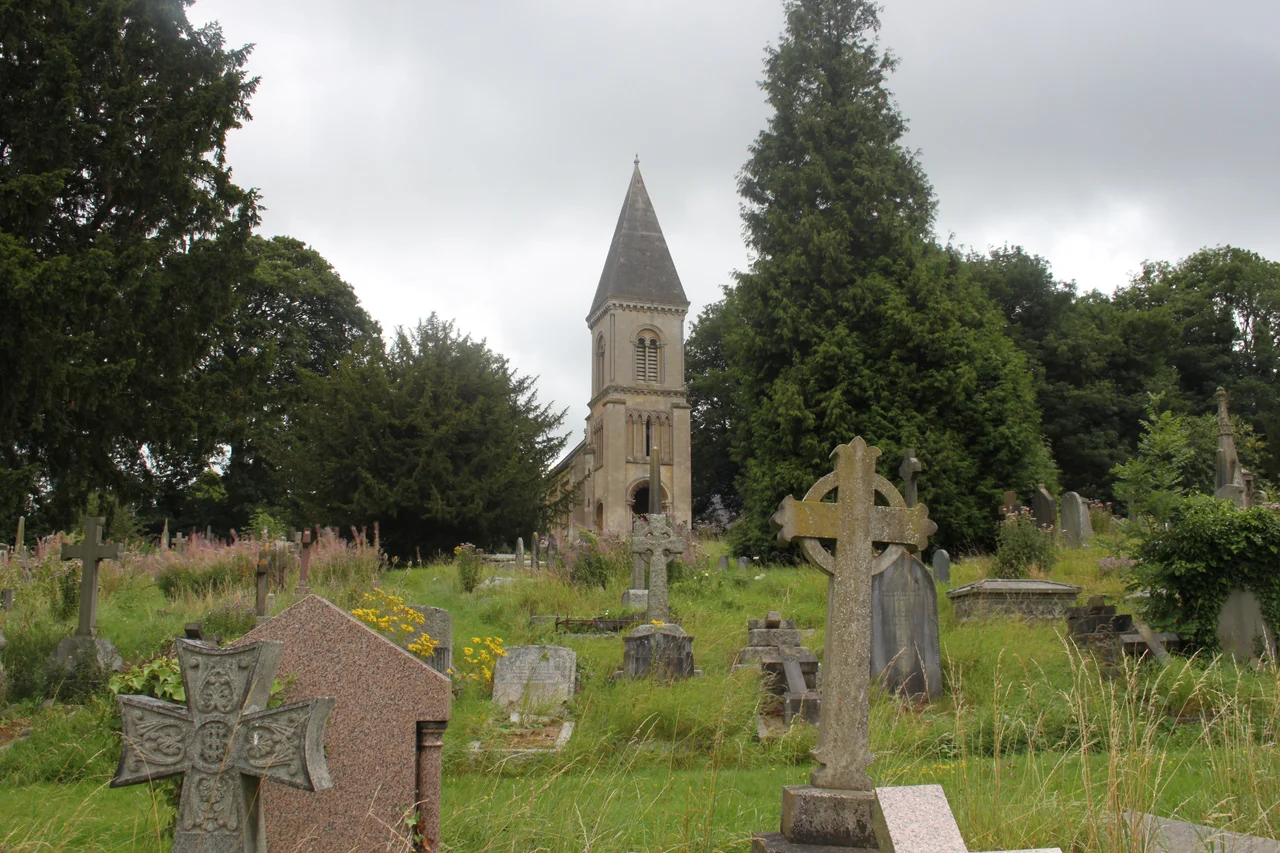
John Claudius Loudon died in December 1843. He had spent the last year of his life writing the book that would change British burial - On the Laying Out, Planting, and Managing of Cemeteries - and designing three cemeteries to demonstrate its principles. Bath Abbey Cemetery, consecrated on 30 January 1844, was the last one he ever laid out. He never saw it finished. The hillside he chose, sweeping up above the city with views back over the river and the abbey itself, is still arranged the way he meant it to be: a central avenue, formal at its head and informal at its edges, gravestones placed so that every visitor would feel they had wandered out of the city into something between a garden and a contemplative grove.
Roman Ground
The dead were here long before the Victorians arrived. When workmen cut the roadway up to the chapel, they turned up three Roman stone coffins and a scatter of coins from the reigns of Constantine the Great and Carausius - the breakaway emperor who briefly ruled Britain in the 290s. In 1952, another Roman coffin emerged from beneath the roots of a tree being cleared from a footpath. The site has been catching burials for at least seventeen centuries. Bath's Roman dead lay in this ground while Aquae Sulis was still a working spa town, and the Victorians who came after, knowingly or not, laid their dead on top of them. The continuity is unintended and quietly remarkable.
The Chapel and Its Crypt
George Phillips Manners, Bath's City Architect, designed the mortuary chapel in the then-fashionable Norman Revival style - heavy, rounded, semi-fortified. It rose on the hillside in 1844, three bays double-height, with a prominent west tower over a three-sided open porte cochere where hearses could pull in out of the weather. A crypt runs beneath, and the original plan called for open cloister wings holding a columbarium for ashes and rows of loculi for coffins. Since the cemetery closed to new burials, the chapel has been shuttered too. Today it stands quiet on the hill, slowly weathering, a Norman Revival monument to a Victorian funerary aesthetic that has not had occupants in a long while.
Monuments of Status
Thirty-seven monuments in the cemetery carry Grade II or II* listings - among the highest concentrations of listed funerary architecture in the country. The pattern is sharply legible: the most elaborate monuments belong to people who had lived at the most exclusive Bath addresses, and a curious convention took hold of who got which style. Clerics were given Gothic Revival monuments, all spires and crocketed canopies. Military men were buried under Greek Revival - clean columns, classical urns, the visual language of Roman republican virtue. The finest of the listed monuments belongs to Jane Williams, who died in 1848 aged 88 at 17 Kensington Place: a miniature white marble Greek temple raised on a Pennant stone pedestal, four fluted columns with lotus and acanthus capitals supporting a canopy over a draped urn, an angel and a mourning female figure attending. Her grandson Henry Williams, aged 17, is commemorated on one face - drowned in a dense London fog after accidentally falling off the West India Docks in 1853.
Beckford and a Soldier from Dad's Army
William Thomas Beckford - the eccentric millionaire novelist who built Fonthill Abbey, then watched its tower collapse, then retired to Bath to build another tower on Lansdown Hill - was originally buried here. He didn't stay. When his beloved Lansdown Tower was threatened with becoming a pleasure ground, his daughter had him exhumed and the site itself was converted into Lansdown Cemetery in his honour, and Beckford was reinterred under his own tower. Arnold Ridley, the actor best known to British television audiences as Private Godfrey in Dad's Army, has his ashes buried in his parents' grave here. Three Commonwealth war graves from the First World War occupy modest plots maintained by the Commonwealth War Graves Commission: a British Army captain, a Canadian soldier, and a Royal Air Force airman. They share their hillside with Roman coffins, Victorian eccentrics, and the man who taught Britain how to plan a cemetery, and they keep company well.
From the Air
Bath Abbey Cemetery sits at 51.3701 N, 2.3481 W on a hillside in the Widcombe and Lyncombe area, about half a mile south-southeast of central Bath. From the air, look for the wooded slope rising above the south bank of the River Avon, with Bath Abbey's distinctive square tower visible to the north and Prior Park's grand Palladian mansion higher up the same valley. Bristol Airport (EGGD) is 14 nm to the west; the smaller airfield at Kemble (EGBP) lies 19 nm to the north-northeast. Best viewed in low afternoon sun, which picks out the Victorian monuments on the slope.
Nearby Stories
- Marlborough Castle 1.4 km away
- Clevedon Pier 4.6 km away
- Stourhead 5.6 km away
- Siege of Bridgwater (1645) 8.4 km away
- Raglan Castle 10 km away
- Berkeley Castle 12 km away
- Mottisfont Abbey 20 km away
- Blenheim Palace 33 km away