
Battle of Blood River
The river had a Zulu name first. The Ncome flowed quietly through the grasslands of what is now KwaZulu-Natal until the morning of 16 December 1838, when more than three thousand Zulu warriors died along its banks and the water ran dark with their blood. The Voortrekkers who watched it happen renamed it Bloedrivier, Blood River, and made the day a holy one. For generations afterward, only one side of this story was told. But two armies met here, and two peoples carried the memory away. The men who fell that morning were not statistics. They were Dingane's soldiers, sons and brothers and fathers, and they charged into musket fire because their king had ordered it.
The Wagons in the Bend
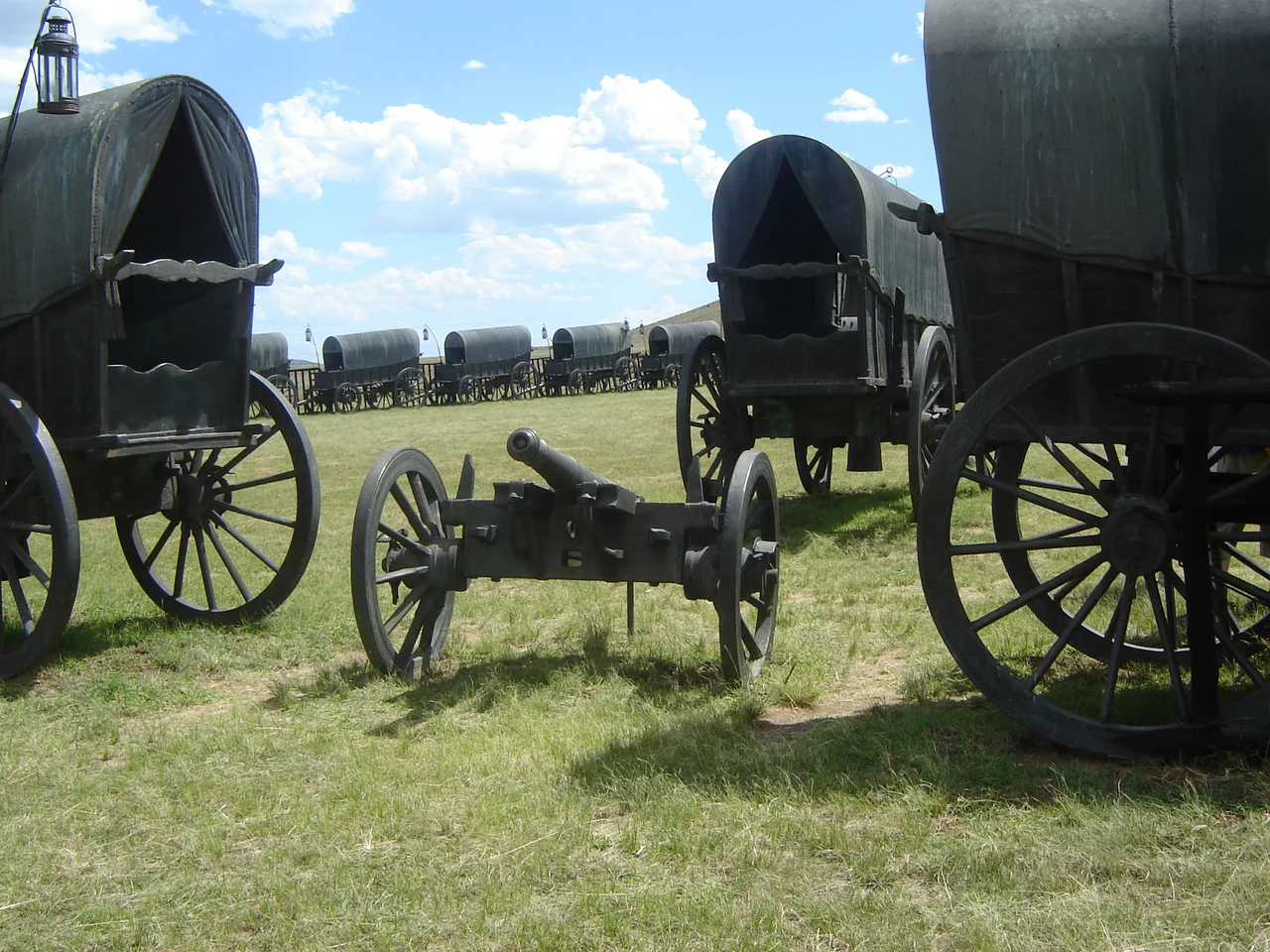
Andries Pretorius chose his ground carefully. Where the Ncome curved, an eight-meter drop fell away into a deep hippo pool, guarding two sides of his position. To the front lay open veld with no cover at all. Into this bend he drew sixty-four ox-wagons, chaining them wheel to wheel into a laager, and wedged movable barriers into the gaps. At two corners he set artillery, including a six-pound naval carronade he had hauled from the Cape and nicknamed Grietjie. His commando numbered roughly 464 men. Across the plain waited an army estimated at twenty-five to thirty thousand. The night before, a thick mist settled over the wagons while the sky above stayed clear. The Boers hung lanterns on their whip-stocks and waited for dawn.
Mown Down Like Grass
When the light came, a Trekker recalled that "all of Zululand sat there." The Zulu charged in waves, and a Zulu eyewitness remembered that the first charge was mown down like grass by the muskets. The short stabbing spear was a fearsome weapon at close range, but the open ground gave the warriors no way to close it without crossing a killing field swept by grapeshot and gunfire. Four times they came on. Four times the volleys broke them, while the lulls between gave the Boers time to reload. After two hours, Pretorius sent horsemen out from the laager to shatter what remained of the formations. The Zulu held for a while, then scattered. Pretorius's war secretary Jan Bantjes counted about three thousand dead. On the Trekker side, three men were wounded. None were killed.
The Generals Who Paid
The man who commanded the Zulu that day was Ndlela kaSompisi, a veteran who had served under Shaka and risen to become Dingane's prime minister. The defeat was not his alone to bear, but bear it he did. Two years later, after the Battle of Maqongqe, Dingane had Ndlela slowly strangled with a cowhide thong, condemned for treason because he had spared and protected the king's rival half-brother, Mpande. Dambusa, Dingane's other general, had already been executed by Mpande and Pretorius. The river that ran red had set in motion a Zulu civil war. When Mpande finally took the throne, the kingdom that had crushed the British forty years later at Isandlwana had already begun to splinter from within.
Two Monuments, One River
For most of the twentieth century, this was Afrikaner sacred ground. The day was called the Day of the Vow, commemorating a covenant the commando had sworn to God before the battle, and Afrikaner nationalists read divine favor into the outcome. A granite ox-wagon was raised here in 1947, and a full bronze laager of sixty-four wagons followed in 1971. But across the Ncome stands a second memorial, opened in 1998, that honors the Zulu dead. In 1994 the holiday was renamed the Day of Reconciliation. At the 1998 inauguration, Zulu leader Mangosuthu Buthelezi apologized to the Afrikaner nation for the killing of Piet Retief, then named the suffering of the Zulu under apartheid, and called the date "a new covenant" binding all South Africans to a shared country. Today both banks remember. They simply remember different dead.
From the Air
The Ncome-Blood River Heritage Site lies at roughly 28.10 degrees south, 30.54 degrees east, in the rolling grasslands of northern KwaZulu-Natal, about 43 km from Dundee and 24 km from Nquthu. From the air, look for the bend in the Ncome River and the bronze laager of wagons marking the western complex, with the Ncome monument visible on the eastern bank. The nearest airport is Newcastle (ICAO: FANC), roughly 80 km to the northwest; Vryheid (ICAO: FAVY) lies to the east, and Richards Bay (ICAO: FARB) is the nearest larger field. The high veld here gives clear visibility most of the year, though summer afternoons can bring sudden thunderstorms. A viewing altitude of 3,000 to 5,000 feet above ground keeps both monuments and the river bend in frame.
Nearby Stories
- Battle of Hlobane 8.4 km away
- Battle of Rorke's Drift 14 km away
- Battlefields (KwaZulu-Natal) 19 km away
- Battle of Kambula 27 km away
- Ladysmith, KwaZulu-Natal 30 km away
- Battle of Majuba Hill 35 km away
- Piet Retief 35 km away
- Piet Retief Delegation Massacre 54 km away