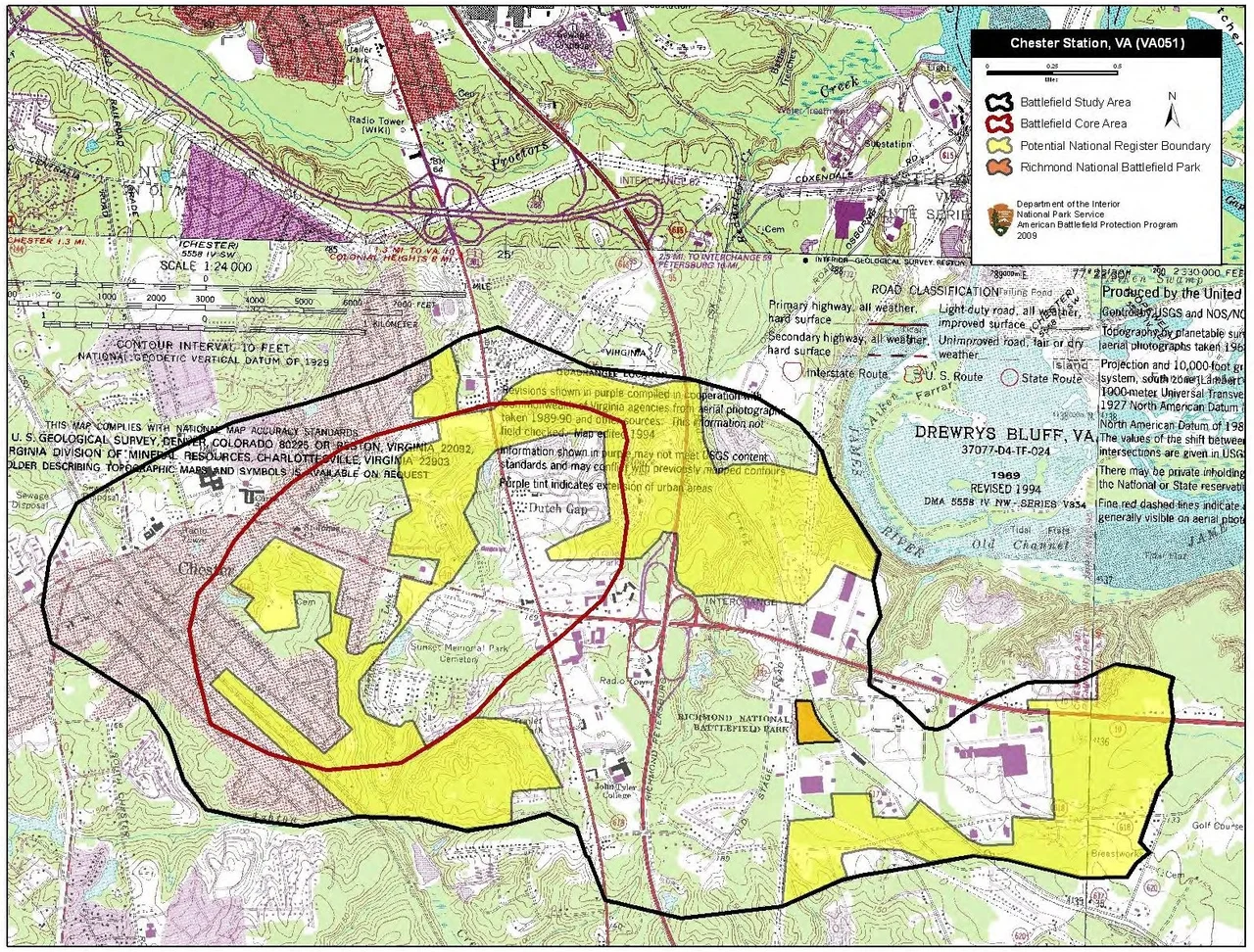

Battle of Chester Station
On May 10, 1864, a Union work party was busy tearing up the Richmond & Petersburg Railroad near a small depot called Chester Station, twelve miles south of Richmond. They had been at it for an hour - prying up rails, smashing ties, doing the slow violence to infrastructure that Benjamin Butler's Bermuda Hundred Campaign required. Then two Confederate brigades under Robert Ransom came south out of Drewry's Bluff and hit them. By the end of the day, both sides had bled hard over a few hundred yards of broken track and a thicket of pines. Neither side won. The track was wrecked but the Confederates kept the wreckers from doing more. The result was officially called a draw - the kind of result that was almost more painful than a defeat, because nothing had been settled and the men still in the woods had died for nothing.
Butler's Half-Forgotten Campaign
Chester Station was a single engagement in the Bermuda Hundred Campaign, Grant's attempt to use Butler's Army of the James as a pincer against Richmond from the south. The plan, on paper, looked good: while Grant grappled with Lee in the Wilderness and Spotsylvania to the north, Butler would land at Bermuda Hundred between the James and Appomattox rivers and cut the railroads supplying Richmond and Petersburg. The plan, in practice, collapsed under Butler's tentative generalship and P.G.T. Beauregard's stubborn defense from Drewry's Bluff. The Confederate position at Drewry's commanded the river and gave Beauregard a fortified base from which to lash out at Union work parties along the railroad. The X Corps under Quincy Gillmore drew the railroad-wrecking duty. On May 10, that meant the 7th Connecticut, the 6th Connecticut, the 13th Indiana, the 169th New York, and a detachment of the 67th Ohio, all working south of Drewry's.
The Fight by the Tracks
Colonel C. J. Dobbs of the 13th Indiana, commanding the right wing of the Union force on the turnpike, ran into Ransom's main body first. He sent back for reinforcements and formed his line behind a section of the 1st Connecticut battery, with the 169th New York on his right. When the Confederates came on with infantry, cavalry, and artillery, Dobbs held his fire until they were close, then turned them back with a single tremendous volley. They reformed and came on again; the second volley broke them. Major O. S. Sanford arrived with the 7th and 6th Connecticut and went into position supporting the advanced line. Two companies of the 7th Connecticut were sent forward to support a battery, and the rest of the regiment crested the hill and opened fire on the Confederate left, driving it back into the woods. The fighting was hand-to-hand at one point. A gun of the 4th New Jersey battery was abandoned in the chaos; Lieutenant Barker of Company K, 7th Connecticut, brought it in under "galling fire."
Reinforcements and Withdrawal
The 7th New Hampshire came up just as the Confederates were attacking again, this time having been reinforced. The Union line waited until the rebels were within easy range, then opened with artillery and infantry together - what one account called a "murderous fire." That settled it. Confederate officers tried and failed to rally their men; the shattered ranks took cover in the woods. Brigadier General A. H. Terry, commanding the 1st Division of X Corps, arrived after the action had begun and directed the latter part of the engagement. By the time it was over, Terry reported Union losses at 280 killed, wounded, and missing. Confederate casualties in Barton's Brigade alone totaled 249, including Lieutenant Colonel Joseph R. Cabell of the 38th Virginia, killed leading his regiment. Total Confederate losses likely ran twice the Union number, with about 50 captured.
The Cost of Inconclusiveness
Both armies withdrew. The Federals pulled back east to Bermuda Hundred. The Confederates retired north to Drewry's Bluff. The track had been damaged but not enough to matter; within days, repair crews would have it serviceable again. Major General Ransom relieved Brigadier General Seth Barton of his command - someone had to be blamed for the failure to drive the wreckers off entirely. Colonel Alvin C. Voris of the 67th Ohio was brevetted Brigadier General for his service that day. The Bermuda Hundred Campaign as a whole would soon end with Butler's army, in Grant's famous phrase, "as completely shut off from further operations directly against Richmond as if it had been in a bottle strongly corked." The men who fought at Chester Station - the Indiana farmers, the Connecticut clerks, the Virginia infantrymen, the New Hampshire millhands - died or were maimed in a fight that historians would label "a relatively minor battle." The qualifier did nothing for their families.
From the Air
Battlefield centered at approximately 37.3529°N, 77.4123°W, just south of Chester in Chesterfield County, about 15 miles south of downtown Richmond. The Richmond & Petersburg Railroad alignment (now Norfolk Southern) and the parallel I-95 corridor are easy to follow from the air. Recommended viewing altitude 2,500-4,000 feet AGL. Nearest airports: Chesterfield County (KFCI) about 6 miles northwest, Richmond International (KRIC) about 18 miles northeast, Petersburg's Dinwiddie County (KPTB) about 10 miles south. Historical markers identify several spots near the battlefield.
Nearby Stories
- Piney Grove at Southall's Plantation 2.5 km away
- Battle of Amelia Springs 3.5 km away
- Lewis Ginter Botanical Garden 4.3 km away
- Cactus Hill 21 km away
- Fork Union Military Academy 25 km away
- Christopher Newport University 44 km away
- Menokin 47 km away
- Long Grass Plantation 65 km away