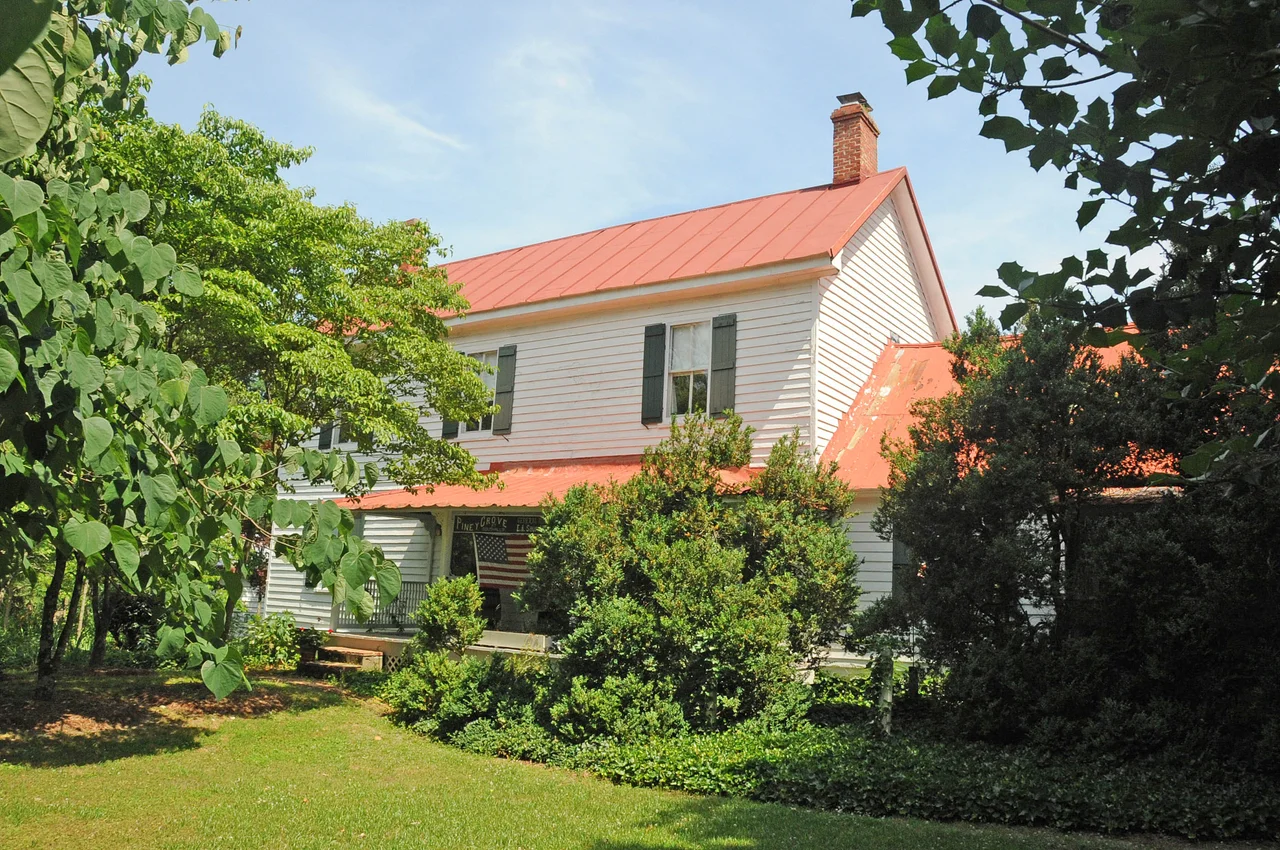

Piney Grove at Southall's Plantation
Most plantation houses on the James River were brick statements, calling cards for tobacco wealth meant to impress visitors arriving by boat. Piney Grove is not that. It started around 1800 as a one-story log corn crib on Furneau Southall's land, a building meant only to keep grain dry. Then, sometime around 1820, someone enlarged it and turned it into a store. In 1853, two more additions went up. In the early 20th century, the whole thing was wrapped in a two-story frame block. The result is unusual: a log farm building that survived three rebuildings without ever being torn down, hidden inside the walls of what looks from outside like a modest Tidewater farmhouse. There is almost nothing else like it in Virginia.
The Land Before the Logs
Before any of this, the high ridge above the James River was Chickahominy country. The plantation site sits near the village of Mattahunk and along the route the colonists called Necotowance's Path - a trail named for the Powhatan chief who in 1646 signed the treaty that opened these lands to English settlement. The Chickahominy never left the region. Their descendants still gather a few miles away. Layer that history beneath the corn crib's logs and the building begins to feel less like a quirk of vernacular architecture and more like the latest tenant on land with a much older lease.
The Common Planter's House
Furneau Southall was not one of the great James River planters. The brick mansions of Westover, Berkeley, and Shirley belonged to families with hundreds of enslaved workers and trading connections in London. Southall's 300 acres put him in a humbler tier - the common planter who served as Charles City County deputy-sheriff under William Byrd III's son, mustered with the local militia under Benjamin Harrison V, and administered the first U.S. Census locally in 1790. His household that year included his wife, seven children, and sixteen enslaved people: Amy, Bess, Bristol, Critty, Dick, Dublin, Jack, Kate, Lucky, Nutty, Patsey, Pompy, Peter, Rippons, Rose, and Silvia. Their names survive in the personal property tax lists alongside the inventory of furniture and livestock - one of the rare records that keeps the people who actually worked this land from disappearing entirely into the ledger.
From Corn Crib to Country Store
By 1857, Furneau Southall's grandson John Seth Stubblefield sold off part of the plantation to Edmund Archer Saunders. The log crib was already on its second life as a store by then. Saunders ran it as Piney Grove Store, supplying the surrounding farms. When the Civil War ended, Saunders moved to Richmond and made a fortune as a wholesale grocer, buying up nearby plantations - Indian Fields, Weyanoke, Upper Shirley - and commissioning a stone baptismal font for Westover Episcopal Church that is still in use. The store stayed open in his absence. Thomas Fletcher Harwood operated Piney Grove Store from 1874 until 1915, and in 1905 he turned the building once again - this time into a five-bedroom residence by wrapping the old log core in a frame house. His son Dr. Ashton Harwood kept a physician's office on the grounds, and the small Harwood children's cemetery still stands behind elaborate cast-iron fencing from the Cincinnati Ironworks.
The Folk Architecture Collection
After the Hughes family sold the property in 1984, the Gordineer family spent five years restoring the house. They went further than restoration. Wanting to save other vernacular buildings facing demolition elsewhere, they moved several to Piney Grove and set them on the grounds: Ashland (1835, from James City County), Dower Quarter (1835, Henrico County), Ladysmith (1857, Caroline County), Duck Church (1917, Dare County, North Carolina), the Pocahontas Tea House Outhouse (around 1930, Henrico), and the Peace Hill Smokehouse (around 1920, Charles City). A reproduction of the 1940 Lanexa Farmstand rounds out the collection. The result is a kind of accidental open-air museum of southern folk architecture, scattered across acres that once grew tobacco and corn.
Visiting Today
Piney Grove sits on Route 5, the John Tyler Memorial Highway that traces the James River plantation route. The grounds are open daily from 9 a.m. to 5 p.m., and the historic 1857 Ladysmith house functions as a bed and breakfast - which means visitors can sleep on a property layered with two centuries of Tidewater Virginia. The site is an official stop on the Virginia Civil War Trails, the Virginia Birding and Wildlife Trail, and the National Register's James River Plantations itinerary. From the road it looks like a quiet farmhouse. Step inside, and the log walls of the old corn crib are still there, holding everything else up.
From the Air
Piney Grove sits in Charles City County at 37.37°N, 76.98°W, along the historic Route 5 corridor between Richmond and Williamsburg. From cruising altitude, look for the wide bend of the James River to the south and the rural ridge of land between the James and Chickahominy rivers. The 4-character geohash dq9k places it about 12 nm west of Williamsburg. Newport News/Williamsburg International (KPHF) is the nearest tower; Richmond International (KRIC) lies about 30 nm to the west-northwest. Best viewing at 3,000-5,000 feet.
Nearby Stories
- Battle of Trent's Reach 2.7 km away
- Mathews County, Virginia 7.4 km away
- Lewis Ginter Botanical Garden 11 km away
- Ocean View Amusement Park 16 km away
- USS Texas (1892) 21 km away
- Christopher Newport University 29 km away
- Menokin 44 km away
- Fort Christanna 63 km away