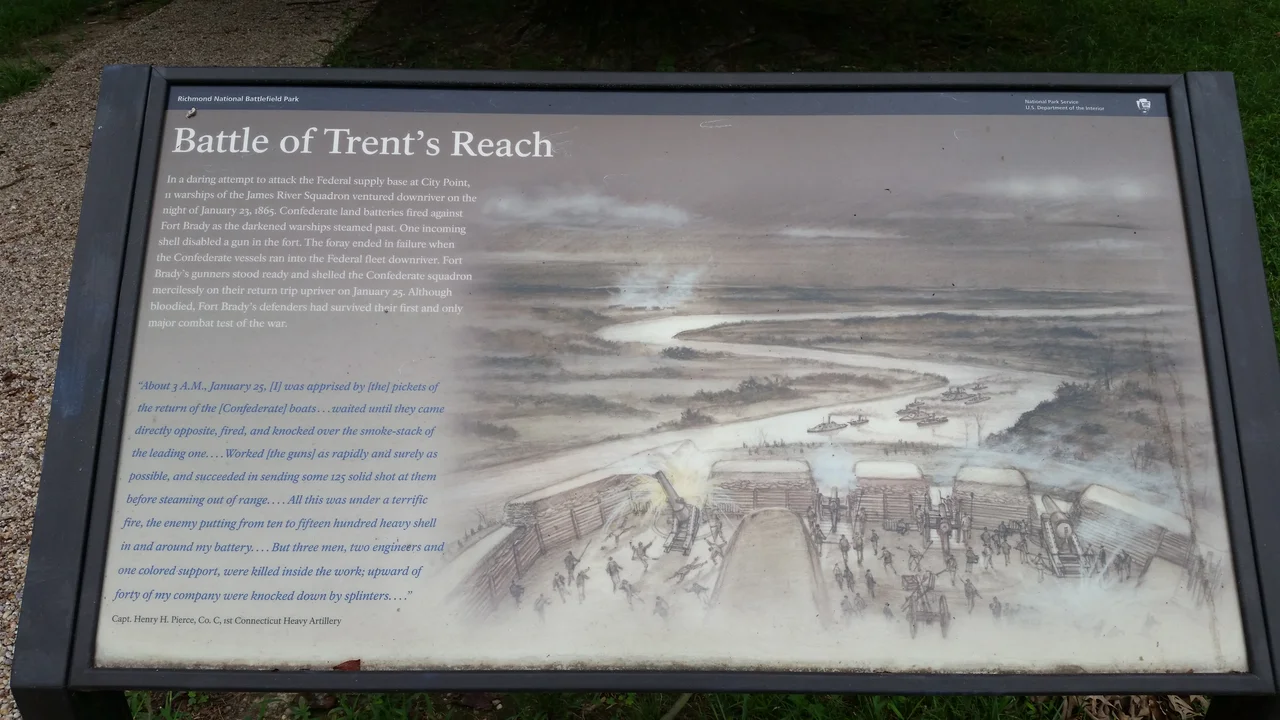

Battle of Trent's Reach
By January 1865, the Confederacy was running out of time. Grant had Lee pinned at Petersburg. Sherman was loose in the Carolinas. The Shenandoah Valley had been burned. So when Commodore John K. Mitchell, commanding the James River Squadron, was ordered to take his three ironclads down the river and bombard Grant's massive supply base at City Point, the mission was almost mythic in its ambition - a last cavalry charge on the water, against the most powerful navy in the world. On the night of January 23, the Confederate ships moved down the James toward Trent's Reach. They had two days. They needed luck. And by the time it was over, only one Union ship would be even slightly damaged, and Mitchell would be relieved of his command.
The Last Squadron
Mitchell's flagship was CSS Fredericksburg, a 700-ton ironclad with a single 11-inch smoothbore and three smaller rifled guns. With him steamed the ironclad rams CSS Richmond, an 800-ton vessel carrying six guns, and CSS Virginia II, 650 tons and six guns. Each ironclad carried about 150 officers and crew. Around the three armored centerpieces clustered eight other vessels - the gunboats Nansemond, Hampton, Beaufort, and Torpedo, each with a gun or two and displacing 100 to 200 tons, plus the torpedo boats Scorpion, Wasp, and Hornet. The torpedo boats each carried a single spar torpedo, the Civil War's answer to a guided missile: a contact mine fixed to the end of a long pole, jammed against an enemy hull at close range. None of those spar torpedoes would be used at Trent's Reach. To reach City Point, the rebels had to fight past Union warships, a minefield supplemented by a net, the guns of Fort Brady, and four shore batteries.
The Run Down the River
The James River at Trent's Reach narrows and bends, the kind of geography that favors defenders and embarrasses fleets. The Confederate ironclads bombarded Fort Brady through the night of January 23 and into the next day, engaging four Union Navy vessels. The Union monitor USS Onondaga was the most powerful ship on the scene, and her crew weathered the action without a single casualty - the boat was only slightly damaged. The Confederate vessels were not so lucky. Most sustained some kind of battle damage. The gunboat CSS Drewry was hit hard and lost crew. The Scorpion took casualties too. Official records counted four Confederates killed on the Drewry and Scorpion plus fifteen wounded, though some sources put losses on the Virginia II alone at six men. Three Union sailors were known killed, and more than forty took slight wounds from wood splinters - the perennial scourge of nineteenth-century naval combat.
Withdrawal Without a Prize
After two days of fighting, the squadron turned around and made its way back upriver to Chaffin's Bluff. The objective of striking City Point had not been achieved. The ships had nothing to show for the advance but battle damage. Commodore Mitchell was relieved of command and replaced by Admiral Raphael Semmes - the same Semmes who had captained the famous Confederate commerce raider CSS Alabama in her fatal duel with USS Kearsarge off Cherbourg, France, six months earlier. Semmes inherited a squadron that was already a dead letter. The James was still blockaded. The river batteries were still there. There would be no second attempt.
The Last Naval Engagement of the Eastern Theater
Exactly two months after Trent's Reach, the Petersburg Campaign ended. Lee, his lines broken and his army starving, abandoned the city. When Richmond fell on April 3, 1865, the James River Squadron - the squadron that had been built at such cost to defend the Confederate capital - was scuttled by its own crews to keep the ships out of Union hands. Fredericksburg, Richmond, Virginia II: all were destroyed where they lay. The battle of Trent's Reach turned out to be the last significant naval engagement of the Main Eastern Theater. It was a small action by the standards of fleet battles, perhaps, but it marked the closing of a great strategic question. The Confederate navy had spent four years trying to break out of the James and onto the sea. It had failed at New Orleans, failed at Mobile Bay, failed in the Carolinas, failed off Cherbourg. At Trent's Reach, in the cold January darkness, it failed for the last time.
From the Air
Trent's Reach is a stretch of the James River centered at approximately 37.3594°N, 77.3733°W, about 10 miles southeast of downtown Richmond between Chaffin's Bluff and Dutch Gap. Fort Brady's earthworks are preserved as part of Richmond National Battlefield Park. Recommended viewing altitude 2,000-3,500 feet AGL; the meandering James and the Dutch Gap Canal are obvious from above. Nearest airport: Richmond International (KRIC), 8 miles north; Chesterfield County (KFCI) is across the river to the southwest. Look for the deep curve of the river at Trent's Reach and the historical marker at Fort Brady.
Nearby Stories
- Piney Grove at Southall's Plantation 2.5 km away
- Battle of Amelia Springs 3.5 km away
- Lewis Ginter Botanical Garden 4.3 km away
- Cactus Hill 21 km away
- Fork Union Military Academy 25 km away
- Christopher Newport University 44 km away
- Menokin 47 km away
- Long Grass Plantation 65 km away