.jpg)
USS Texas (1892)
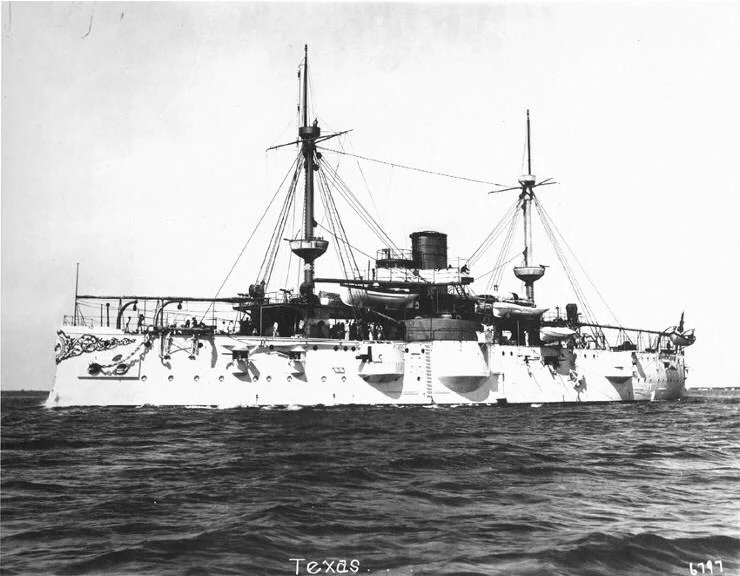
In 1883, Brazil took delivery of the ironclad Riachuelo, and the U.S. Navy realized it had a problem. The Brazilian Navy was suddenly the most powerful in the Western Hemisphere, and as one congressman put it, if the old American fleet ever met the Riachuelo in mid-ocean, it was doubtful a single American ship would make it home. The response was Texas - America's first commissioned battleship, designed by a British firm in Barrow-in-Furness, laid down at the Norfolk Navy Yard in 1889, and launched in 1892. By the time she entered service in 1895, her main armament arrangement was already obsolete. She would run aground, flood at the pier, and earn the nickname 'Old Hoodoo' before redeeming herself in the Spanish-American War. Then the Navy that built her would sink her in the Chesapeake Bay as a gunnery target, where her hull still rests two to six feet below the surface in Tangier Sound.
The Riachuelo Problem
South American naval modernization in the 1880s caught the United States off guard. Brazil, Argentina, and Chile were buying modern armored warships from European yards. Congressman Hilary A. Herbert, chair of the House Naval Affairs Committee, characterized the gap brutally. The Navy Advisory Board began planning for ships that could defend American ports against hostile ironclads. Two coastal battleships emerged: the Maine - armed with four 10-inch guns - and the Texas - armed with two 12-inch guns. Both had to fit in existing American drydocks, both had to have shallow drafts to use all the major Atlantic ports, both had to make at least 17 knots, and both followed the European fashion of mounting their main turrets en echelon, sponsoned out over the sides of the ship so they could fire across the deck for end-on attacks. The arrangement looked elegant on paper.
Old Hoodoo
The accidents began before Texas was even commissioned. Her keel was laid in June 1889, but stability concerns delayed construction for nearly eight months. After her trials, the floors had buckled their brackets and the cement near the keel had cracked - structural problems that took further work to fix. Then came the sea. In September 1896, she ran aground near Newport, Rhode Island, due to operator error and signal failure. A few officers were publicly reprimanded. In November, while under repair in New York, a yoke on the main injection valve in the starboard engine room broke. Water pressure unseated the valve. The flooding spread through every watertight bulkhead leak the ship had, and Texas settled to the bottom of the harbor with her gun deck awash. Several crew members drowned. The water was shallow enough to salvage her, but she had to be lightened by 300 tons of coal just to enter drydock. In February 1897 at Galveston, a strong tide swung her onto a mud bank. By the time she was hauled off the next day, she had earned her nickname: Old Hoodoo, the jinxed ship.
Santiago de Cuba
Old Hoodoo's redemption came in Cuba. On May 18, 1898, with Captain John W. Philip in command, Texas was at Key West, preparing to enforce the blockade. Three days later she arrived off Cienfuegos with the Flying Squadron. She bombarded a Spanish fort in Guantanamo Bay and supported the Marine landings there. Then, on July 3, 1898, came the day every American battleship dreamed of. Admiral Pascual Cervera's Spanish fleet attempted to escape from Santiago de Cuba, and Texas opened fire on four Spanish ships immediately. Her main battery pounded the armored cruisers; her secondary battery worked over the destroyers. The two Spanish destroyers beached themselves quickly. One by one, the larger Spanish warships followed, sheering toward shore as American shellfire wrecked them. Texas was hit only once - by a single 6-inch shell that damaged her ash hoist and air shafts. The Battle of Santiago de Cuba was a one-sided American victory, and Texas had been part of it. Two weeks later, Santiago fell, and Spain sued for peace.
The Long Decommissioning
After the war, Texas resumed peacetime patrols. A 1900-1902 refit raised her funnel and topmasts, doubled the armor over her ammunition hoists, and removed her broadside torpedo tubes. By 1908, she had become the station ship at Charleston, South Carolina. By 1910, she was obsolete by every measure - the dreadnought era had begun, and pre-dreadnoughts like Texas with their en echelon main guns were museum pieces. On February 15, 1911, her name was changed to San Marcos to free the name 'Texas' for the new battleship BB-35 then under construction. Within weeks, the Navy began using her for gunnery testing. The Navy wanted data on how modern shells affected armored and unarmored hulls, where underwater hits actually landed, and how shells looked when they struck at long range. The ship that had been America's first commissioned battleship was about to become a giant scientific instrument.
Tangier Sound
On March 21 and 22, 1911, the battleship New Hampshire fired on San Marcos in shallow water in Tangier Sound, Chesapeake Bay. There were so many holes below her waterline by the end that the water in her forward and rear compartments moved with the bay outside. The interior above the waterline was demolished. She was used for torpedo experiments on April 6. In 1912 the Navy built a cage mast atop her remains - a duplicate of those on the new dreadnoughts - and tested it against 12-inch shells fired by a monitor from 1,000 yards. The mast was knocked down by nine hits but considered to have performed well. Throughout World War II, San Marcos served as a gunnery target, sitting two to six feet below the surface, marked by an unlit buoy. In 1940 she sank the cargo ship Lexington following a collision. The Navy used tons of explosives in 1959 to demolish what remained of her upperworks and drive her hull deep into the mud. She is still there, in the Chesapeake Bay where the Navy that built her finally finished her off.
From the Air
The wreck of USS Texas (later San Marcos) lies in Tangier Sound at approximately 37.72°N, 76.08°W, southwest of Tangier Island in the Chesapeake Bay. From cruising altitude, look for the distinctive narrow waters of Tangier Sound between Smith Island, Tangier Island, and the Eastern Shore of Virginia. The wreck is now buried in mud below the surface. Tangier Island has a 2,420-foot runway (KTGI). Salisbury Regional Airport (KSBY) lies about 25 nm east on the Delmarva Peninsula. Best viewing at 3,000-5,000 feet with good light to see the underwater terrain features.
Nearby Stories
- Werowocomoco 3.4 km away
- Smith Island, Maryland 7.2 km away
- Pocomoke City, Maryland 11 km away
- Mathews County, Virginia 15 km away
- Menokin 15 km away
- Mid-Atlantic Regional Spaceport 17 km away
- Camp Peary 42 km away
- Battle of the Chesapeake 53 km away