.jpg)
Battle of Delium
Some of the Athenians at Delium killed each other by mistake. They had circled around a stubborn Thespian contingent that refused to break, and when their two flanking columns met behind it they could not tell each other apart in the dust and confusion. There were no state shield emblems yet - those came later, after lessons like this one - and so Athenians cut down Athenians thinking they were Boeotians. Thucydides recorded it in passing, the way he recorded most catastrophes, and twenty-four centuries later we still call it the first documented friendly fire incident in Western military history.
Pagondas Sees the Trap
It was 424 BC and the Peloponnesian War was in its seventh year of grinding stalemate. The Athenian generals Demosthenes and Hippocrates planned a coordinated invasion of Boeotia: Demosthenes from the west by sea to Siphae, Hippocrates from the east overland to seize the temple at Delium near the Euripus strait. Demosthenes sailed too early and was betrayed by a Phocian named Nicomachus, the Boeotians intercepted him, and the western half of the plan collapsed before it began. Hippocrates went ahead anyway with 7,000 Athenian hoplites, 1,000 cavalry, and 10,000 lightly armed metics and non-citizens. He fortified the temple, garrisoned it, and started home. The Boeotian commander Pagondas of Thebes argued his reluctant fellow generals into a chase. The Athenians had to be punished now, he said, or they would simply come back next year.
A New Kind of Phalanx
Greek hoplite warfare in the fifth century BC was a stubbornly conservative business. Two lines of armored men met in a shoving match, eight ranks deep on each side, and whichever side broke first lost. Pagondas threw out the textbook. He stacked his Theban right wing 25 ranks deep instead of the standard 8 - a mass of men whose weight alone could not be stopped by a normal line - and accepted that this would make his line shorter and force his left wing to be outnumbered. He pushed forward unevenly, used his cavalry as an active reserve, and sent peltasts skirmishing through the gaps. The two armies were hidden from each other by a low hill. The Boeotians charged unexpectedly while Hippocrates was still giving his speech to his men. The deep Theban wing crushed everything in front of it. The Athenian wing was still winning when Pagondas sent his cavalry around the hill to reinforce his defeated left, and the Athenians, mistaking horsemen for an entire fresh army, broke and ran.
Socrates in the Retreat
About 1,000 Athenian hoplites died at Delium, including Hippocrates himself; the Boeotians lost about 500. One of the Athenian survivors was a forty-five-year-old stonemason named Socrates. Plato, in the Symposium, has the young aristocrat Alcibiades describe what he saw of Socrates during the rout: walking deliberately back from the disaster, looking around him calmly, glaring at any pursuer who came too close, sticking with his comrade Laches who had lost his nerve. Alcibiades watched him from horseback and concluded that anyone Socrates marched alongside was safer than they would otherwise have been. The philosopher's wartime composure became part of his legend - the same self-possession that would walk him to his execution thirty-five years later. Plato did not invent it. Socrates fought in the line. He carried a hoplite shield.
The Flamethrower at the Temple
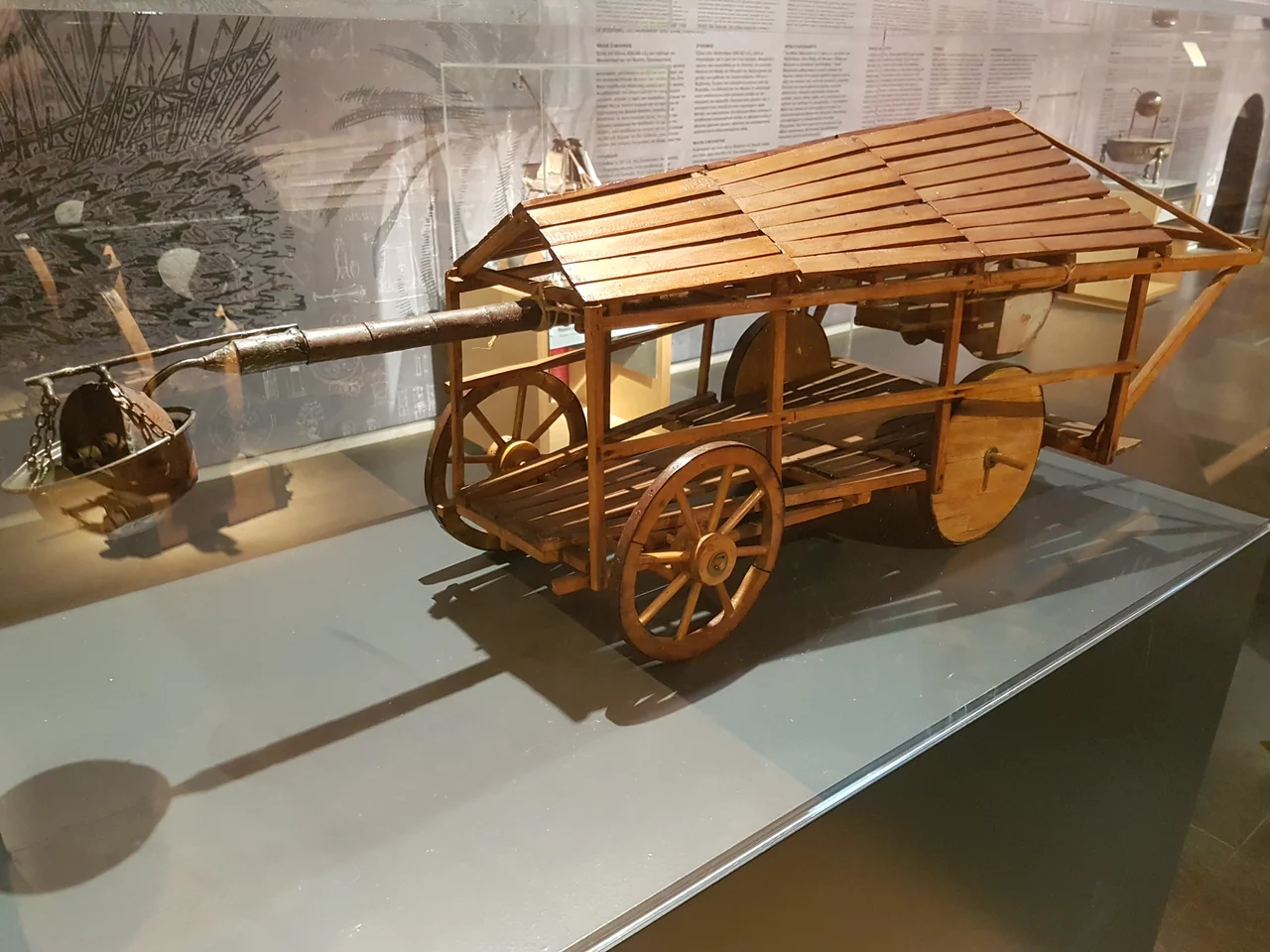
The aftermath was almost stranger than the battle. The Athenian survivors fortified themselves inside the temple at Delium and refused to leave the sacred ground. The Boeotians, joined by 2,000 Corinthian hoplites and other allies, debated how to dislodge them. After two weeks they built a remarkable device: a hollowed-out tree trunk, lined with metal, mounted on wagons, with bellows on one end and a cauldron of pitch, sulfur, and burning charcoal at the other. Thucydides describes it precisely - he was a contemporary general writing in real time - and modern reconstructions in Thessaloniki's Science Center suggest it worked roughly the way he claimed. The Boeotians blew flame against the wooden palisade, the temple fortifications burned, and the Athenian garrison broke and fled with about 200 more dead. It is the first proto-flamethrower in Western military history. Today the small village of Dilesi sits roughly where Delium stood, on the eastern coast of Boeotia opposite the island of Euboea, and the Euripus strait still runs by it - the same waters whose mysterious tidal reversals Aristotle would puzzle over a century later.
From the Air
The site of ancient Delium (modern Dilesi) lies on the eastern coast of Boeotia, central Greece, at approximately 38.35N, 23.65E, on the strait facing southern Euboea. Recommended viewing altitude 3,000-4,500 ft AGL. Nearest airports are Athens International (LGAV) 30 nm south and Tanagra (LGTG) 8 nm west. From altitude the Euripus strait is unmistakable as a narrow blue channel separating Euboea from the Greek mainland; the southern Euboean Gulf opens to the east, and Mount Parnitha rises to the south. The battlefield was on flat coastal land just inland from the temple site.
Nearby Stories
- Hellenic Police 2.9 km away
- Tower of Aliartos 8.5 km away
- Great Sand Beach 13 km away
- John the Russian 22 km away
- Saint George Monastery, Aidipsos 23 km away
- Sousaki Volcano 25 km away
- Skyros 32 km away
- Carystus 46 km away