
Battle of Garnett's & Golding's Farms
By the morning of June 27, 1862, the Army of the Potomac was already half-trapped along the muddy banks of the Chickahominy. Two corps stood south of the river; three stood north, and Robert E. Lee, four weeks into his command of the Army of Northern Virginia, intended to destroy the northern wing at Gaines's Mill. The fighting at Garnett's and Golding's farms, two days of small clashes on the south bank, looks at first like a footnote. It killed and wounded six hundred men. And it whispered something into George McClellan's ear that would change the entire campaign: you are being attacked from two sides.
Lee Takes the Initiative
Richmond was the prize. McClellan had landed his army on the peninsula and pushed it within sight of the Confederate capital. By the end of May, his forces straddled the Chickahominy, two Union corps to the south, three to the north. On May 31, Joseph E. Johnston tried to crush the southern wing at Seven Pines and Fair Oaks; he failed, took a wound, and the next day Jefferson Davis handed command to his military adviser, Robert E. Lee. Lee did not hesitate. After the Union probe at Oak Grove on June 25 and a costly Confederate repulse at Mechanicsville on June 26, McClellan pulled his northern wing back to Boatswain's Swamp and built a defensive line. There, on June 27, Lee threw the heart of his army at Gaines's Mill, one of the bloodiest days of the Peninsula Campaign.
The Diversion South of the River
While that battle raged, John B. Magruder, a theatrical Virginian who had bluffed his way through the early peninsula campaign, held the line south of the Chickahominy. James M. Garnett's farm sat on bluffs above the river near Old Tavern. Nearby, Simon Gouldin's Golding's Plain ran along a precipitous ravine and a wooded hill called Garnett's Hill. The night before the battle, Union artillerists from William "Baldy" Smith's division of the VI Corps hauled six batteries of reserve guns up onto Garnett's Hill. They were still working at dawn. Confederate brigades under Robert Toombs and George T. Anderson, both attached to David R. Jones's division, took position across the ravine. Lafayette McLaws sent a small force forward at midday; it withdrew under heavy fire after ten minutes. Then, late in the day, Toombs, ordered to merely "feel the enemy," turned his reconnaissance into a sharp ninety-minute fight before Winfield Scott Hancock's brigade drove him back. Toombs lost 271 men killed, wounded, and missing. Nothing was gained.
Golding's Farm and McClellan's Mind
On the morning of June 28, Jones suspected the Union forces were withdrawing from around Golding's house, and authorized Toombs to push forward and check. Once again Toombs turned the order into an attack, dragging some of Anderson's regiments with him. The VI Corps was waiting. The Federals shattered the assault before Jones could call it off. Anderson's brigade bore the worst of the day's counter-fire and suffered 156 casualties. Across the two days, the Confederates lost 438 men killed and wounded; the Union lost 189. Five hundred soldiers, North and South, became casualties for ground that neither army wanted. But the effect on McClellan was profound. He had just watched the disaster at Gaines's Mill across the river. Now he was being attacked, weakly but persistently, on his other flank. He concluded he was being struck from both sides at once. That night, he made the decision that defined the rest of the Seven Days: he abandoned his base at White House on the Pamunkey and ordered a full retreat across the peninsula toward Harrison's Landing on the James.
A Small Battle, A Large Consequence
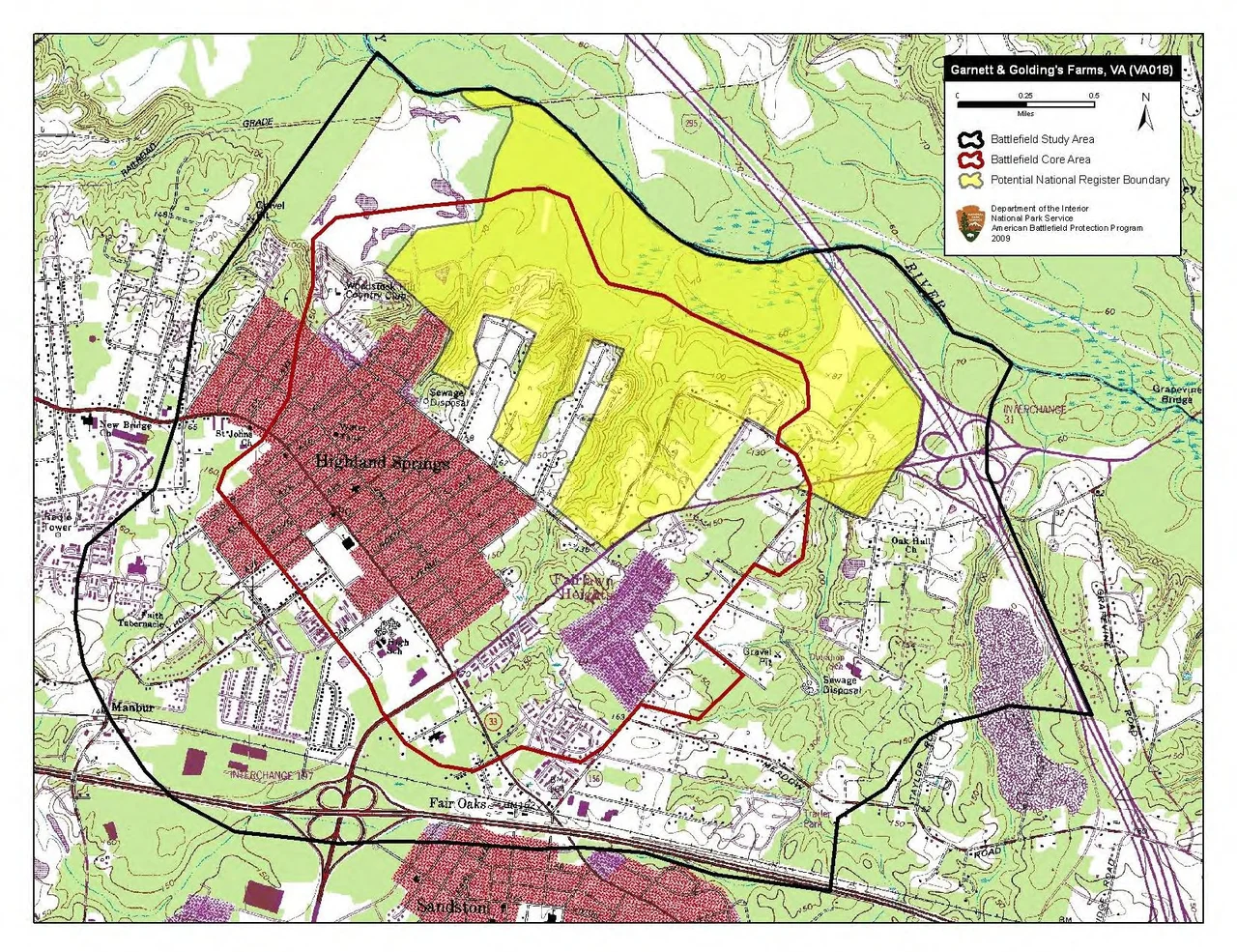
Magruder's diversion accomplished almost nothing on the ground. The maps drawn up later by the American Battlefield Protection Program show a few hundred acres of bluff, ravine, and farm field around what is now suburban Henrico County, hemmed in by interstate and subdivision. But the strategic effect was outsized. McClellan's withdrawal handed the initiative permanently to Lee. The Battle of Savage's Station, the next day's punishment of the Union rear guard, followed directly. So did the larger fights at Glendale and Malvern Hill. The men who fell at Garnett's farm and Golding's farm became part of a much larger calculation made by a commander who had decided, against the evidence in front of his own brigades, that he was beaten.
From the Air
The Garnett's and Golding's battlefield sat at roughly 37.55 N, 77.31 W in what is now eastern Henrico County, between Richmond and the Chickahominy floodplain. Today the site is largely consumed by suburban development east of Richmond. The Chickahominy River, still wide and swampy here, is the only landscape feature that has not changed since 1862. From the air, look for the river's broad green corridor running northwest-to-southeast just east of I-295. Nearest field is Richmond International (KRIC) about 8 nm west; Hanover County Municipal (KOFP) is 14 nm north. Best viewed at 2,500-4,000 feet AGL in clear afternoon light.
Nearby Stories
- Huguenot Memorial Chapel and Monument 4.1 km away
- Carter's Grove 6.7 km away
- Gloucester County, Virginia 18 km away
- Siege of Petersburg 19 km away
- Kings Dominion 25 km away
- Francisco's Fight 34 km away
- Point Lookout Light 39 km away