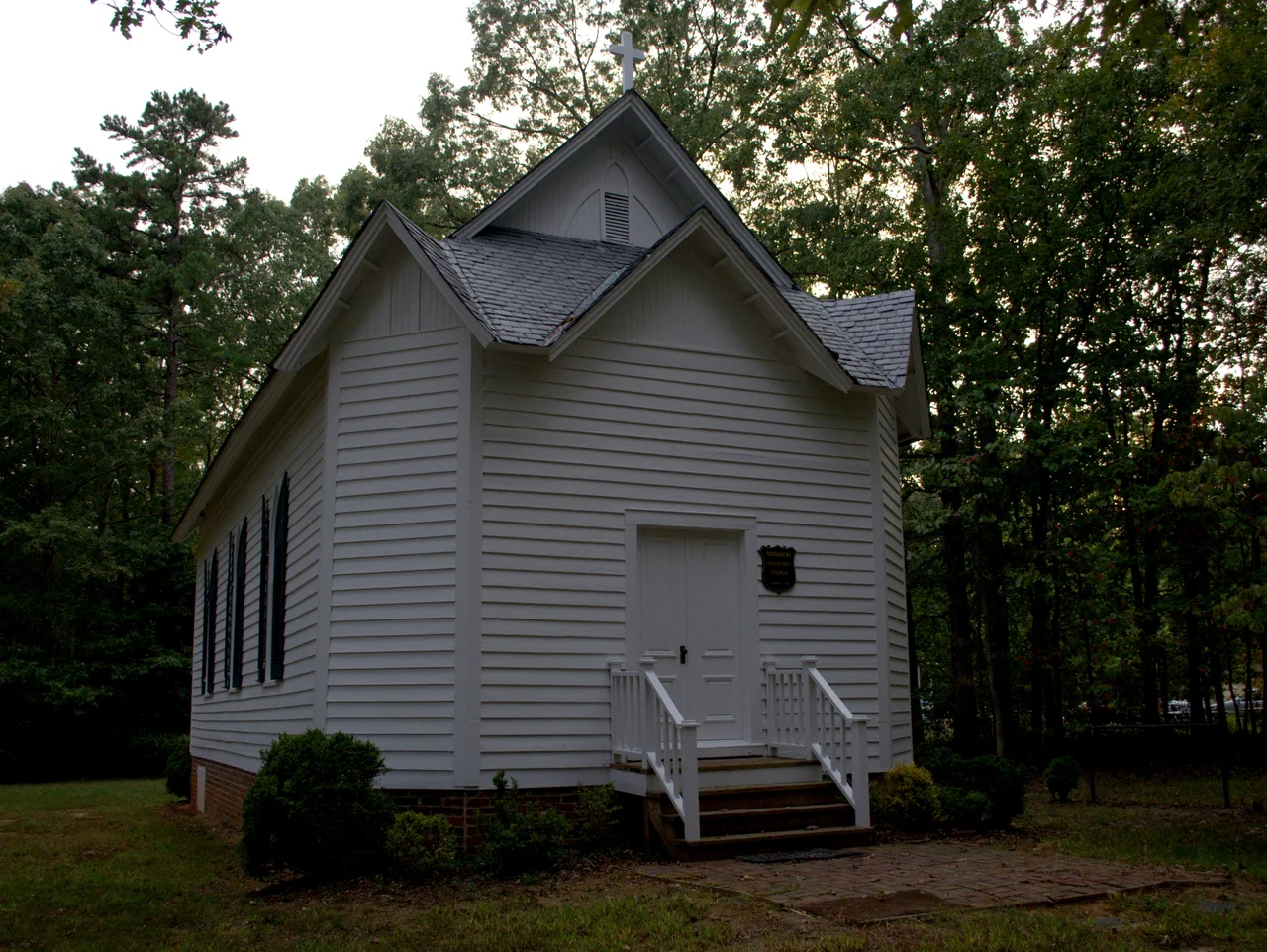

Huguenot Memorial Chapel and Monument
In October 1685, Louis XIV revoked the Edict of Nantes and made being a French Protestant illegal overnight. Within fifteen years, several shiploads of those refugees - Huguenots, followers of Calvin who had fled France for England - sailed up the James River past the falls and stepped ashore at a tract of land the Monocans had once cleared. They called the place Manakin towne, and they planted a settlement that would become the largest Huguenot colony in colonial America. The town itself failed within a generation. But twenty miles west of Richmond, on a quiet road through wooded country, a small white chapel still stands as their memorial - and a charred beam beneath its floor may be the oldest surviving fragment of any Huguenot building on this continent.
The Refugees Who Came Up the River
King William III's government and the Protestant Relief Fund underwrote the cost of resettling about 300 souls on 10,000 acres in what is now Powhatan County. William Byrd I had proposed the project in 1698, less out of charity than calculation - a French settlement upriver would strengthen frontier defenses and raise the value of his own mill at Falling Creek. Some of the refugees believed they were founding their own colony. The Virginia Governor and Council corrected them sharply in 1702, banning the title "colony" and ordering all future petitions be presented "in the English tongue." Still, the General Assembly created King William Parish on December 5, 1700, exempting the French refugees from public levies for seven years and letting them collect tithes for their own pastor. Their first minister had died shortly after arrival, and the Bishop of London sent Benjamin de Joux to take his place.
Four Churches on the Same Hill
The first Manakin church was a small octagonal wooden structure, probably built near the James River between Bernard's and Norwood Creeks. A second frame church served the parish from 1710 until it burned around 1729. In 1730-31 the carpenter Francois James raised a third, larger building farther from the river, where the Huguenot ferry road and the river road crossed. That third church stood for over a century and a half. By the 1890s the congregation had shrunk, the building had grown expensive to maintain, and the parish ordered it razed. They used its timbers in a fourth, smaller chapel - the white wood-frame building, in modified Gothic Revival style, that stands today. It measures only 24 by 32 feet, with three pointed windows on each side, a steep gable roof, and a distinctive three-sided narthex that proved so awkward for funerals that the original doors were eventually weatherboarded over.
The Beam Beneath the Floor
In September 1985, Calder Loth of the Virginia Division of Historic Landmarks and Edward Chappell of Colonial Williamsburg crawled under the chapel and examined the structural members. What they found supported a tradition the congregation had passed down for decades. The large summer beam holding up the flooring system - thirty feet eleven inches long, hewn on three sides and pit-sawn on the fourth - was clearly reused. A four-by-nine-inch section had been removed from one end because it was deeply charred, suggesting the beam had survived the 1729 fire that destroyed the second church. If that hypothesis is correct, this single timber is the oldest surviving architectural fragment of a Huguenot building anywhere in America. Other reused pieces are scattered through the building: old whitewashed weatherboards held by hand-wrought T-headed nails, baseboards repurposed as roof braces, a straight-sawn rafter doing duty as a stud. Layered history, holding the building up.
The Monument and the 1937 Dedication
The Huguenot Society of the Founders of Manakin in the Colony of Virginia organized in Vallejo, California in 1922 to preserve the memory of their ancestors. By 1936 they had raised enough to commission a light granite plinth, carved with a Huguenot cross and three inscriptions, from Lawson and Newton of Norfolk. On April 18, 1937, about 800 people gathered in the spring sunshine to watch it unveiled. Dr. Henri Flournoy, a Swiss psychiatrist and Huguenot descendant, described the scene for readers of the Journal de Geneve: men and women of advanced age, curly-headed children, flags in the breeze, hymns sung by school children, then "absolute silence" as the cross stood revealed. Most memorably, historian Douglas Southall Freeman drew an explicit parallel between the Huguenot exodus and the exodus then unfolding from Nazi Germany. The United States, he said, was "fortunate to have such members of the Jewish race as Dr. Einstein with us" - a deliberately pointed comment about American anti-Semitism, delivered four years after Hitler took power.
What Remains
The chapel has been moved twice. In 1954 it was shifted 200 feet south to make room for a fifth Manakin Church - the first built of brick, modeled (somewhat ironically) on William Byrd's English church at Westover rather than any French prototype. In 1985 it moved again, about 300 feet east onto land owned by the Society, so it could be preserved as a memorial and museum. Despite all the moves, it sits within a few hundred feet of where the original church stood. The monument is about 300 feet north of the chapel, both maintained in their wooded setting along what the Virginia General Assembly designated the "Huguenot Highway." Manakin towne itself never prospered. The 1714 parish counted 291 souls; by 1744 only 239 remained, and few lived in the village proper. The Scott family eventually owned most of the original land. But the descendants kept the name.
From the Air
Location: 37.5647°N, 77.7092°W, in Powhatan County about 20 miles west of downtown Richmond. The chapel sits in wooded country off scenic Route 711, roughly a mile and a half south of the James River. Recommended viewing altitude 2,500-3,500 feet AGL; the river makes an excellent visual reference. Nearest major airport: Richmond International (KRIC), about 25 miles east; smaller fields include Chesterfield County (KFCI) to the southeast. The Manakin Episcopal Church (the fifth, brick church) is the more visible landmark from the air; the small white chapel and granite monument sit just east and north of it.
Nearby Stories
- Battle of Garnett's & Golding's Farms 3.7 km away
- Francisco's Fight 21 km away
- Highland (James Monroe House) 22 km away
- Cactus Hill 31 km away
- Appomattox-Buckingham State Forest 33 km away
- John Wilkes Booth 40 km away
- Red Hill Patrick Henry National Memorial 51 km away