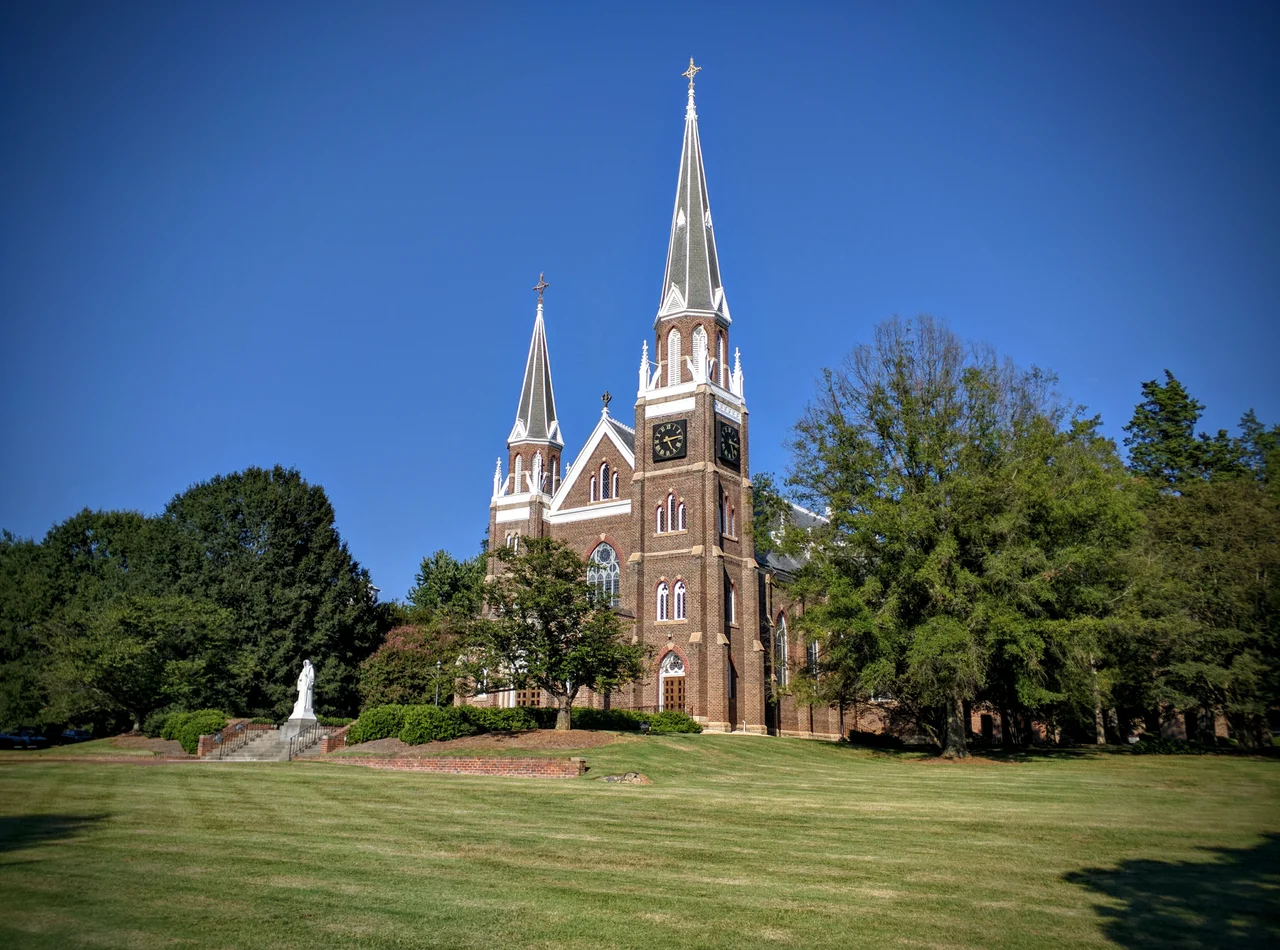

Belmont Abbey, North Carolina
On December 19, 1884, Pope Leo XIII signed a decree raising a small priory in rural Gaston County, North Carolina, to the rank of an abbey. The community took the name Abbey of Mary Help of Christians. Its first abbot, elected later that month, was a German-American monk named Leo Michael Haid. He would hold the position for forty years. In that time, Belmont Abbey would become the first and only Catholic cathedral in North Carolina, the territorial center of Catholic life across eight counties, and eventually a minor basilica recognized by Rome.
Leo Haid, Abbot-Bishop
In July 1886, the first three novices professed vows. That same year, an alumnus of the affiliated college took the habit. Haid founded a seminary at Belmont in those same months. On February 4, 1888, Pope Leo XIII appointed him Vicar Apostolic of North Carolina. Cardinal James Gibbons consecrated him bishop at the Baltimore Cathedral on July 1, 1888. Haid became the first American abbot-bishop, holding both monastic and diocesan authority over a state where Catholics were a tiny minority. In May 1891, he dedicated the Grotto of Our Lady of Lourdes on the abbey grounds as a pilgrimage shrine. Katharine Drexel, the Philadelphia heiress and future saint whose family fortune funded Native American and African American Catholic missions across the country, visited Belmont in 1904 as a benefactor.
The Cruciform Church
Construction on the Abbey Church of Mary Help of Christians began in 1892 and finished two years later. The dedication came on April 11, 1894. The plan is cruciform, a Latin cross laid into the Piedmont, with a steep gable roof and a front facade carrying two towers of unequal size. The church is a clear example of Gothic Revival in brick, expansive for its rural surroundings, and serving from its dedication as North Carolina's only Catholic cathedral until the Diocese of Raleigh was erected in 1924. On July 27, 1998, the Vatican elevated the church to the rank of minor basilica, recognizing its historical importance to the Catholic experience in the American South.
The Font and the Stone
The baptismal font inside the basilica is carved from a stone that was once used in the North Carolina trade in enslaved people. The bidders had stood at it. The buyers had stood at it. The people being sold had been forced to stand on it. After emancipation, the stone came to Belmont, where the monks chose to carve it into the vessel that washes new Christians into the church. The transformation does not undo what happened on that stone. It does propose that the same physical object, in a different liturgical context, can carry a new meaning without erasing the old one. Catholic visitors come to the basilica for the Eucharist and the Liturgy of the Hours. They also come, increasingly, to see the font and to sit with what it means.
Territorial Abbey
Belmont Abbey served as a territorial abbey from 1910 through 1977, exercising some functions of a diocese. The territory included Gaston, Catawba, Cleveland, Burke, Lincoln, McDowell, Polk, and Rutherford counties, an expansive swath of western North Carolina. In 1944, all counties except Gaston went to the Diocese of Raleigh. Gaston followed in July 1960. In 1977, the territorial abbey was suppressed under the new Diocese of Charlotte. Belmont Abbey reverted to the role of a Benedictine monastery without diocesan responsibility, but its prior status remains visible everywhere on the campus, in the size of the basilica, in the layout of the grounds, and in the institutions that grew up around it.
The Living Community
Belmont Abbey is the motherhouse of Saint Leo Abbey in Tampa, Florida, and of Mary Mother of the Church Abbey in Richmond, Virginia. The Belmont monks remain the benefactors of Belmont Abbey College, the four-year Catholic liberal arts college that shares the campus. As of 2020, about twenty monks live at Belmont. They follow the Rule of St. Benedict, observe the canonical hours, and welcome visitors to the daily services. The Abbey Basilica was added to the National Register of Historic Places in 1973. The central monastic campus was added to the Register in 1993 as the Belmont Abbey Historic District. Walking the grounds at dusk, you can sometimes hear Ora's bells across the lawn, the sound moving the same way it has for more than a century.
From the Air
Belmont Abbey sits at 35.26 N, 81.04 W in Belmont, North Carolina, on the southwest edge of the Charlotte metropolitan area about 11 nm west-southwest of Charlotte Douglas (KCLT). The two unequal towers of the basilica are landmarks from the air, framed by the surrounding campus of Belmont Abbey College. The site lies inside Charlotte's Class B airspace; transit or sightseeing requires coordination with Charlotte Approach. Recommended useful base: Gastonia Municipal (KAKH) 8 nm west-northwest, just outside the Class B veil. Lake Wylie lies 4 nm south. The Catawba River runs east of the campus. KIPJ (Kings Mountain Municipal) lies 22 nm west for diversion or staging.
Nearby Stories
- Winthrop University 4.4 km away
- Reed Gold Mine 5.7 km away
- Grace Evangelical and Reformed Church 8 km away
- Gardner-Webb University 9.8 km away
- 2025 North Carolina Cessna Citation II Crash 30 km away
- Spartanburg 34 km away
- Joara 38 km away
- Charleston Naval Hospital Historic District 51 km away