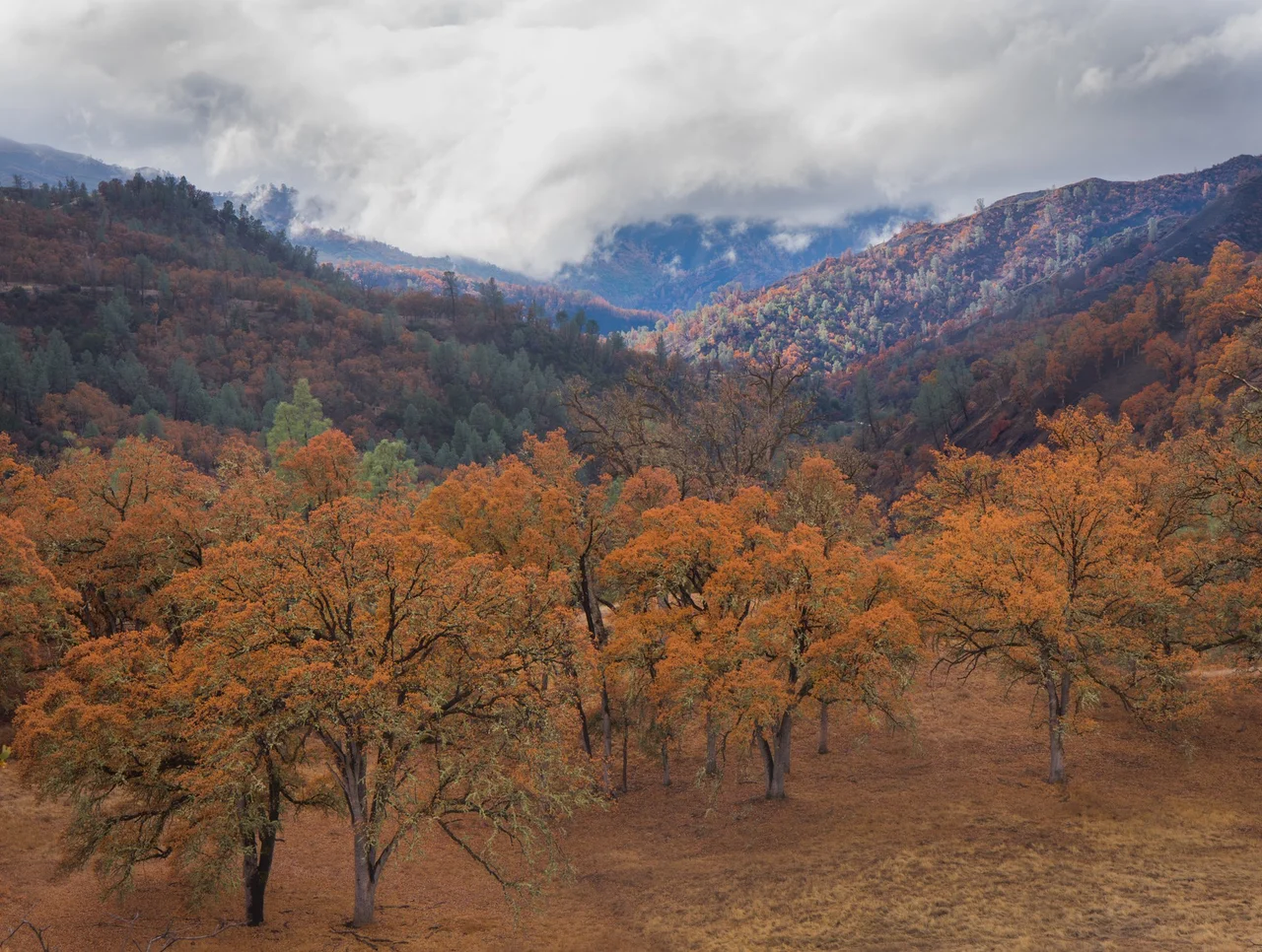

Berryessa Snow Mountain National Monument
The Berryessa family left their name on a lake, and the lake left its name on a mountain, and together they gave a name to one of the most improbable national monuments in California. Improbable because it protects no single iconic peak or famous canyon. Instead it strings together a hundred-mile corridor of the Coast Ranges, from the oak woodlands of Mendocino County south to the ridges flanking Lake Berryessa in Napa and Yolo counties. The monument exists not because of spectacle but because of stubbornness: the stubborn diversity of its wildlife, the stubborn survival of its rare plants, and the stubborn advocacy of communities who fought for a decade to win its protection. When President Obama signed the proclamation on July 10, 2015, he preserved 344,476 acres of terrain that most Californians had never heard of and almost none could find on a map.
A Californio Name on Ancient Land
The monument takes its name from the Berryessa family, prominent Californios whose roots in the Bay Area stretch to the days of Spanish and Mexican California. Their surname endures on the lake, the valley, and now the national monument itself. But human habitation here predates any European surname by thousands of years. At least eight linguistically distinct Native American peoples have called this landscape home for roughly 11,000 years: the Yuki, Nomlaki, Patwin, Pomo, Huchnom, Wappo, Lake Miwok, and Wintun. That so many language groups overlapped in a single corridor speaks to the richness of the land. Rivers full of salmon, forests thick with game, hillsides loaded with acorns -- this was not marginal country. It was a crossroads, and it sustained dense, complex societies long before anyone drew a property line.
The Serpentine Garden
What makes Berryessa Snow Mountain ecologically extraordinary is not its size but its soil. Serpentine rock, California's state rock, weathers into a toxic stew of heavy metals that most plants cannot tolerate. The species that thrive here are specialists, described as particularly delicate serpentine plants clinging to otherwise barren and rocky mountainsides. They grow nowhere else. Above them, the high-elevation Snow Mountain area ranks as one of the most biologically diverse regions in the state. Bald eagles and golden eagles patrol the thermals. Mountain lions and black bears share the ridges with tule elk and black-tailed deer. In the streams below, California Coastal chinook salmon and Northern California steelhead complete spawning runs that connect this inland landscape to the Pacific. The northern spotted owl, the marten, and the fisher round out a roster of wildlife that reads like a field guide to California's rarest species.
The Lake That Was Left Out
Lake Berryessa sits squarely within the monument's geography, but you will not find it within the monument's boundaries. When the coalition pushing for protection drafted its proposal, critics raised a pointed concern: could monument status eventually restrict motorized boats, jet skis, and watercraft on the lake? The question was enough to carve the lake out of the proclamation entirely. It is a distinctly Californian compromise -- protecting the wild ridges and canyons while leaving the reservoir to its recreational users. The result is a monument shaped like a doughnut in its southern section, embracing the lake on all sides without actually touching it. Cache Creek Wilderness, Cedar Roughs, and Snow Mountain Wilderness all fall within the boundaries. The lake does not.
Molok Luyuk and the Expanding Vision
Nearly a decade after the monument's creation, President Biden expanded it on May 2, 2024, adding 13,696 acres that include an 11-mile ridgeline called Molok Luyuk. The name comes from the Patwin language, one of those eight indigenous tongues still echoing through the landscape. The expansion reflected a broader pattern in federal land protection: recognizing not just ecological value but cultural significance, and doing so in partnership with the tribal nations whose ancestors shaped these places. Berryessa Snow Mountain now encompasses 344,476 acres across seven counties -- Napa, Yolo, Solano, Lake, Colusa, Glenn, and Mendocino. It is jointly managed by the U.S. Forest Service and the Bureau of Land Management, a dual administration that mirrors the monument's own identity as a place that defies tidy classification.
A Hundred Miles of Quiet
From the air, the monument reads as a long crease in the landscape, running north-south through the rumpled hills of the inner Coast Ranges. There are no entrance gates, no visitor centers, no shuttle buses. This is not Yosemite. The trails are lightly used, the roads are often rough, and the solitude is genuine. That anonymity is both its vulnerability and its charm. A journalist writing in 2015 praised the joys of isolation here, and little has changed since. The monument protects a California that most people fly over without noticing -- oak savanna giving way to chaparral, chaparral yielding to conifer forest, and everywhere the pale green shimmer of serpentine barrens where life persists against the odds.
From the Air
Centered at approximately 39.22N, 122.77W in the California Coast Ranges. The monument extends roughly 100 miles north-south from Mendocino County to Napa/Yolo counties. Lake Berryessa is a prominent visual landmark on the southern end. Snow Mountain (7,056 ft) is the highest point. Nearest airports include Nut Tree Airport (KVCB) in Vacaville to the southeast and Ukiah Municipal Airport (KUKI) to the northwest. Terrain rises significantly; maintain safe altitude over ridgelines. Mountain weather can produce turbulence and low visibility, especially along the western slopes.
Nearby Stories
- Where the Tule Boats Still Race 1.4 km away
- Sites Reservoir 7.6 km away
- Rico Harris 13 km away
- Point Arena Air Force Station 20 km away
- Hendy Woods: A Dying Man's Promise That Saved a Forest 25 km away
- August Complex Fire 29 km away
- Bidwell Mansion State Historic Park 47 km away
- Fort Gaston 168 km away