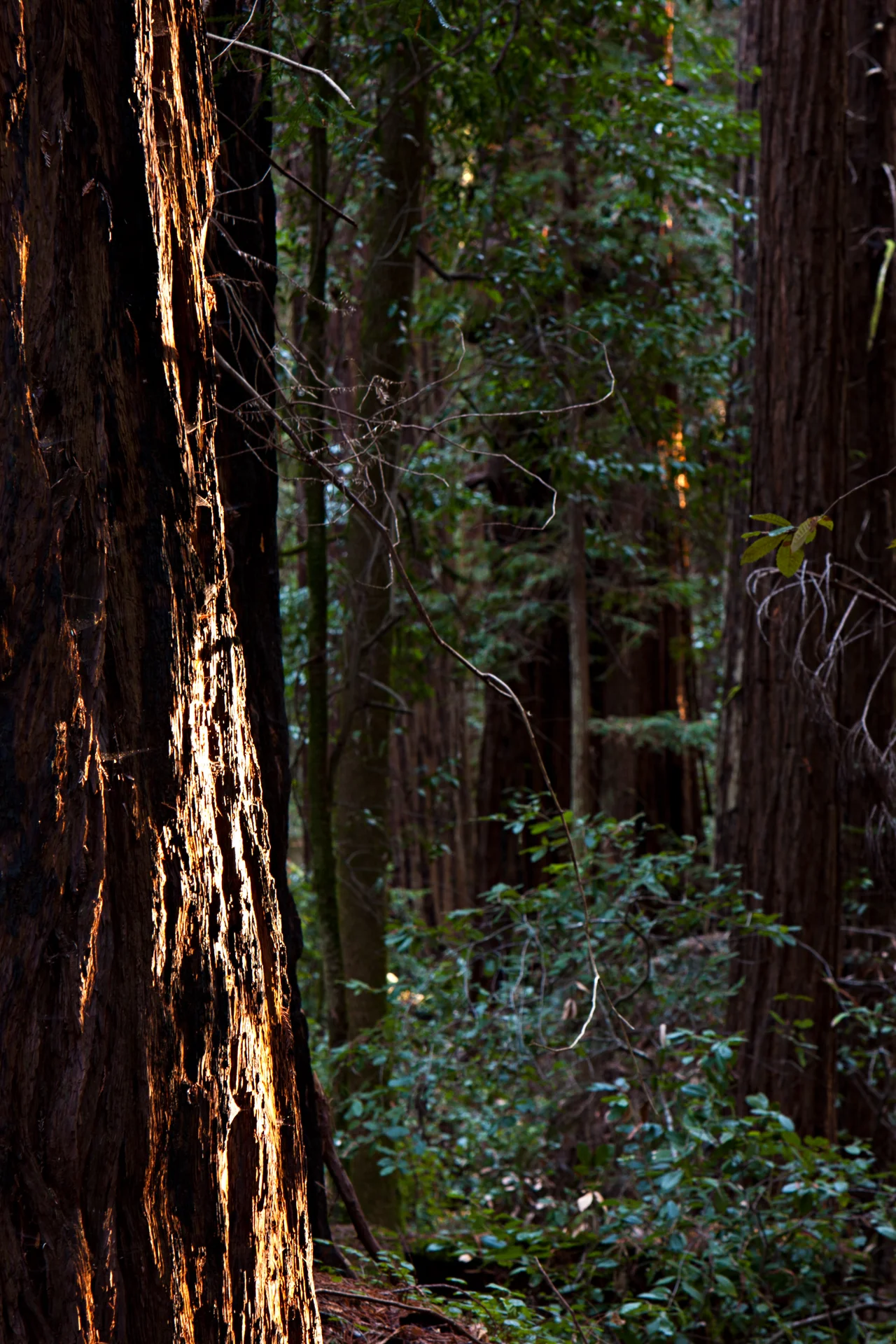

Hendy Woods: A Dying Man's Promise That Saved a Forest
Joshua Hendy was dying, and he had one condition. The English-born blacksmith who had crossed a continent chasing gold, who had built a sawmill on the Navarro River and made his living cutting timber, wanted two groves of coast redwoods left standing. When he wrote his will in 1891, he bequeathed the property to his nephews with that stipulation attached. It was, by any measure, an unlikely act of conservation from a man in the lumber business. But the groves survived -- through four changes of ownership, through a logging boom that stripped Mendocino County bare, through a corporate acquisition by the Masonite Corporation in 1948 that brought industrial forestry roaring back to the region. The trees Hendy wanted protected still stand today, some of them over 300 feet tall and nearly a thousand years old, in 816 acres of parkland nestled in the Anderson Valley of Mendocino County.
Before the Sawmill
The Pomo people lived in the forests of the Anderson Valley for thousands of years, sustaining themselves as hunter-gatherers in a landscape dominated by redwoods, madrone, Douglas fir, and California laurel. Russian fur traders arrived first among Europeans, claiming Pomo lands and forcing the Pomo people into servitude. The colonization devastated their population and way of life. Today, the remaining Pomo communities are greatly reduced in number. The valley they inhabited for millennia now draws visitors from San Francisco for weekend camping, a three-hour drive that crosses worlds of geography and history. What the Pomo managed sustainably for thousands of years, European settlers nearly destroyed in decades.
Big Hendy and Little Hendy
Two groves anchor the park: Big Hendy, at 80 acres, and Little Hendy, at 20 acres. Both contain old-growth coast redwoods, trees that were already centuries old when Joshua Hendy first saw them. The park sits about 20 miles inland from the coast, and that distance matters. Freed from the fog and chill that blankets the coastal redwood forests, the Anderson Valley is noticeably warmer, giving these inland groves a different character than their seaside relatives. The park also holds 3.3 miles of frontage along the Navarro River, providing the only public access to the river within the Anderson Valley. It is a place where ancient trees meet wine country -- the surrounding valley has become one of Mendocino County's premier winemaking regions, making Hendy Woods an unlikely neighbor to tasting rooms and vineyards.
Four Owners, Zero Chainsaws
The remarkable thing about Hendy's deathbed wish is that it held. His nephew Samuel Hendy honored the stipulation until his money ran out, then sold the property to the Pacific Coast Lumber Company. The land passed next to the Albion Lumber Company, then in 1930 to the Southern Pacific Land Company, and in 1948 to the Masonite Corporation, which bought a vast stretch from the park site all the way to the coast and built a fiberboard mill in Ukiah. Each new owner could have logged the groves. None did. Whether out of respect for Hendy's original wish, legal caution, or simple indifference, the old-growth redwoods remained untouched while everything around them was cut. The land finally entered the California State Park system in 1958, ending a 67-year chain of custody that somehow never broke the promise of a dead blacksmith.
The Fight to Stay Open
In 2012, Hendy Woods faced a different kind of threat. California's budget crisis put 70 state parks on a closure list, and Hendy was among them. The math was deceptively simple: the park cost $468,000 per year to operate and collected $239,000 in fees, leaving a gap of $229,000. But that calculation ignored the nearly 50,000 visitors per year who poured an estimated $2.8 million into Mendocino County's economy through lodging, dining, and wine tasting. In November 2011, a group of protesters affiliated with the Occupy movement camped in the park -- despite the campground being officially closed for winter -- to draw attention to the shortsightedness of the cuts. Local fundraising campaigns rallied communities across the state to save their parks, and Hendy Woods survived again. The closure never happened.
Among the Giants
Walking through Big Hendy today, the scale is disorienting. Trees 300 feet tall create a canopy so dense that the forest floor exists in permanent twilight, carpeted in ferns and sorrel. The air smells of damp bark and earth. Sound works differently here -- voices carry strangely, absorbed by the sheer mass of wood. These are not the tallest redwoods in California, nor the most famous, but they carry a particular weight. They are the trees one man decided to save, not because he was a conservationist or a politician, but because he had spent a lifetime cutting timber and knew what it meant to lose something that could not be replaced. The Anderson Valley wineries draw most of the tourists to this corner of Mendocino County. The redwoods remind them why they stay.
From the Air
Located at 39.07°N, 123.47°W in the Anderson Valley of Mendocino County, approximately 110 miles north of San Francisco. From altitude, the park appears as a dense patch of old-growth forest contrasting with the surrounding vineyards and mixed woodland of the Anderson Valley. The Navarro River threads along the park's western edge. Nearest airports include Ukiah Municipal Airport (KUKI), about 20 miles northeast, and Little River Airport (KLLR) on the coast. The valley runs northwest-southeast, flanked by coastal hills that create the warmer microclimate distinguishing this inland redwood forest from its coastal counterparts.
Nearby Stories
- Gualala River 9.5 km away
- Robinson Rancheria: The Tribe That Came Back 12 km away
- Cyrus 20 km away
- The Asbill Massacre 54 km away
- August Complex Fire 54 km away
- SS Camden 824 km away
- Westport, Washington 865 km away
- Red Sand Beach 3646 km away