
Bibra Family
Stand on the dry, wind-scoured flank of Dirk Hartog Island, at the far western edge of Australia, and you are about as far from a medieval German cathedral as it is possible to get. Yet the name carried on the wind here, the name of the man who leased this island in 1869 to graze sheep and dig guano, belongs to one of the oldest noble houses of Franconia. The von Bibra family had been barons and prince-bishops in Bavaria and Thuringia for centuries before one of their sons washed up on the edge of Shark Bay. How a German dynasty older than most nations ended up tied to this lonely island is a story that spans an ocean and nearly a thousand years.
Knights, Bishops, and a Famous Tomb
The House of Bibra was Uradel, ancient nobility, with records reaching back to a Rupertus de Bibra named in a document of 1119. For roughly a century and a half, from the mid-1400s to about 1600, they were among the most powerful families in Franconia, rising from imperial knights to barons of the Holy Roman Empire. Two of them, Lorenz and Conrad, became Prince-Bishops of Würzburg, ruling as both churchmen and dukes. Lorenz left the most beautiful trace of all: his tomb in Würzburg Cathedral, carved by the great late-Gothic sculptor Tilman Riemenschneider, is considered one of that master's finest works. The bishop reclines in stone, sword and crozier in hand, the twin emblems of worldly and spiritual power held by a single family.
A Castle Held Through Every Storm
The family's seat was Burg Bibra, near Meiningen in Thuringia, reportedly the longest continuously family-owned castle in the region, held since written records began and kept even through the decades of communist East Germany. The Bibras did not have an easy run of luck. By 1600 plague and the celibacy of their many churchmen had thinned the bloodline, and after one death in 1602 a rival prince-bishop seized much of their property, triggering a lawsuit that ground on for seventy-nine years. They never fully recovered their old dominance, but they endured. Among the later generations was Ernst von Bibra, born in 1806, a restless polymath who was a chemist, zoologist, novelist, duellist, and one of the first scientists to study mind-altering plants, a discipline he helped invent.
The Family That Sailed South
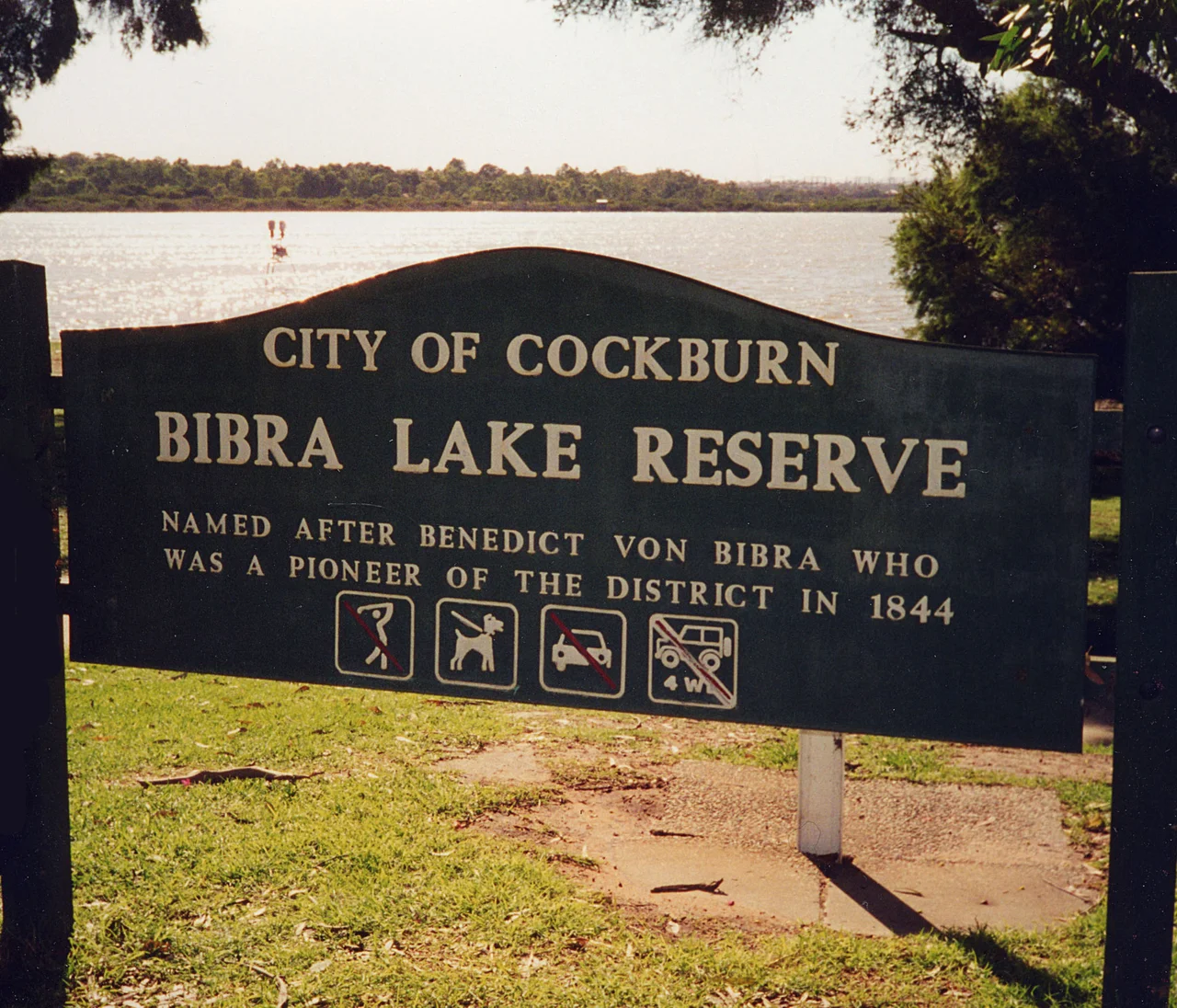
By the nineteenth century the Bibras had scattered far from Franconia, to Austria, Britain, the United States, and to the bottom of the world. Franz Ludwig von Bibra, a soldier and author born in 1783, became an early settler of Tasmania. His sons carried the name onward across Australia. One, Benedict von Bibra, arrived in the Swan River Colony from Tasmania in the early 1830s and made his living as a carpenter between Perth and Fremantle; in 1843 he bought land beside a seasonal lake the local Beeliar Noongar people called Walliabup, and today that suburb of Perth bears his name as Bibra Lake. The barons' descendants had become tradesmen, settlers, and graziers on a continent the family's medieval ancestors could never have imagined.
A Baron's Name on a Desert Island
It was another of Franz Ludwig's sons, Francis Louis von Bibra, who brought the name to Shark Bay. In 1869 he was granted a lease over Dirk Hartog Island, the long, arid barrier island that shelters the bay from the open Indian Ocean. There he ran sheep across the spinifex and traded guano, the seabird droppings then prized as fertiliser, shipped out from the island's bays. It was a hard, isolated life, worlds away from cathedral tombs and baronial castles. Yet that is the strange reach of this single family: a name first written in a Latin charter in 1119 came to mark a stretch of the Western Australian coast, carried there by a younger son chasing a living at the far end of the earth.
From the Air
The Western Australian end of the Bibra story centres on Dirk Hartog Island, near 25.93 degrees south, 114.23 degrees east, in the Shark Bay World Heritage Area. From the air the island is a long, dun-coloured strip with dramatic limestone cliffs facing the open ocean to the west and sheltered bays and seagrass shallows to the east, where von Bibra once shipped guano. Shark Bay (Monkey Mia) Airport, ICAO YSHK, near Denham is the closest field, just across the eastern gulf; Carnarvon Airport (YCAR) lies to the north. The region is arid with reliably clear skies and superb visibility. Recommended viewing altitude 2,000 to 5,000 feet to take in the contrast between the surf-battered western cliffs and the calm, luminous waters of the bay.
Nearby Stories
- Shark Bay Marine Park 2.5 km away
- Woodleigh Impact Structure 15 km away
- Heirisson Prong 15 km away
- Hamelin Pool Marine Nature Reserve 23 km away
- Pimbee National Park 31 km away
- Hartog Plate 62 km away
- Carnarvon Tracking Station 92 km away
- Mount Narryer 138 km away