
Block 5A, South Sudan
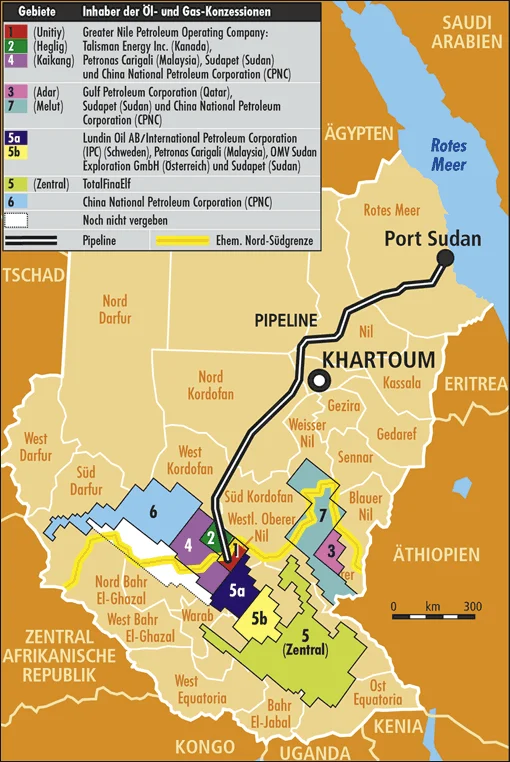
Out of 240,000 people, 12,000 died and 160,000 were driven from their homes. Those are the numbers that international investigators settled on for what happened in Block 5A during the war that preceded South Sudan's birth. The block is an oil concession - a rectangle drawn on a map of the Muglad Basin, covering the central part of Unity State west of the White Nile and extending into Warrap and Jonglei. Before the oil companies arrived, Block 5A was a floodplain fed by rivers from the Congo, Uganda, Kenya, and Ethiopia, home to Nuer pastoralists of the Bul, Leek, Jagei, Western Jikany, and Dok sections, and to the Thiang Nuer on the southern part of Zeraf Island. Then a pipeline was drawn across it.
Before the Pipeline
The people who lived here did so by rhythm more than by calendar. In the dry season, the land parches and pastoralists move their herds in search of grazing, keeping close to rivers and permanent wetlands. In the wet season, the low country floods and families move to higher ground. Leer, a town in Dok Nuer territory, stood in a key position near the block's center. Riek Machar, the rebel commander who would later dominate so much of South Sudan's story, was born in Leer. This was his home country. Chevron had prospected for oil here as early as 1982, finding a strike about four hours' walk northwest of Koch - but after rebels killed three of Chevron's expatriate workers in February 1984, the company left the field. For a while, the swampy, inaccessible country was strategically worthless to Khartoum. That changed when the pipeline changed.
The Road from Bentiu
In February 1997, the Sudanese government granted the Block 5A concession to a consortium: Lundin Oil of Sweden, OMV of Austria, Petronas of Malaysia, and Sudapet of Sudan. In 1998, the consortium established a drilling site at Ryer in Jagei Nuer territory, built an unpaved road from Bentiu north through Duar and Guk to Thar Jath. They brought in hundreds of Arab and Chinese laborers and gave little work to local people. At the same time, a government-supported militia under Paulino Matiep began attacking communities along the new road. Residents of the Ryer area were told to leave with little notice in 1998, taking only their cattle, and their houses were destroyed. In June, July, and August of that year, Paulino's forces attacked Leer - looting and destroying the hospital, the NGO compounds, the churches. A World Food Programme representative described thousands of people hiding in swamps for days, 'surviving on just water lilies and fish.'
What Satellite Photos Showed
The scale of what happened was such that you could see it from space. A Landsat study comparing 1999 to 2004 found that farming activity had collapsed in 10-kilometer bands along the new oil roads. The fields around Nhialdiu - where a series of village attacks had been reported for three consecutive years - showed no agriculture at all by 2002. Traditional farming areas had been abandoned; cultivation was drifting south and west, away from the oil infrastructure. The International Crisis Group described the pattern in February 2003: 'The offensive from late December until the beginning of February was an extension of the government's long-time strategy of depopulating oil-rich areas through indiscriminate attacks on civilians in order to clear the way for further development of infrastructure.' The report went on to detail abductions of women and children, mass rape, helicopter gunships, burning villages. The consortium's operations suspended and resumed in step with the military offensives.
The Trial in Stockholm
There was an outcry in Sweden. Lundin sold its stake to Petronas in 2003. Talisman Energy, the Canadian company working adjacent blocks, sold its interests in Sudan to India's ONGC Videsh in October 2002, the Talisman president telling shareholders they were 'tired of continually having to monitor and analyse events relating to Sudan.' A 2003 Human Rights Watch report accused the consortia of having deliberately ignored the methods Khartoum used to clear their concessions. In June 2010, a Swedish prosecutor opened an inquiry. In November 2021 - more than two decades after the worst of the displacement - criminal charges were brought against two former Lundin executives. Company chairman Ian Lundin and board member Alexander Schneiter were charged with aiding and abetting war crimes committed during the seizure of Block 5A. Their trial opened September 5, 2023, and is scheduled to run until February 2026.
The Marshes Remember
Production started at Thar Jath in 2006, at an initial rate of 40,000 barrels per day. By 2008, children in Koch were reportedly dying from drinking contaminated water; local officials counted more than 1,000 suffering from unknown illnesses. In 2009, the German NGO Sign of Hope tested the water in Rier, near the Thar Jath central processing facility, and found critical levels of salts, cyanides, lead, nickel, cadmium, and arsenic. The all-weather oil roads had disrupted the drainage of the marshes, creating blockages over eight kilometers long. The pollution had begun to reach the Sudd, a wetland of international importance under the Ramsar convention. The Nile floods what it has always flooded. The salt in the water does not wash out. The families who fled to Bentiu and Mankien have some of them returned and some of them have not. The block produces oil. The marshes remember everything.
From the Air
Block 5A spans approximately 8.74°N, 30.14°E in Unity State, South Sudan, west of the White Nile in the Muglad Basin. From cruise altitude over this stretch of Upper Nile, the Thar Jath central processing facility and the unpaved oil road running north from Bentiu are visible as clearings and straight cuts through the flooded grassland of the Sudd margins. Nearest airport: Bentiu Airport (ICAO: HSBT), a gravel strip. Regional hubs: Juba International (ICAO: HSSJ) to the south, Malakal Airport (ICAO: HSSM) to the east. Heavy cloud and haze common May-November.
Nearby Stories
- Bahr al-Arab 10 km away
- Leer, South Sudan 18 km away
- Mechra el Rek 25 km away
- Unity State 40 km away
- Sudd 67 km away
- Ayod County 111 km away
- Doleib Hill 120 km away
- Warrap 141 km away