
Bocchoris (city)
In flat farmland near Port de Pollença, a long line of ancient wall still runs through the fields, and its gateways still stand open to the air. This is nearly all that visitors can see of Bocchoris, one of the oldest cities on Mallorca — a settlement whose roots reach back to around 1400 BC. The ground around it has never been excavated, so most of Bocchoris remains exactly where it has always been: underground, waiting. Yet for a place so thoroughly forgotten, it once held a remarkable distinction. Rome, the greatest power of the ancient world, treated this small Balearic town not as a conquest but as a formal ally.
A Wall in a Farmer's Field
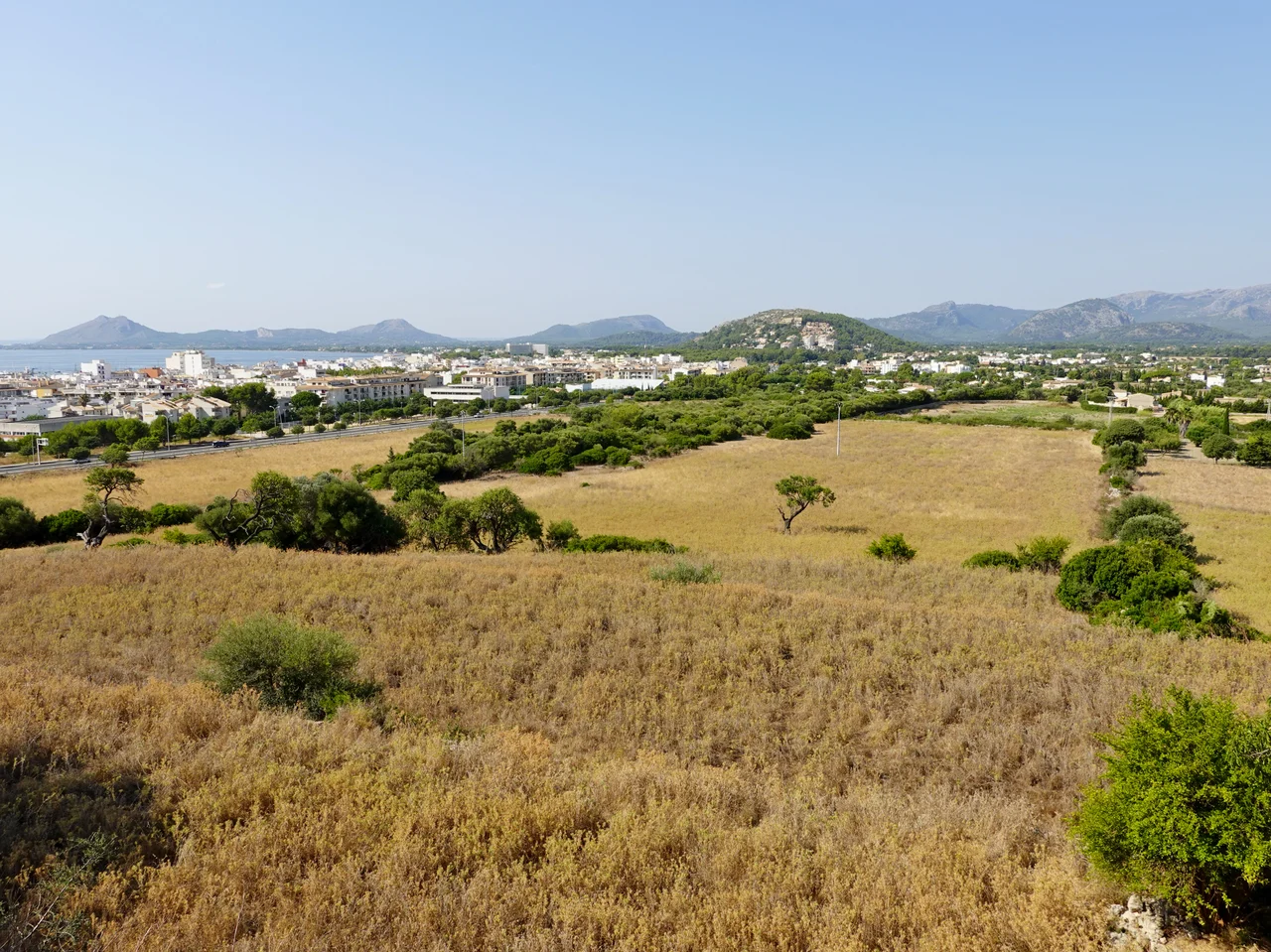
Bocchoris lay near the modern town of Port de Pollença, on a hill just off the road that runs up to Pollença, in the area of the Boquer Valley. What survives above ground is spare but striking: a long stretch of the old town wall and its entrance gates, still standing in what is now flat, worked farmland. The rest lies buried and unstudied — the surrounding fields have never been dug — which means the city keeps most of its secrets. For an ancient settlement of such age, so little disturbed, that intact wall in the middle of ordinary countryside is a quietly astonishing thing to come upon.
Rome's Balearic Ally
Bocchoris earns its place in history through a rare legal status. Among all the towns of Mallorca, it alone is documented as a civitas foederata — a federated city, formally allied to Rome rather than simply ruled by it. Pliny the Elder recorded the arrangement in his Naturalis Historia in the first century AD, in a passage that also captured the islanders' fearsome reputation. 'The Baleares, so formidable in war with their slingers,' he wrote, listing the island's towns and naming 'Bocchorum' as a federate town. The Balearic slingers were among the ancient Mediterranean's most feared warriors, prized as mercenaries, and Bocchoris was one of the communities that produced them.
Names Cast in Bronze
The proof of that alliance came out of the ground in the form of bronze tablets. Two such tabulae patronatus — patronage inscriptions — record Bocchoris formally choosing powerful Romans as its protectors. The first, found in the Bay of Pollença in 1951 and dated to 10 BC, names the city's patron as Marcus Licinius Crassus Frugi, who had served as a Roman consul in 14 BC. The second was discovered far earlier, in 1765; dated to 6 AD, it records the Senate and people of Bocchoris selecting the Roman senator Marcus Atilius Vernus as their patron by mutual consent. These small bronze plaques are the closest thing Bocchoris has to a signature — its own name, and its own decisions, cast in metal two thousand years ago.
Bocchor, Boquer, and a Poet's Egypt
Even the city's name is uncertain. Scholars cannot agree whether it was truly Bocchor, Bocchoris, or Bocchorum, and its origins are lost. What is certain is that the name never entirely died: it survives, worn down by centuries, in the Catalan word Boquer, which still labels the valley near Port de Pollença. The name also fired the imagination of the Mallorcan poet Miquel Costa i Llobera, who in his epic La deixa del geni grec — built on the legend of the seeress Nuredduna — wrote that Egyptians had founded Bocchoris in the deep past, tying its name to the pharaoh Bakenranef. He had the idea from his friend, the archaeologist Fidel Fita. It is almost certainly legend rather than history, but it suits a city that has kept so much of itself hidden.
Pliny's Islands
Bocchoris comes down to us largely through a single ancient paragraph, and it is worth reading in full. In listing the Balearics, Pliny the Elder recorded that the Greeks had called them the Gymnasiae, and that the larger island — Mallorca — measured a hundred miles in length and four hundred and seventy-five around. He named its towns in order of their standing: Palma and Pollentia, whose people held the rights of Roman citizens; Cinium and Tucis, with the lesser Latin rights; and Bocchorum, the federate town. In that brisk civic ranking, drawn up two thousand years ago, a small city near the Boquer Valley took its place among the notable settlements of the island — the last time, perhaps, that Bocchoris stood clearly in the historical light.
From the Air
Bocchoris lies at 39.9122°N, 3.0814°E on a low hill inland from Port de Pollença, in Mallorca's northeast. From the air the site itself is subtle — a line of ancient wall in flat farmland — so navigate instead to the striking cleft of the Boquer Valley, which runs down toward the coast nearby and is the area's clearest landmark, with the Bay of Pollença and the Formentor peninsula just beyond. A viewing altitude of 2,500–4,000 ft frames the valley and bay together. Palma's airport (LEPA) is about 55 km to the southwest; Menorca (LEMH) lies east across open water. Low-angle morning or evening light best reveals the old wall's line across the fields.
Nearby Stories
- Jewish quarter of Inca 6.4 km away
- Andratx 17 km away
- Hypogeum of Torre del Ram 25 km away
- Llobregat Delta 120 km away
- Cala de Sant Vicent 126 km away
- Montjuic Cemetery 141 km away
- Shipwreck of Dellys 315 km away
- Cosquer Cave 365 km away