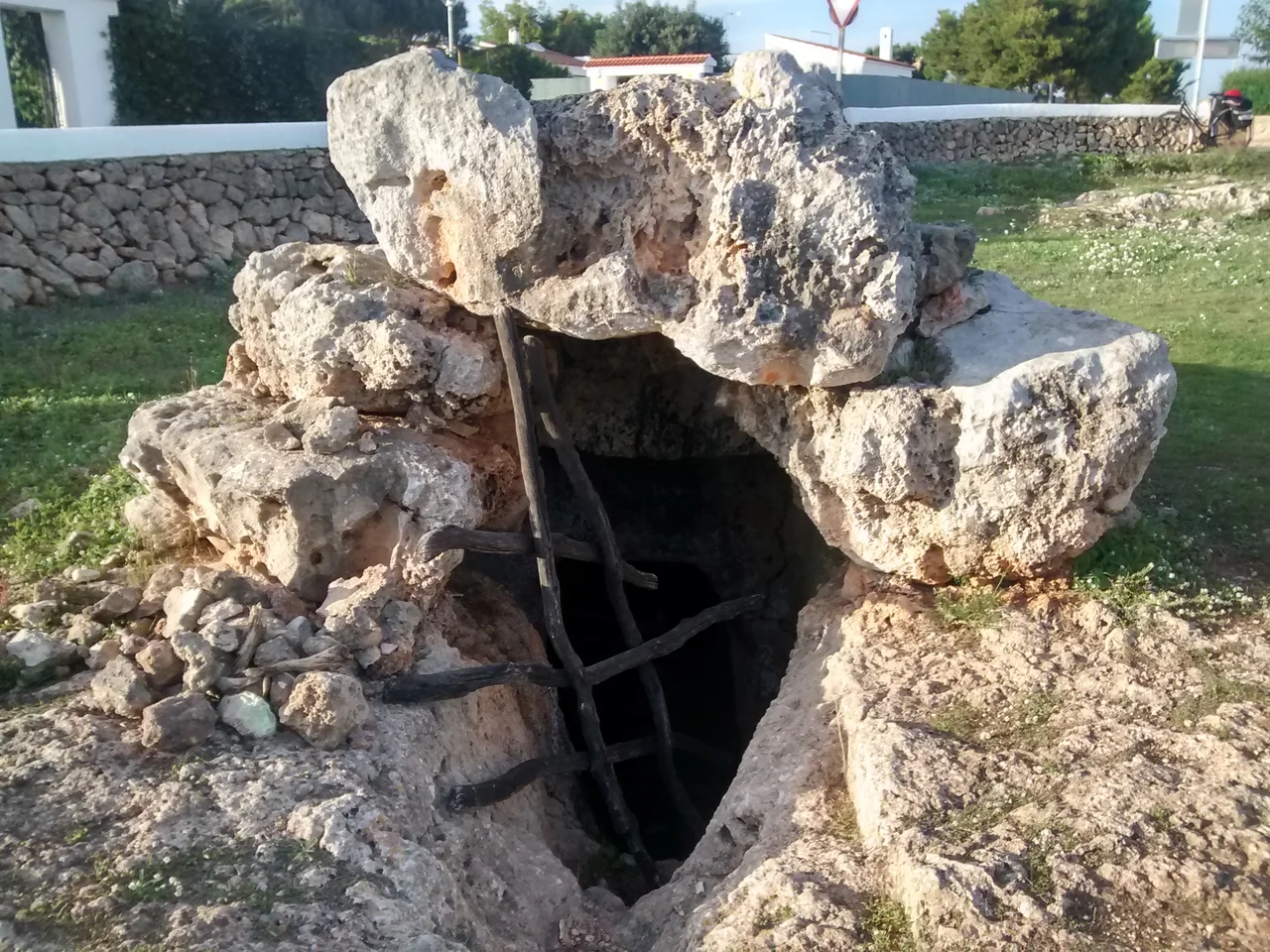

Hypogeum of Torre del Ram
Someone once turned a tomb into a barn. Near Cala en Blanes, on the coast west of Ciutadella, a rock-cut chamber that Bronze Age islanders built to hold their dead was later swept clean and pressed into service as a cattle shelter. In doing so, whoever emptied it erased almost everything worth knowing: the bones of the people laid to rest here, the offerings buried with them, the dates that would have anchored the whole story. What remains is the architecture itself and a handful of strange carvings, a tomb that has to be read like a ruined manuscript with most of its pages torn out.
A Tomb Turned Barn
The Hypogeum of Torre del Ram was a collective tomb, a place where a family or a small community returned again and again to bury their dead together. Because it was gutted in later centuries and reused for livestock, archaeologists lost the direct evidence that would normally date it, the interred population, the grave goods, the layered chronology of use. They have to reach the answer sideways instead. The tomb so closely resembles other prehistoric burials scattered across Menorca that it can be placed between 1700 and 1400 BC with real confidence, even without a single surviving skeleton to confirm it.
Down the Stepped Corridor
The design still reads clearly. A stepped corridor, a little over two and a half meters long, descends toward a rectangular chamber, and around the inner walls of that chamber runs a carved stone bench where the dead were likely laid. The chamber is generous for its age, nearly nine meters long, two and a half wide, and just under two meters high. Part of the stone gallery that once roofed the corridor and entrance still survives, assembled in the Cyclopean technique, the method of fitting massive unmortared blocks that gives Menorca's ancient monuments their brooding, giant-built look. To stand at the entrance is to look down the same steps mourners once descended.
Three Ships on the Wall
Then there are the carvings. On the walls of the inner chamber, someone incised three sailing ships and a scatter of other figures whose meaning has been lost. It is a tantalizing image for a seafaring island: vessels cut into stone in a tomb, as if to carry the dead across water. Some scholars argue the engravings are genuinely ancient, a rare glimpse of Bronze Age boats. Others caution that no one has actually dated them, and that they could have been added in any later century by any passing hand. The ships sail on, unplaceable in time, which only deepens their pull.
The Silence of the Missing
What makes Torre del Ram haunting is not what it holds but what it lost. Every collective tomb is a record of a community's memory, generations returning to the same dark chamber to honor their own. When the chamber became a byre, that record was scattered, and the specific people who mattered here, whose names and lives were once bound up in this rock, slipped beyond recovery. The bench, the steps, and the three ships are what survived the careless centuries. They are enough to prove that people grieved here, and not quite enough to tell us who they grieved for. In a landscape as thick with prehistoric monuments as Menorca, that partial silence is its own kind of testimony, a measure of how much has been lost even where so much remains standing.
From the Air
The hypogeum sits at 40.0057 N, 3.8095 E, inland of the Cala en Blanes coast just west of Ciutadella on Menorca's northwest tip. The site itself is a modest ground-level feature, so navigate by the coastline: recommended viewing altitude is 2,000 to 3,500 feet to follow the low rocky shore and the resort coves west of the city. The long harbour inlet and cathedral tower of Ciutadella lie a short distance to the southeast. Menorca airport (LEMH) is about 47 km east near Maó; Palma de Mallorca (LEPA) is west across open water. Clear, calm conditions between the island's frequent tramuntana winds offer the best low-level look at this coast.
Nearby Stories
- Colom Island 6.2 km away
- Bocchoris (city) 11 km away
- Kingdom of Majorca 16 km away
- Castle of Capdepera 22 km away
- Llobregat Delta 145 km away
- Somorrostro 178 km away
- Gouraya National Park 338 km away
- Cosquer Cave 343 km away