.jpg)
Somorrostro
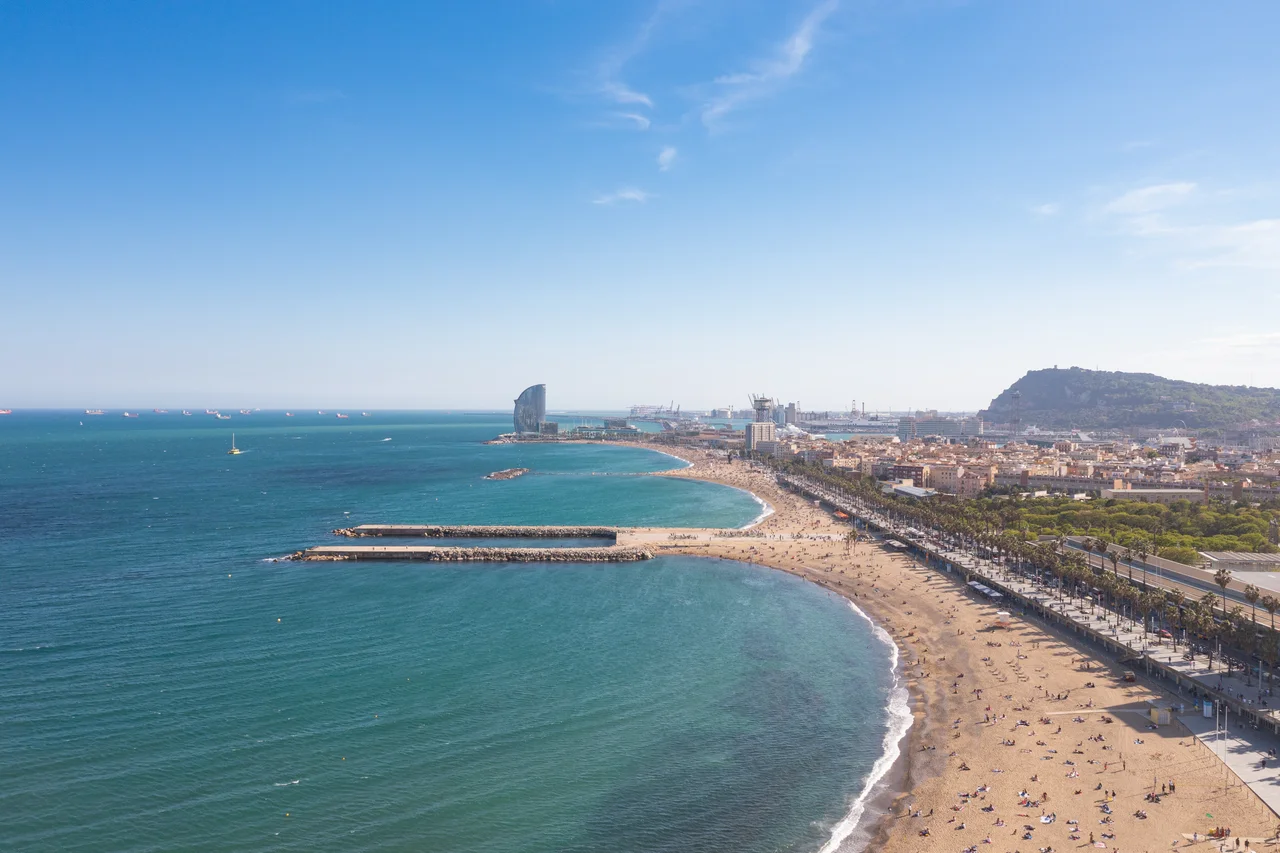
A girl learned to dance on this sand, in a hut with no electricity and no running water, and grew up to conquer the stages of the world. Her name was Carmen Amaya, and she was born in 1918 in Somorrostro, then not a beach at all but a sprawling shanty town on the eastern edge of Barcelona. Today Somorrostro is a clean strip of Mediterranean sand between the Hospital del Mar and Marina Street, 522 meters long and 89 wide, crowded with sunbathers in summer. Almost none of them know that a neighborhood of fifteen thousand people once stood where they lay their towels, or that the beach nearly lost its name entirely.
The Name That Was Erased
For decades this stretch of shoreline had no name of its own. The shanty town that gave it identity was cleared away, and as the beach filled instead with swimmers and joggers, the word Somorrostro slipped out of common use, remembered only by the old and the displaced. The erasure was quiet but real, the kind of forgetting that happens when a poor community is removed and a pleasant amenity takes its place. It was not until 2010 that the city of Barcelona formally restored the original name to this section of the waterfront. Giving the beach its name back was a small act, but it was also a return of memory, an acknowledgment that the sand had a history worth naming.
Fifteen Thousand Lives on the Shore
Through the nineteenth century and much of the twentieth, Somorrostro and the beaches around it were home to a self-built neighborhood of more than two thousand shacks housing some fifteen thousand people, many of them from Barcelona's Roma community. It is easy, from a distance, to reduce a shanty town to a statistic or a slum, but this was a place where people lived full lives: raising families, working the docks and the sea, making music, marking births and deaths within sight of the water. They built what the city would not build for them. The clearance came slowly, beginning around the 1966 visit of the dictator Francisco Franco and continuing through demolitions that stretched from the 1960s into the 1980s, until the last of the huts was gone and the neighborhood existed only in memory.
La Capitana
The greatest thing Somorrostro gave the world came from one of its poorest homes. Carmen Amaya was born in the shanty in 1918, reportedly in hut number 48, and learned flamenco on the beach itself, dancing on the sand before she ever saw a stage. She would become one of the most electrifying dancers in the history of the art, nicknamed La Capitana, the Captain, for the ferocity of her command. She was the first woman to master the thunderous, high-speed footwork long reserved for male dancers, and she scandalized and thrilled audiences by performing it in men's trousers, breaking one convention with every step. Wherever she danced, from Barcelona to Buenos Aires to Hollywood, she carried the name of the beach where she was born, proof that a place written off as a slum could produce a genius. Her story is a rebuke to anyone tempted to see Somorrostro only as a problem to be cleared away, for the same poverty and the same tight-knit Roma community that outsiders pitied were also the soil in which one of the twentieth century's great artists took root.
Witnessed by History
Somorrostro also caught the eye of history at a hinge moment. In 1936, at the outbreak of the Spanish Civil War, the photographer Gerda Taro made one of her memorable images here, Woman Training for a Republican Militia, capturing a woman crouched in exercise on this very shore. The photograph freezes a beach that was, for a time, a place where ordinary lives and epochal events overlapped. That layering is the real story of Somorrostro: a beach that has been a refuge, a slum, a cradle of art, a backdrop to war, and finally a place of leisure. The sunbathers may not know it, but they are lying on ground that once held a whole world of its own.
From the Air
Somorrostro Beach lies at 41.383N, 2.196E, on Barcelona's eastern waterfront, between the Hospital del Mar and the marinas of Port Olimpic. From 1,500 to 3,000 feet it appears as a pale ribbon of sand along the Mediterranean, just southwest of the twin towers and yacht basin of Port Olimpic and northeast of the dense Barceloneta peninsula. Barcelona-El Prat (LEBL) is about 13 km down the coast to the southwest, Sabadell (LELL) sits inland to the northwest beyond the Collserola hills, and Girona (LEGE) lies to the northeast. In clear coastal light the straight modern shoreline stands out sharply, giving no hint of the self-built neighborhood that once crowded this same stretch of beach.
Nearby Stories
- Vilafranca del Penedès 7.5 km away
- Montseny Massif 18 km away
- National Day of Catalonia 27 km away
- Torre dels Escipions 37 km away
- Tarragona Amphitheatre 86 km away
- Argelers concentration camp 102 km away
- Cap de Formentor 135 km away
- Palace of the Kings of Majorca 144 km away