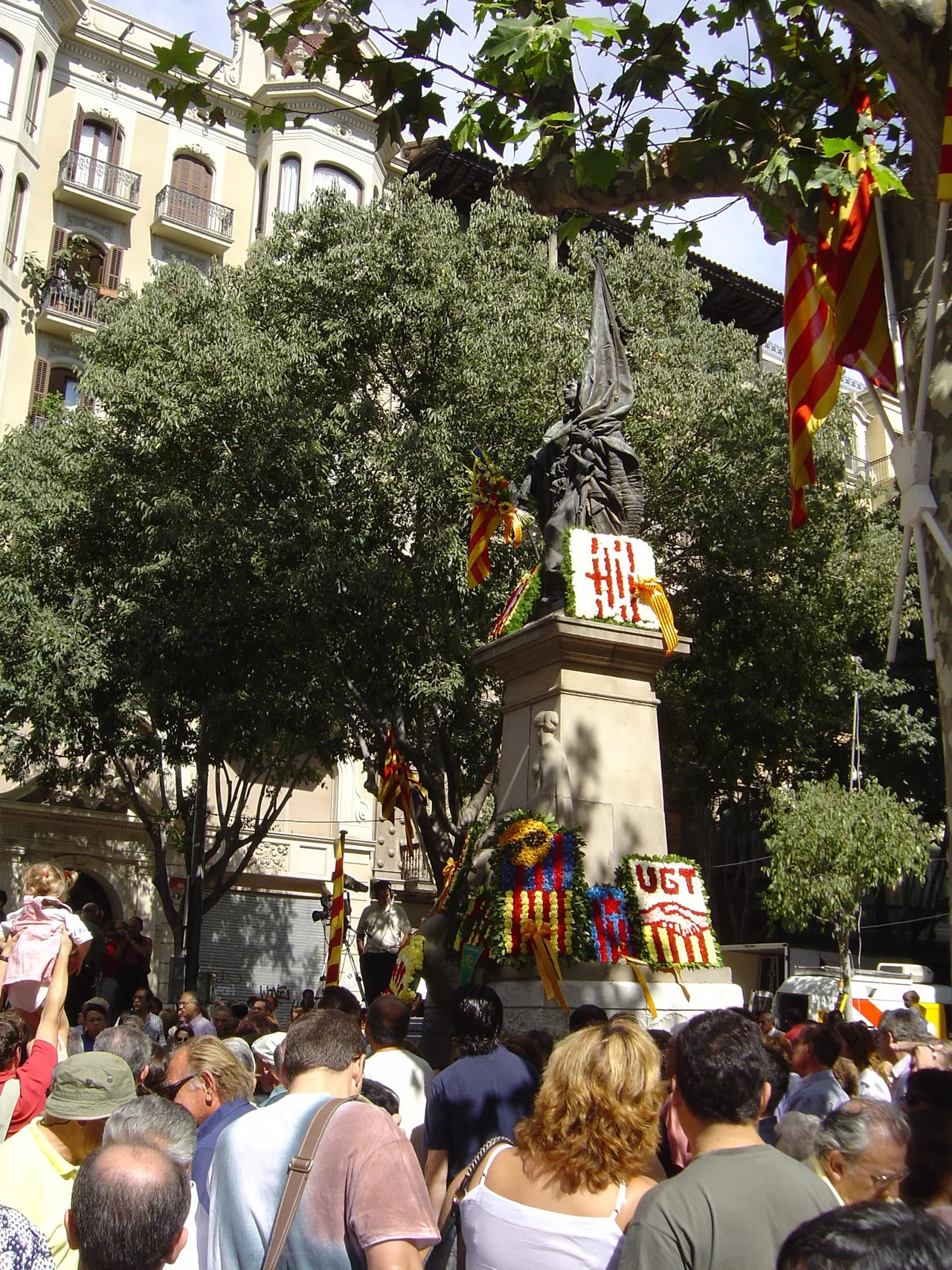

National Day of Catalonia
Most nations hold their great celebration on the day they won something: a war, their independence, a founding. Catalonia does the opposite. Every 11 September, Catalans mark the day in 1714 when their capital fell, their army was crushed, and their self-government was abolished. The Diada, as it is known, commemorates a defeat, and it has become one of the most powerful expressions of Catalan identity precisely because of it. It remembers the end of the Siege of Barcelona, when after fourteen months the city surrendered to the combined armies of Spain and France, and with that surrender Catalonia lost the institutions and laws that had made it a distinct nation.
The Fourteen-Month Siege
The roots of the day reach back to the War of the Spanish Succession, the great European conflict over who would inherit the Spanish throne. Catalonia had backed the Habsburg claimant, but when the Peace of Utrecht in 1713 recognized the Bourbon Philip V as king, its allies withdrew and left the region exposed. Rather than submit to the repression they saw coming, the Catalans made a fateful choice. On 9 July 1713 their assembly, the Junta de Braços, voted to fight on alone to defend the Catalan constitutions and their lives. Barcelona's own citizen militia, the Coronela, joined the improvised Army of Catalonia. The siege that followed lasted fourteen months. It ended on 11 September 1714, when the Spanish and French forces broke through and the city's chief councillor, Rafael Casanova, fell wounded defending the wall.
What Was Lost
Defeat brought exactly the repression the Catalans had feared. In 1716 the victorious Philip V imposed the Nueva Planta decrees, which swept away most of Catalonia's distinct institutions at a stroke: the Catalan Courts, the Generalitat that governed the region, and the Consell de Cent that had run Barcelona for centuries. The Principality of Catalonia ceased to exist as a self-governing entity and was absorbed as a mere province into a centralized, French-style Kingdom of Spain. Its laws, its assemblies, and its separate status were gone. This is what the Diada actually mourns and honors, not a battle won but a way of governing lost, along with the memory of the people who died trying to keep it. That sense of something taken has given the day its enduring emotional charge.
A Holiday Suppressed and Reborn
For a long time the loss could only be commemorated quietly, and the day's own history mirrors Catalonia's political fortunes. It was first marked publicly in 1886, and in 1888 a statue of Rafael Casanova became its gathering point. The Diada of 1923 drew a huge crowd and more than a thousand floral offerings, but clashes left seventeen people injured, and soon afterward the dictatorship of Primo de Rivera banned it. The Second Spanish Republic embraced and institutionalized the celebration in the 1930s, only for Franco's regime to suppress it again in 1939 and cart off Casanova's monument; Catalans kept it alive in secret, hanging flags and passing leaflets. Not until 1976, a year after Franco's death, was it openly celebrated once more. In 1980 the newly restored Parliament of Catalonia made its official recognition the very first law it passed.
Flowers and Flags
Today the Diada has its own rituals. Political parties, institutions, and ordinary citizens lay floral offerings at the monuments to the defenders, above all Rafael Casanova and General Josep Moragues. Many gather at the Fossar de les Moreres, the square built over the mass grave where Barcelona's fallen were buried, to honor those who died in the siege. Across Catalonia people hang the senyera, the striped Catalan flag, from their balconies, and pro-independence supporters add the estelada, its star-bearing variant. Through the 2010s the day grew more overtly political, its demonstrations swelling into some of the largest independence rallies Europe has seen. Whatever one makes of that politics, the Diada remains a rare thing: a national day that draws its strength not from triumph but from grief, memory, and a refusal to forget.
From the Air
The National Day is centered on Barcelona, though this entry is pinned inland at 41.8375°N, 1.5378°E, in the Catalan hinterland roughly 60 km northwest of the city. The Diada's true landmarks are urban: the Fossar de les Moreres and the Rafael Casanova monument in central Barcelona, where crowds gather each 11 September. From the air on the day itself, the tell is the senyera flags draped across countless city balconies. Barcelona-El Prat (LEBL) lies on the coast to the southeast, Sabadell (LELL) sits between this point and the city, and Girona (LEGE) is about 90 km northeast. Clear, warm late-summer skies are typical for the date.
Nearby Stories
- Battle of the Segre 6.6 km away
- Vic Cathedral 12 km away
- Abric Romaní 17 km away
- Bombing of Granollers 17 km away
- Roca dels Bous (archaeological site) 18 km away
- Catalan Romanesque Churches of the Vall de Boi 41 km away
- Abbey of Saint-Martin-du-Canigou 45 km away
- Aiguestortes i Estany de Sant Maurici National Park 68 km away