
Abric Romaní
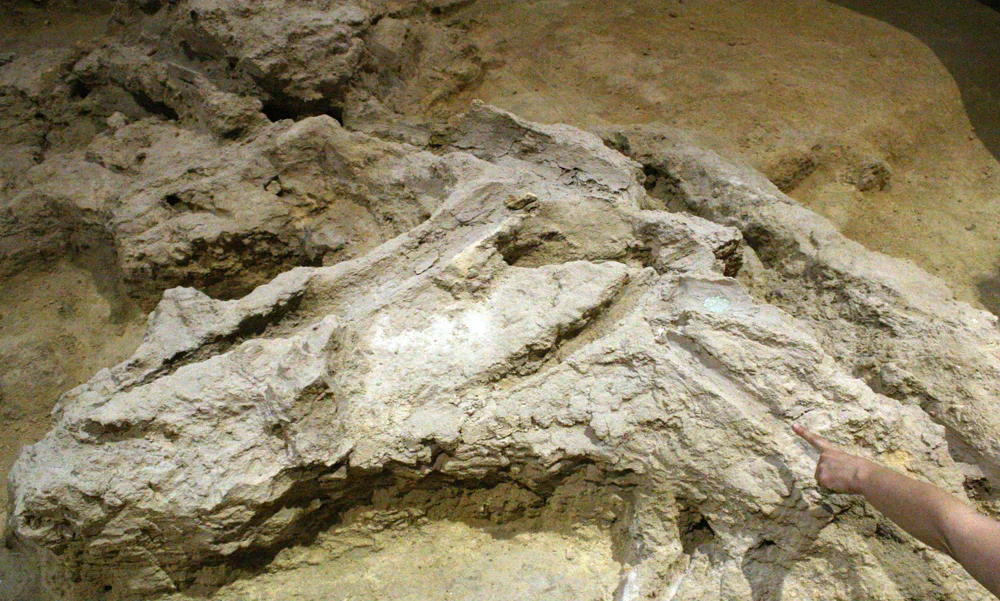
Wood rots. Give it sixty thousand years and it should vanish entirely, leaving archaeologists to reconstruct ancient lives almost wholly from stone and bone. Yet at the Abric Romaní, a rock overhang above the small Catalan town of Capellades, the wood survived, after a fashion. Water heavy with dissolved limestone once trickled over this cliff, coating everything it touched in travertine and freezing the shape of every branch and sharpened stick into stone. The result is a record of Neanderthal life found nowhere else on the planet: the ghosts of wooden tools, cast in rock, made by people who lived and worked here between 70,000 and 39,000 years ago.
A Cliff That Turned Wood to Stone
The shelter sits sixty meters above the Anoia river, tucked beneath cliffs the locals call the Cingles d'El Capelló. Geologically the whole mountain is travertine, a pale sedimentary limestone that forms when calcium precipitates out of warm, mineral-laden water. Here the water did more than build the cliff. As it flowed, it buried whatever lay in its path under fresh layers of stone. Beneath the overhang lies a deposit some twenty meters thick, holding 27 distinct archaeological layers identified by 2011. Nearly all belong to the Middle Paleolithic, the long age of the Neanderthals, with only the topmost layer left by the modern humans who followed. Radiocarbon and uranium-thorium dating anchor the whole sequence between roughly 70,000 and 39,000 years ago. The overhang's original dome-shaped roof, a fossilized crust of tuff, has largely collapsed and eroded over the millennia, yet enough survives to show how the shelter once arched protectively over the people who camped beneath it.
The Ghosts of Wooden Tools
What makes the site extraordinary is what the travertine trapped. As debris, clay, and calcium-rich water washed over discarded wood, the mineral crust preserved either the wood itself or a perfect hollow impression of it in the limestone. Nowhere else on Earth have such conditions been found. Most of the remains are rounded sticks, a few the size of small tree trunks, others mere branches two or three centimeters across. From these casts, researchers can glimpse a dimension of Neanderthal life that almost always disappears without a trace: how they shaped and used wood, an everyday material that leaves no fossil in ordinary circumstances. The oldest wooden remains reach back around 70,000 years, quiet evidence that these were skilled woodworkers, not the brutes of old caricature.
Stone Blades and a Changing of the Guard
The stone record is just as rich. More than 5,000 pieces of worked flint have come out of the shelter, the oldest, from layer G, dated to about 56,000 years ago. The Neanderthals who made them worked in the Mousterian tradition, striking flakes and blades from carefully prepared cores and sometimes using the sophisticated Levallois technique to control the shape of each piece. Some tools were meant for the hunt; a striking number were meant for working wood, tying the flint and the wooden casts into a single picture of daily labor. In the youngest layer, dated to roughly 39,000 years ago, the tools change character entirely. They belong to the Aurignacian, the signature of modern humans, marking the moment our own species arrived and the last Neanderthals gave way.
Quarry, Graveyard, Landmark
Long before anyone grasped its importance, the site was simply useful stone. Quarrymen cut into it during the 1300s and 1400s, and in the 1800s it served as a burial ground under the name Balma del Fossar Vell, the shelter of the old graveyard. That changed in 1909, when Amador Romaní Guerra recognized the ancient artifacts, gave the overhang his own name, and moved the recent human remains to the Capellades cemetery before he began to dig. Later teams carried the work forward: the Catalan Institute of Studies before the Spanish Civil War, then Eduard Ripoll and Henry de Lumley across fifteen years from the 1950s, and since 1989 the prehistory department of the Rovira i Virgili University in Tarragona. No Neanderthal bones have ever surfaced here, only the traces of their hands, which somehow feels more intimate.
From the Air
Abric Romaní lies at 41.5337°N, 1.6884°E, above Capellades in the Anoia valley, about 50 km west-northwest of Barcelona and 300–320 m above sea level. From the air the marker is the pale travertine escarpment of the Cingles d'El Capelló standing over the green ribbon of the Anoia, the town clustered at its foot. Best viewed from 2,000–3,000 ft AGL. Sabadell (LELL) sits about 35 km east, Barcelona-El Prat (LEBL) roughly 50 km southeast on the coast, and Girona (LEGE) some 90 km northeast. Inland skies are often clear, though summer haze can soften the valley.
Nearby Stories
- Llobregat Delta 2 km away
- National Day of Catalonia 3.7 km away
- Battle of the Segre 6.7 km away
- Siurana (Tarragona) 12 km away
- Vic Cathedral 16 km away
- Bombing of Granollers 17 km away
- Roca dels Bous (archaeological site) 18 km away
- Autódromo de Sitges-Terramar 18 km away