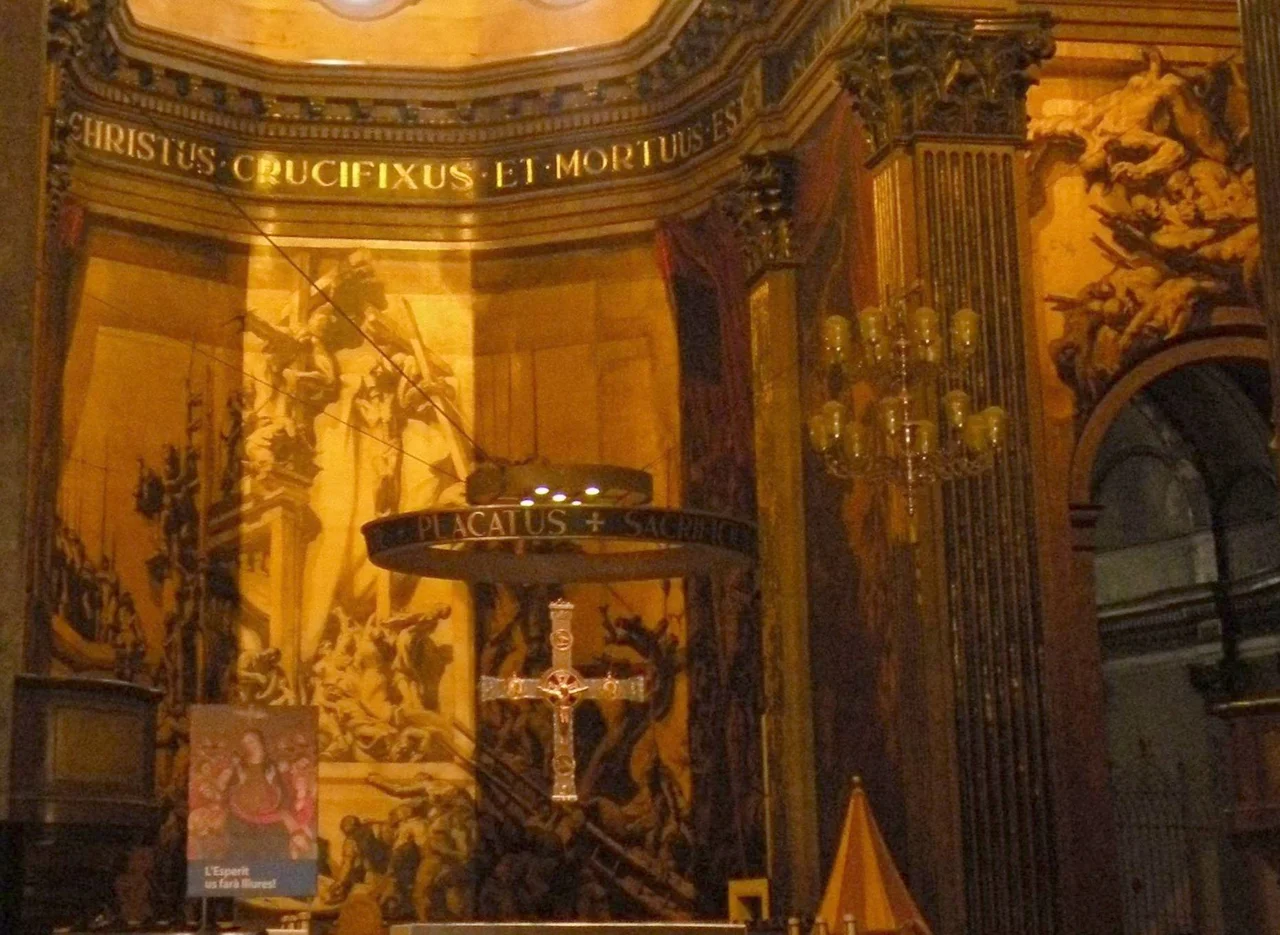

Vic Cathedral
The Catalan painter Josep Maria Sert covered these vast white walls once, filling them with brooding, gold-shadowed canvases. In 1936, at the outbreak of the Spanish Civil War, fire consumed nearly all of it. Sert returned and painted the entire interior a second time, then died before he could finish the last panels. That doubled labor is fitting for a building that has been torn down and raised again for fourteen centuries. Vic Cathedral, officially the Cathedral of St. Peter the Apostle, is a church that refuses to settle into any single era.
Fourteen Centuries of Rebuilding
A cathedral in Vic is documented as early as the year 516, though no one is certain where that first paleochristian and Visigothic basilica actually stood. It was most likely destroyed during the Arab invasion of 717 to 718. When Count Wilfred the Hairy repopulated the area in 886 and restored the bishopric, the faithful raised a modest provisional church of rammed earth. In the 10th century, with the Christian frontier more firmly held, they rebuilt again, this time in stone, with three naves and two sister churches devoted to Saint Mary and Saint Michael. The pattern was already set: whatever stood on this ground would eventually be pulled down and replaced by something more ambitious. Few European cathedrals carry so many demolitions in their story.
Oliba's Romanesque and What Survived
A century later, Abbot Oliba rebuilt the cathedral in a monumental Romanesque style, consecrated in 1038 by Archbishop Wilfred of Narbonne. Its bell tower rose 46 meters, standing slightly apart from the main building, and it still stands today, together with the crypt beneath. That crypt is the cathedral's quiet treasure. Its carved capitals are older than the 1038 church itself, salvaged and reused from the 10th-century temple that came before. Vic never received the soaring Gothic reconstruction that reshaped most European cathedrals. Instead it accumulated pieces over time: an upper cloister begun in 1318, and a delicate alabaster altarpiece finished by the sculptor Pere Oller in 1428. Both survive, small islands of medieval craft embedded inside a much later shell.
The Neoclassical Gamble
By the late 18th century, the old fabric was giving way to a grand new plan. The unusual round church of Santa Maria la Rodona, a sister temple that had stood for centuries, was demolished in 1787 to clear space; its outline is now marked in the pavement of the cathedral square, its foundations left open by excavation. The first stone of the present church was laid on 24 September 1781, and it was consecrated on 15 September 1803, the work of Vic-born architect Josep Moretó i Codina in a severe academic neoclassical style. Scholars have never much warmed to it. They call the white-stone facade cold and disproportioned, its Doric and Tuscan orders applied against their own rules. The building is admired less for its exterior than for what later happened within.
Painted, Burned, Painted Again
Between 1926 and 1930, Josep Maria Sert covered the bare interior with enormous oil canvases, and in 1931 the cathedral was declared a Historic Artistic Monument. Five years later, at the start of the Civil War, revolutionary mobs set the church alight; the vaulting collapsed and Sert's work was lost, surviving only in photographs. He began again in 1939 and worked until his death in 1945, when his disciples completed the final panels in his manner. The second version is darker and less colorful than the first. Sert's figures are massive and almost monochrome, built from golds, browns, and ochres with sudden touches of red, and the play of chiaroscuro lends the flat walls a startling sense of depth. The temple reopened in 1945, its cycle of redemption painted in the shadow of its own destruction.
The Tombs and the Bones
Along the north side of the temple runs a series of Baroque chapels, the surviving fragment of a 17th-century plan for yet another new cathedral. Under the bell tower, the chapel of Sant Bernat Calbó honors a 13th-century bishop of Vic who rode with James I of Aragon in the conquest of Valencia; his body rests in a great silver-plated reliquary, wrought by the goldsmith Joan Matons between 1700 and 1728. In the two-story cloister, Romanesque below and Gothic above, lies the grave of Jaume Balmes, the philosopher born in Vic, crowned by a statue moved here in 1865. To walk this building is to travel through Catalan history in stone, from a rammed-earth chapel on a frontier to a painter's determined second act.
From the Air
Vic Cathedral stands at 41.928°N, 2.256°E on the edge of the old town of Vic, about 60 km north of Barcelona. Recommended viewing altitude is 3,500-5,000 ft AGL. The clearest landmark from the air is the freestanding 46 m Romanesque bell tower beside the pale neoclassical block of the church, near the river Mèder. The whole basin is prone to morning fog, so favor midday passes. Nearest airports: Sabadell (LELL) and Barcelona-El Prat (LEBL) to the south, Girona (LEGE) to the east. Best visibility on clear afternoons after the basin fog clears.
Nearby Stories
- Bombing of Granollers 5 km away
- Castle of Cardona 6.1 km away
- Abric Romaní 15 km away
- Abbey of Saint-Martin-du-Canigou 39 km away
- Argelers concentration camp 46 km away
- Cave of Niaux 72 km away
- Palace of the Kings of Majorca 86 km away
- Cap de Formentor 192 km away