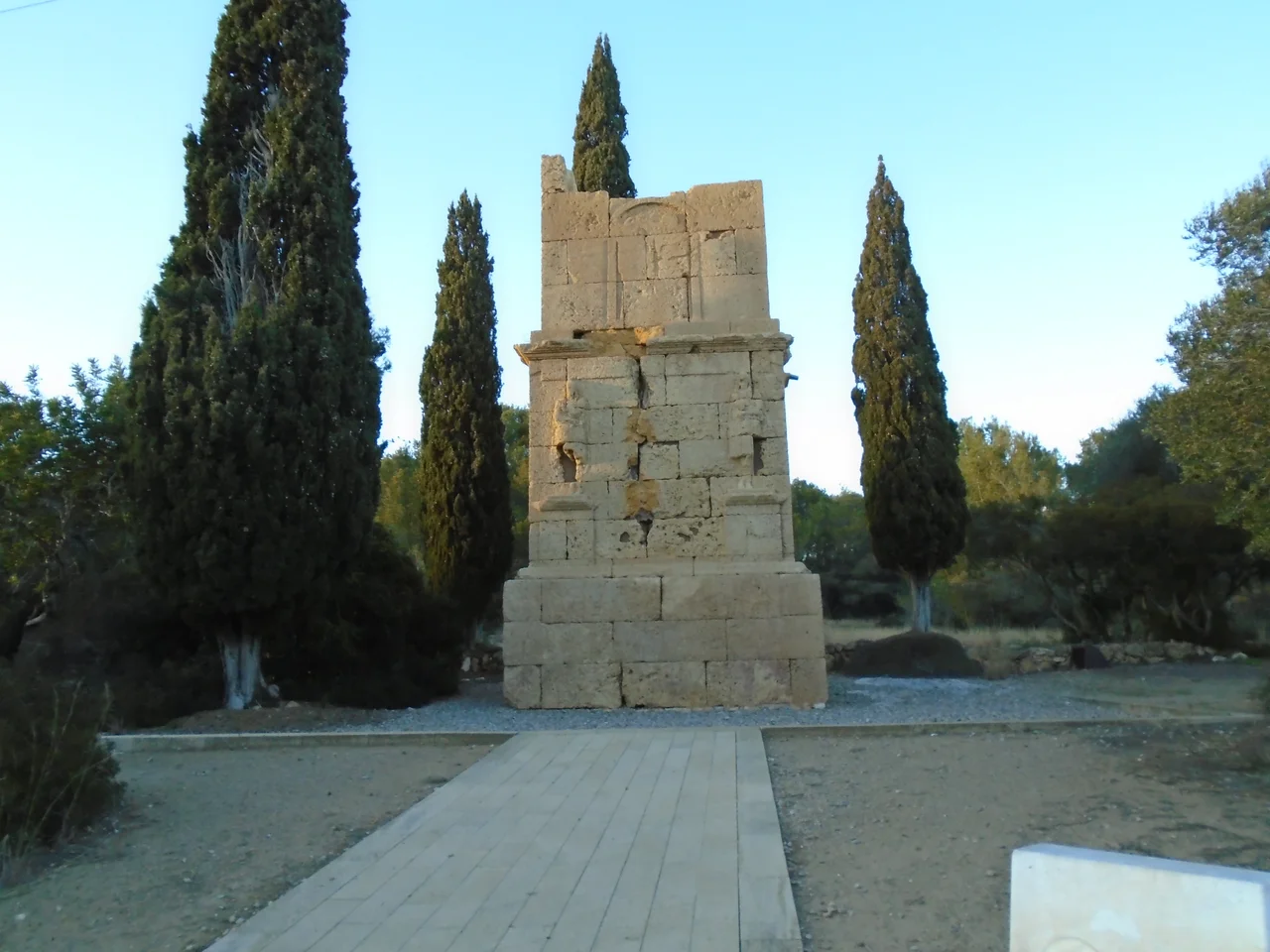

Torre dels Escipions
The tower is named for two men who are almost certainly not buried in it. For centuries, travelers on the road out of Tarragona looked up at the pair of carved figures on this Roman tomb and saw the Scipio brothers, the generals who brought Rome to Spain, and the name Tower of the Scipios stuck fast. It was a mistake. The figures are not the Scipios at all but the Phrygian god Attis, and the identity of whoever actually rests here has been lost for nearly two thousand years. What survives is the monument itself, three tiers of weathered stone standing where the Romans meant the dead to be seen.
A Tomb Beside the Road
The Romans did not bury their dead in the heart of the city. By custom and by law, the departed were laid to rest outside the walls, and the roads leading out of town became avenues of tombs, so that every traveler entering or leaving passed among the monuments of the deceased. The Torre dels Escipions belongs to exactly this tradition. Built in the 1st century AD, it stands about six kilometers from Tarraco, then capital of the Roman province of Hispania Citerior, along the Via Augusta, the great highway that ran the length of the peninsula from the Pyrenees down to Gades, present-day Cádiz. That road was the busiest artery in Roman Spain, carrying merchants, officials, and legions past this spot in an unending stream. To be remembered, a Roman tomb needed an audience, and here it had one of the finest in the province, a place where the dead could keep company with the living traffic of an empire.
The God of Death and Rebirth
The tower rises in three superimposed stories set on a tapering base, built from rectangular stone blocks. On its intermediate level are the two reliefs that gave the monument its fame and its confusion: images of Attis, the Phrygian god associated with death and resurrection. The choice was fitting for a tomb. A deity who died and returned offered the dead a promise of renewal, and his carved presence turned a block of stone into a statement of hope. On that same level lies the burial chamber itself, which once held the furnishings that accompanied the deceased into the afterlife, its base measuring roughly 4.4 by 4.7 meters. Everything about the design was meant to carry a person's memory forward through time.
The Tower That Wears a Wrong Name
The famous name is a case of mistaken identity that history refused to correct. For years, the two weathered figures of Attis were read as portraits of the brothers Publius and Gnaeus Cornelius Scipio, the Roman commanders who fought and died in Spain during the Second Punic War. It was an understandable error and an appealing one, linking the tomb to the founding legends of Roman Tarraco. Even after scholars recognized the figures as a Phrygian god rather than two Republican generals, the old name held, too deeply rooted in local memory to shift. So the monument goes on being called the Tower of the Scipios, a small lesson in how a good story, once attached to a place, can outlast the facts that were supposed to anchor it. Names, it turns out, are among the most durable things a monument carries, more durable sometimes than the truth.
One of the Last of Its Kind
Whatever we call it, the tower matters because so few like it remain. It is counted among the most important funerary monuments of the Roman era still standing on the Iberian Peninsula, a rare survivor of a form that once lined roads across the empire. Today it is one element of the Archaeological Ensemble of Tarraco, inscribed on the UNESCO World Heritage List and catalogued under the code 875-010. It stands a little northeast of the city, beside the route of the ancient road, exactly where its builders placed it to catch the eye of passersby. Two millennia on, it still does its job, drawing the gaze of travelers who pause to wonder who lies within.
From the Air
The Torre dels Escipions stands at 41.132N, 1.319E, a few kilometers northeast of central Tarragona along the line of the old Via Augusta, near the modern coastal highway. It is a small vertical monument best located from 2,500 to 4,000 feet by tracing the coast road out of the city toward the northeast. Reus (LERS) lies about 9nm west, Barcelona-El Prat (LEBL) roughly 48nm northeast, and Lleida-Alguaire (LEDA) some 52nm northwest. Clear Costa Daurada visibility helps pick out the tower's setting between the shoreline and the inland fields.
Nearby Stories
- Miravet 8.9 km away
- Montblanc 9.5 km away
- Freixenet 13 km away
- Amposta 13 km away
- Roca dels Moros 17 km away
- Sitges 21 km away
- Battle of Ebro River 32 km away
- Sa Calobra 136 km away