
Sitges
Twice a year, in a town otherwise known for its ease, Sitges throws off its composure entirely. Carnival arrives, and forty floats and two thousand costumed revellers pour through streets that spend the rest of the year strolling gently down to the sea. It is a fitting contradiction for a place of many lives. Thirty-five kilometres southwest of Barcelona, on the sweep of coast called the Costa Dorada, the Golden Coast, Sitges has been a fishing village, a painters' pilgrimage, a beach resort and one of Europe's most welcoming gay destinations, sometimes all at once.
Seventeen Beaches
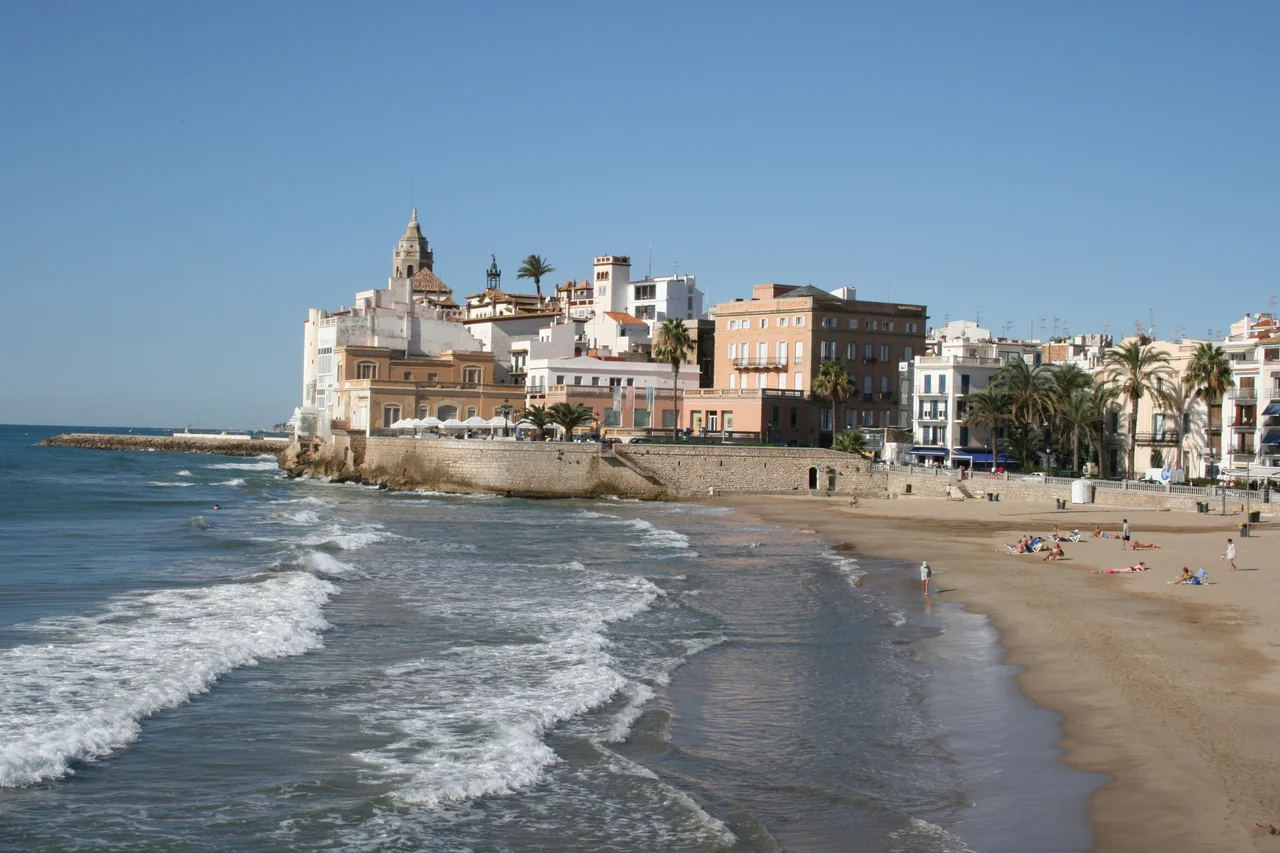
The sea is the whole point. Sitges counts seventeen sandy beaches strung along its coast, from Les Botigues in the east near Castelldefels to the harder-to-reach coves in the west. Most of the town and eastern beaches fly the European Union's blue flags for water quality and post flags reporting the state of the sea each day. The town itself, a huddle of white houses gathered around the seafront church, overlooks the Mediterranean with broad avenues behind and narrow lanes within. It is a small place, best crossed on foot, by taxi, or on a rented electric bike, and the light that pours off the water is the same light that once drew a generation of Catalan painters here.
A Coast That Welcomed Everyone
Sitges has long held one of the liveliest gay scenes on the Spanish coast, and that reputation is not incidental. In a country where being openly gay was criminalized well into the twentieth century, a town that welcomed people as they were mattered a great deal, and Sitges became a place where visitors and residents could simply be themselves by the water. Its beaches reflect that ease: several, including Platja dels Balmins and Platja d'Aiguadolç to the east and the more secluded Platja del Muerto to the west, are given over to naturists and used by every part of the community. The result is a shoreline that feels, by design, open to all comers.
Carnestoltes
The Carnival, Carnestoltes in Catalan, is the town's wildest hour, and it follows the old liturgical rhythm. It opens on Dijous Gras, Fat Thursday, with the arrival of King Carnestoltes, and it runs until the burial of the sardine late on Ash Wednesday afternoon. In between come folk dances, communal meals of the local salad, and two great processions: the Rua de la Disbauxa, the Debauchery Parade, on Sunday night, and the Rua de l'Extermini, the Extermination Parade, on Tuesday. Around forty floats and more than two thousand participants fill the streets, and for a few nights the tidy resort surrenders completely to spectacle.
Malvasia and Xató
The local table has its own quiet treasures. Sitges's signature dish is xató, a winter salad of endive, salt cod, tuna, anchovies and black olives whose real soul is the sauce, a pounded mixture of scalded chillies, toasted almonds and garlic. To finish, there is malvasia, a delicate dessert wine whose name traces back to the Peloponnesian port of Monemvasía. In an unusual arrangement, the town's Hospital de Sant Joan Baptista still makes malvasia the traditional way, from its own vines and in its own cellars, producing about four thousand bottles a year and giving the proceeds to charity. Few glasses of wine come with a better story attached.
Beyond the Beach
For all its seafront glamour, this is a small town of some thirty thousand people, and the wild country begins right behind it. Sitges backs directly onto the Parc del Garraf, a rugged expanse of pale limestone hills, and it serves as a trailhead for the GR-5, a long-distance path that threads north from here through the Garraf and on across some of Catalonia's finest natural parks, Montserrat, Sant Llorenç del Munt i l'Obac, Montseny, before finishing on the coast beyond. The city itself is easy to reach and easy to leave. Frequent trains from Barcelona cover the distance in little more than half an hour, and drivers can choose between the fast C-32 toll motorway inland and the free C-31, which clings to the cliffs above the sea.
From the Air
Sitges lies at 41.2339 N, 1.8042 E, on the Costa Dorada about 35 km southwest of Barcelona, where the coastal plain meets the abrupt limestone hills of the Garraf massif. From 2,000-4,000 ft AGL the compact white town and its seafront church on a small rise make an easy visual fix, with beaches running east and west along the shore. Barcelona-El Prat (LEBL) is roughly 30 km northeast up the coast; Sabadell (LELL) sits inland to the north, and Girona (LEGE) lies well up the Costa Brava. The exposed Mediterranean coast usually offers excellent visibility.
Nearby Stories
- Terrassa Witch Trials 11 km away
- Josep Maria Jujol 12 km away
- Cervera 23 km away
- Vandellòs I nuclear incident 45 km away
- El Celler de Can Roca 64 km away
- Battle of Ebro River 94 km away
- Fageda d'en Jordà 103 km away
- Sa Calobra 126 km away