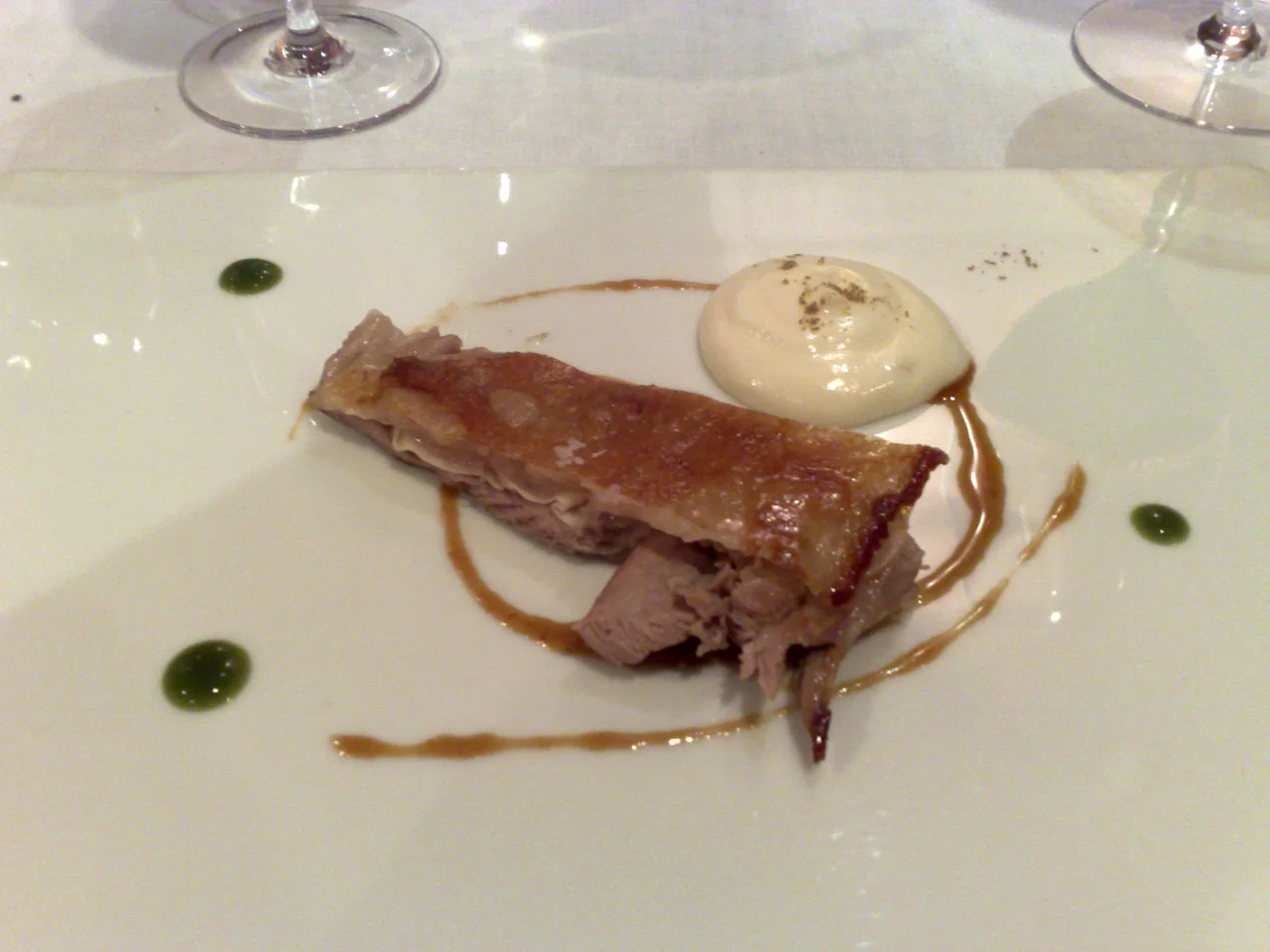

El Celler de Can Roca
Before one of the desserts arrives, a fine cloud of lemon perfume drifts across the table. It is not a garnish or a gimmick but part of the dish itself, a scent distilled from a plate the kitchen calls Lemon Distillation. This is how El Celler de Can Roca thinks about eating: as something that reaches you through the nose and the memory as much as the mouth. On the outskirts of Girona, in a quiet purpose-built building, three brothers have twice been ranked the best restaurant in the world, and they got there by rethinking what a plate of food is for.
From the Family Bar
The Roca story begins not with fine dining but with a working restaurant. Their parents ran Can Roca, a modest place open since 1967, and the three brothers grew up in its kitchen and dining room. In 1986, Joan, Josep, and Jordi opened El Celler de Can Roca right next door. For two decades it operated in that family orbit until, in late 2007, it moved about 100 meters away into a modern building designed from scratch for the restaurant. The old location never closed; it became the place where the staff still eat their own meals. The new dining room is understated, with wooden floors and simply dressed tables, and on each table sit three stones, one for each brother. It is a small daily reminder that everything here rests on the three of them together. The restaurant never strayed far from home; it remains bound to the same corner of Girona where the family first set up shop.
Three Minds, Three Talents
The restaurant runs on a clean division of gifts. Joan, the eldest, leads the kitchen. Josep, the middle brother, commands a wine cellar of 60,000 bottles and pairs them to the food. Jordi, the youngest, invents the desserts. The Michelin stars arrived in a slow, deliberate climb: the first in 1995, the second in 2002, the third in 2009. Then came the wider crown. On the World's 50 Best Restaurants list, El Celler de Can Roca was named the best in the world in 2013 and again in 2015, and in 2011, 2012, and 2014 it finished second, just behind the Danish restaurant Noma. Critics regularly describe it as the successor to El Bulli, the legendary Catalan restaurant whose experimental spirit the Rocas carried forward into a new generation.
Science on the Plate
The cooking is unmistakably Catalan and unmistakably strange. Traditional local ingredients meet the techniques of molecular gastronomy, so a familiar flavor arrives in an unfamiliar form. Calamari is frozen with liquid nitrogen, blended, then piped and baked into a delicate cracker. Caramelized olives hang from the branches of a miniature bonsai tree, plucked and eaten one at a time. The menu leans on the landscape around Girona, where pigeon, hake, and pig's trotters share the table with lobster and foie gras. The critic Jonathan Gold called the presentation of those olives delectable and unforgettable, and A. A. Gill placed the restaurant within a great, confident wave of new Spanish food, complex and technically exhausting yet aware of its landscape, history, and politics. Nothing here is quite what it first appears to be.
Bottling a Memory
The most audacious dishes chase scent itself. The brothers have built desserts around famous perfumes, translating fragrances by Calvin Klein, Carolina Herrera, Lancôme, and Bulgari into things you can eat. The traffic runs both ways: the restaurant released its own perfume, Núvol de Llimona, based on that Lemon Distillation dessert and designed to be misted over diners as they eat. This restless curiosity has carried the brothers well beyond the dining room. They have appeared at Harvard University as part of its Science and Cooking program, explaining how a plate of food can also be an experiment. Diners often leave describing not just flavors but places and moments the food called up. Three stones on every table, three brothers, one relentless idea: that a meal can be a memory you assemble from taste, smell, and surprise.
From the Air
El Celler de Can Roca sits at 41.993°N, 2.808°E on the northern edge of Girona in northeastern Catalonia. Recommended viewing altitude is 2,000-4,000 ft AGL. Girona-Costa Brava airport (LEGE) lies only about 12 km to the south, so this area falls within its terminal airspace; expect controlled approaches and coordinate accordingly. From the air, orient on the medieval core of Girona along the Onyar river and its colored riverfront houses just to the south. Barcelona-El Prat (LEBL) is roughly 90 km southwest and Sabadell (LELL) somewhat nearer. Best visibility on clear days along the Costa Brava hinterland.
Nearby Stories
- Terrassa Witch Trials 14 km away
- Bombing of Granollers 28 km away
- Patum de Berga 30 km away
- Abbey of Saint-Martin-du-Canigou 43 km away
- Château de Montségur 80 km away
- Cala Morell Settlement 188 km away
- Langlois Bridge at Arles 202 km away
- Cap de Formentor 218 km away