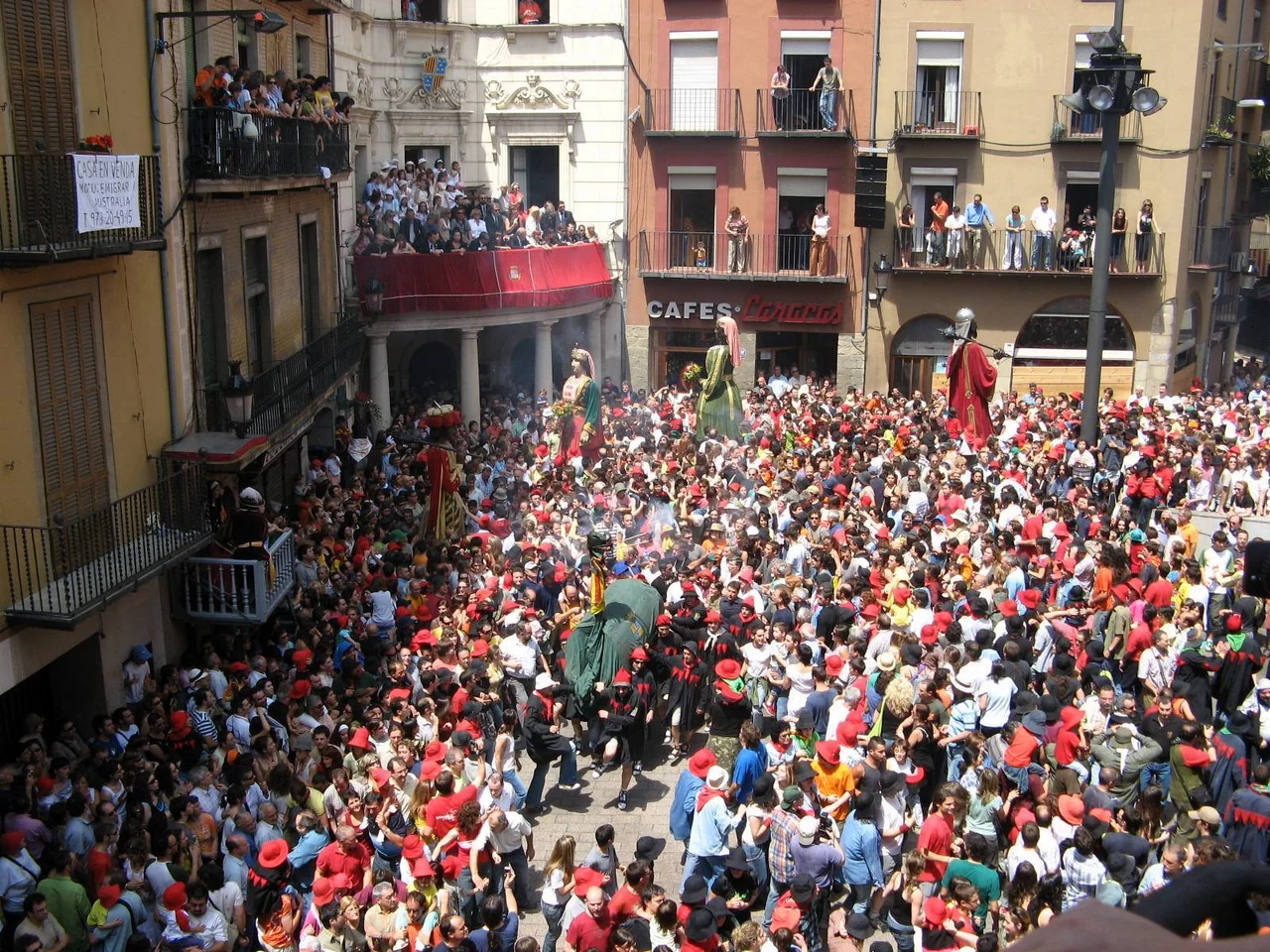

Patum de Berga
The festival is named after a sound. When the great drum called the tabal booms out over the square in Berga, it goes pa-tum, pa-tum, and that beat gives the celebration its name: La Patum. For a few days each summer, this small Catalan city hands its streets over to giants, devils, eagles, and dwarfs, danced by ordinary townspeople in costume and wreathed in fire and showers of sparks. Berguedans wait all year for it. The whole thing is loud, ancient, and slightly overwhelming, part religious procession, part pyrotechnic street theater. UNESCO counts it among the great living traditions of humanity, and the people of Berga guard it fiercely.
A Beat, a Fire, a City
La Patum takes place at Corpus Christi, the early-summer Catholic feast, and for its duration the ordinary rhythms of Berga dissolve. At the center of everything is the tabal, a huge drum whose slow, insistent pulse holds the whole event together and lends it its name. The dances, or balls, are performed with a strange gravity, more ritual than revelry, and they make lavish use of fire. Costumed figures spin through the square trailing lit fireworks while the crowd presses close enough to feel the heat and catch the falling sparks. Smoke hangs in the night air, and the smell of gunpowder clings to everyone who stays to the end. It is exhilarating and a little dangerous, a communal experience passed down through so many generations that taking part is, for Berguedans, a kind of birthright. Children grow up watching from their parents' shoulders, then step into the costumes themselves, so the same families carry the same figures year after year.
The Cast of Characters
The Patum's power comes from its cast, a procession of figures each with its own dance and its own centuries of history. The giants, the Gegants, have towered over the festival since 1695, joined by old dwarfs from 1853 and new ones from 1890. An enormous eagle, l'Àliga, has danced since 1756. There are the Turcs i Cavallets, Turks and little knights locked in mock combat, and the Guites, folkloric mules that snap and charge through the crowd, the oldest documented since 1626. Fiercest of all are Els Plens, recorded since 1628: dancers entirely covered in fire, their costumes studded with fireworks, who erupt into a roaring, smoke-filled leap that is the festival's blazing climax. Each figure is old, specific, and beloved, and the town knows every one of them by name.
Solstice Beneath the Saints
For all its Catholic setting, the Patum reaches back to something older. Its roots lie in pre-Christian celebrations of the summer solstice, which the Church absorbed and reinterpreted as part of its Corpus Christi observances; the earliest record of a Corpus procession in Berga dates to 20 May 1454. Through the Middle Ages the event drew in elements of popular and religious theater, accumulating its unlikely troupe of giants, devils, angels, Moors, and stranger creatures still. What began as a sacred pageant, descended from what were once called eucharistic performances, has become in its present form a work of popular theater, unique in Catalonia. Anthropologists and folklorists have long been drawn to it, trying to read in its fire and figures the layered beliefs of the people who kept it alive.
Recognized and Renewed
Recognition has come from the highest levels. The Generalitat de Catalunya declared the Patum a Traditional Festival of National Interest in 1983, and in 2005 UNESCO named it a Masterpiece of the Oral and Intangible Heritage of Humanity, adding it to its Representative List in 2008. Yet the festival stays stubbornly alive rather than merely preserved. In 2016, to mark the 150th anniversary of the old giants and the 125th of the new, the two giant couples danced together to an arrangement of Bruce Springsteen's If I Should Fall Behind, adapted by Sergi Cuenca, a moment that captured how a centuries-old ritual can still make room for something new. For a few days each summer, Berga is not a place you observe but one you enter, drum, fire, and all.
From the Air
Berga sits at 42.1043°N, 1.8462°E, at the foot of the pre-Pyrenees roughly 100 km north of Barcelona, the festival centered on the old town's main square. From the air the town is a compact cluster of rooftops below rising mountains, the higher pre-Pyrenean ranges climbing away to the north; during the Patum the square glows with fire after dark. Best viewed from 3,000–5,000 ft AGL. Sabadell (LELL) lies about 70 km south, Barcelona-El Prat (LEBL) roughly 100 km south on the coast, and Girona (LEGE) about 85 km southeast. This is mountain-edge country, with cooler, clearer air than the coast and frequent afternoon cloud over the peaks.
Nearby Stories
- Fageda d'en Jordà 7.1 km away
- Cave of Saint Ignatius 15 km away
- Cervera 22 km away
- Tremp Formation 28 km away
- Abbey of Saint-Martin-du-Canigou 43 km away
- Aiguestortes i Estany de Sant Maurici National Park 45 km away
- Palace of the Kings of Majorca 51 km away
- Cap de Formentor 218 km away