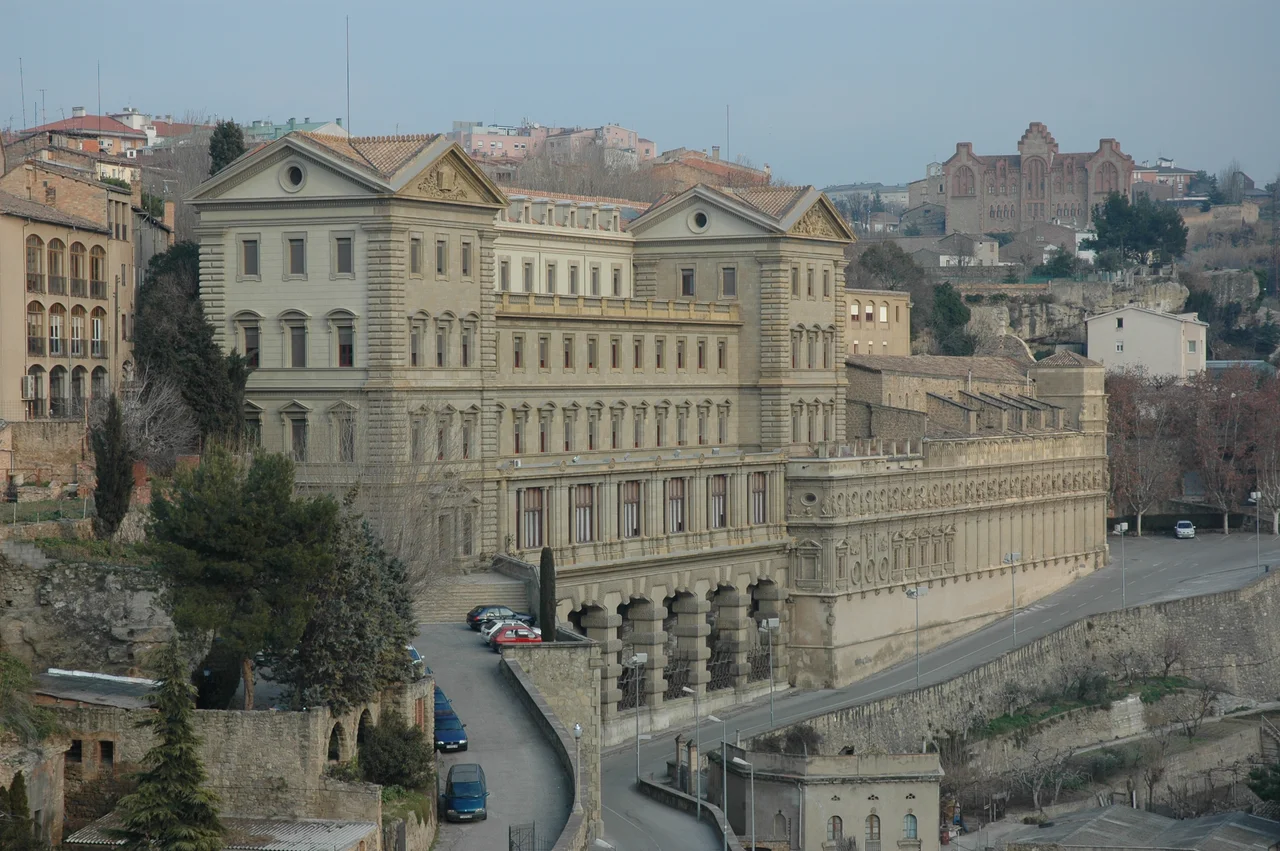

Cave of Saint Ignatius
The altarpiece inside the cave shows Saint Ignatius kneeling with a pen in his hand, his gaze turned toward Montserrat. It is a fitting image, because the man who came to this grotto above Manresa in 1522 had recently traded one life for another. A few weeks earlier, at the abbey on that serrated mountain across the valley, the former soldier had laid his sword and dagger on the altar of the Virgin and walked away from his military career for good. Here, in a natural cave in the hillside, he would spend eleven months praying, fasting, and writing, and the small book he began would go on to shape a religious order that reaches across the globe.
From Cannonball to Conversion
The story begins with a shattered leg. In May 1521, a Basque nobleman named Íñigo de Loyola was defending the citadel of Pamplona against the French when a cannonball smashed his right leg. Surgeons broke and reset the bone more than once, leaving him with a permanent limp and no future as a soldier. During a long, restless convalescence he asked for tales of chivalry to pass the time and was handed lives of Christ and the saints instead. Something in them took hold. By the time he could travel, he had resolved to remake himself as a pilgrim. He made his way to Montserrat, kept an all-night vigil before the Virgin, surrendered his weapons, and set out on foot for the nearby town of Manresa.
Eleven Months in a Cave
From March 1522 to February 1523, Ignatius lived in and around Manresa in deliberate poverty. He begged for food, ate and drank sparingly, let his hair and nails grow, and gave himself over to hours of prayer each day, often withdrawing to a natural cave in the hillside to pray and do penance. It was a season of intense inner struggle and, eventually, of breakthrough. Sitting one day by the Cardoner river, he experienced a flood of understanding so profound that he counted it among the decisive moments of his life. Out of these months came the raw material of the Spiritual Exercises, a compact manual of guided meditation and self-examination. Nearly five centuries later it remains a cornerstone of Catholic spiritual practice, still used on retreats around the world.
The Sanctuary Built Around a Rock
For a long time the cave was just a cave. Then, in 1603, a chapel dedicated to Saint Ignatius rose beside it, and over the following centuries an entire sanctuary grew up to enclose and honor the site. A baroque church was raised in 1759 as a kind of grand vestibule to the grotto, and blessed in 1844. The convent and a house of spirituality followed from 1894 to 1896, and between 1915 and 1918 the passage linking church and cave was richly decorated. Inside the grotto, an alabaster altarpiece from the later 1600s depicts Ignatius as a penitent, pen in hand, his eyes toward Montserrat. Nearby, carved directly into the living rock, three crosses mark the very spot where, according to tradition, he knelt to pray. The layered building history, chapel upon church upon convent, means the modest natural grotto now sits at the heart of a far grander complex than Ignatius, in his rags, could ever have imagined.
Facing the Holy Mountain
The cave looks out across the valley toward Montserrat, the mountain where Ignatius had given up his sword, and that line of sight is no accident; the sanctuary keeps the two places in constant conversation. In 1534, a dozen years after his Manresa retreat, Ignatius and six companions took vows in Paris that would grow into the Society of Jesus, formally approved by the pope in 1540, and he became the first leader of an order that would carry Jesuit schools, missions, and scholarship to every continent. All of it traces back, in part, to the quiet months this limping ex-soldier spent in a hillside cave. Manresa now anchors the Camí Ignasià, a modern pilgrimage route that retraces his journey across northern Spain, and the site draws visitors who come to sit where the Spiritual Exercises were born and to look, as the stone Ignatius does, toward the peaks of Montserrat.
From the Air
The Cave of Saint Ignatius stands at 41.7212°N, 1.8315°E, on the edge of Manresa, roughly 55 km northwest of Barcelona, its cave and baroque church facing southwest toward Montserrat. From the air the sanctuary reads as a cluster of church roofs and cloisters on the town's riverside flank, with the saw-toothed massif of Montserrat filling the horizon beyond, a reliable cue for orienting on Manresa. Best viewed from 2,500–4,000 ft AGL. Sabadell (LELL) lies about 30 km southeast, Barcelona-El Prat (LEBL) roughly 55 km south on the coast, and Girona (LEGE) about 85 km east-northeast. Inland skies are generally clear, with haze possible over the Llobregat valley.
Nearby Stories
- Patum de Berga 13 km away
- Monastery of Sant Cugat 13 km away
- Cervera 15 km away
- Santes Creus 16 km away
- Fageda d'en Jordà 16 km away
- Tremp Formation 30 km away
- El Celler de Can Roca 40 km away
- Cap de Formentor 181 km away